
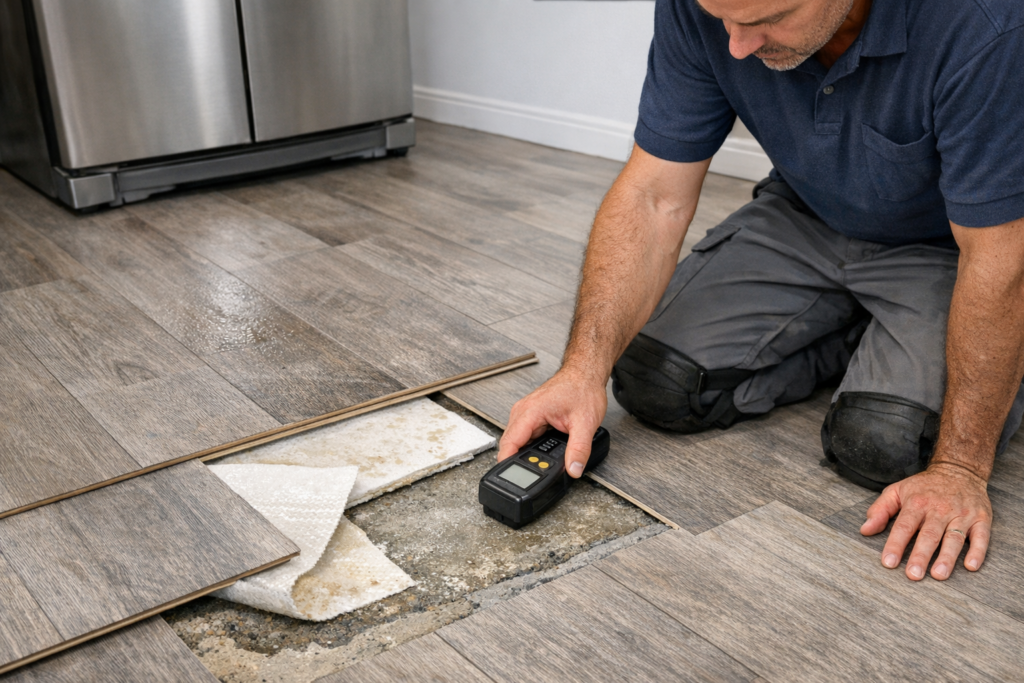
Water trapped beneath floating flooring requires assessment of the layers below the visible surface, not just cleanup of the top. A floor that looks dry may still cover wet underlayment, a damp slab, or a moisture-affected wood subfloor. Safe observations help explain the event, but they cannot verify concealed drying.
This Las Vegas guide covers seven checks for property owners arranging an assessment. Start with safe access and source control, then ask how the assembly will be evaluated before deciding on removal, drying, or repairs. Do not pull planks or test wet electrical equipment to investigate.
On this page
Understand water trapped beneath floating flooring
A floating floor is an installation method: connected planks or panels rest above a substrate rather than being fastened across their entire underside. Depending on the product, the assembly may include attached padding, separate underlayment, a moisture-control layer, and concrete or wood underneath. Those layers affect inspection access and the path moisture can take.
Water can enter at perimeter gaps, transitions, pipe openings, or joints. It may travel sideways beneath the finish, so a small puddle beside an appliance does not establish the concealed boundary. When people describe water under floorboards, the important question is which layers were contacted and how their condition will be evaluated.
Water-resistant product descriptions also need context. A plank’s resistance to water does not demonstrate that its backing, underlayment, or substrate is dry. Conversely, suspected moisture does not automatically mean every plank must be discarded. Different products can require different drying and repair decisions.
Set safe boundaries and confirm the source
Do not enter standing water to inspect flooring, retrieve belongings, or reach a shutoff. If electrical equipment, outlets, or wiring may be affected, keep away and arrange qualified help. Do not test appliances to see whether they still work. Lifted, softened, or slippery flooring can also make ordinary walking unsafe.
If a known shutoff is reachable from a dry, safe location, stopping an active supply may limit further damage. Otherwise, leave source control to the appropriate professional. Keep people and pets out of the affected area, and explain access concerns when requesting help.
Record when water was discovered, where it appeared, and what source repair has been completed. A supply-line leak, appliance discharge, toilet overflow, and exterior floodwater can require different handling. Clear appearance does not establish cleanliness. Do not lift materials or direct fans across suspected contamination. Ask about professional water extraction when recoverable water remains.
Why do my floors look dry when water may be underneath?
When evaluating water trapped beneath floating flooring, distinguish the visible finish from the concealed assembly. Water on top may be removed while questions remain about the backing, padding, or substrate. Las Vegas outdoor heat does not establish drying conditions under an indoor floor. Neither appearance nor touch can verify every concealed layer.
From an already safe position, photograph new edge swelling, separated joints, staining at transitions, or changed trim. Identify the room, a fixed landmark, and the time you noticed each change. Describe observations without deciding what they prove: raised seams or odors can have more than one explanation.
Do not walk repeatedly across a questionable floor to make it squish, press joints to release water, or pry up trim for photographs. Those actions are not reliable tests. Explain connected closets and rooms to the assessor, even when they appear unchanged. Ask whether selected professional access would help resolve the uncertainty.
Connect moisture assessment with material decisions
A useful assessment relates measurements to the source history, flooring construction, neighboring materials, and suitable comparison areas. Ask which material each reading evaluates, whether it is a screening observation or a direct measurement, and what remains inaccessible. A measurement over the finish may not isolate moisture in every layer beneath it.
Instrument type, measurement depth, and the materials present affect interpretation. Concrete and wood require different approaches; readings should not be treated as interchangeable. The explanation of moisture meters in restoration provides background for discussing the evidence behind the work.
Water trapped beneath floating flooring calls for separate decisions about the planks, underlayment, and substrate. Ask whether removal is proposed because a material is damaged, because access is needed, or both. Reuse depends on condition, water history, cleaning requirements, and product instructions. Successful lifting does not prove that a locking joint will remain suitable for reinstallation.
For example, consider a refrigerator supply leak beside flooring that continues into a hallway. This is an illustrative scenario, not a report about a customer. The assessment may need to address the appliance recess, adjacent cabinet base, flooring transition, and accessible wall edges. Describe where water first appeared and which areas were reached before cleanup. Water trapped beneath floating flooring should be evaluated in relation to those connected spaces, rather than assuming the kitchen doorway marks the limit.
For water trapped beneath floating flooring, ask for a written distinction between materials being retained, areas requiring access, and finishes included in the rebuild. If a closet or adjoining unit cannot be inspected, have that limitation recorded and identify who can arrange authorized access. Keep source-repair documents separate from drying records while retaining both in the project file. A repaired supply connection answers a different question from verification of retained flooring layers. For water trapped beneath floating flooring, that distinction makes the next decision easier to review without treating every stain or reading as a complete diagnosis.
Verify drying of water trapped beneath floating flooring
During structural drying and dehumidification, ask how progress will be checked and what would prompt a change in access or equipment strategy. Dry room air does not prove a dry concealed assembly. A fixed number of days is not a substitute for appropriate material-specific verification.
Do not move equipment, change its settings, or disconnect it without coordinating with the restoration contact. Report new water, changed staining, or practical concerns about access. Keep photographs, source-repair information, assessment findings, and progress records together so the reasons for changes remain understandable.
Before repair and reconstruction, ask which retained materials were checked, what limitations remain, and which installation requirements apply to the replacement flooring. Confirm repair boundaries, transitions, baseboards, and finish choices. Source repair, drying verification, and rebuilding answer different questions and should be documented accordingly.
Reduce the chance of another leak
To help prevent water damage, follow the confirmed source rather than guessing from the stain. Arrange appropriate repair or maintenance of the failed appliance, connection, or building component. Keep the repair record and report recurring dampness promptly. Suitable leak alerts may help with early notice near water-using equipment, but they do not replace maintenance or inspection.
Do not improvise sealing around floating-floor perimeter gaps. Those spaces may be needed for movement, and changes should follow the product’s installation and care requirements. Ask the installer about the particular assembly rather than applying a general fix to every floor.
For independent background, read the EPA guide to mold, moisture, and your home. Keep assessment questions separate from insurance decisions: restoration records can explain the loss and work performed, while coverage and reimbursement depend on the policy and the insurer’s review.
Questions about water trapped beneath floating flooring
Does a squishing sound prove the entire floor needs replacement? No. Report a sound already noticed without recreating it. The condition warrants assessment, but the removal boundary should follow the actual findings, assembly, and water history rather than a sound alone.
Should I lift one plank to check underneath? Leave disassembly to the assessment plan. Lifting can damage locking edges or disturb unknown conditions. Ask where access would be informative and what precautions are needed. Existing product records and photographs are safer preparation.
Will a dehumidifier dry everything without opening the floor? Not necessarily. A flooring layer can restrict moisture release or access. Ask what supports continued drying in place and what would justify selective removal. Retained materials and the substrate need suitable verification before covering them again.
Presto Water Damage serves Las Vegas, Henderson, and North Las Vegas. Explain the source, affected rooms, safe-access conditions, and work already performed when requesting help. Call 725-529-5195 to discuss water trapped beneath floating flooring and the next assessment step.