
Water heater pan overflow damage needs two separate evaluations: why water escaped the pan, and which surrounding materials became wet. From a dry, safe location, note whether water is still appearing, photograph the pan and surrounding area, and report changes at walls, floor edges and adjoining rooms. Arrange qualified plumbing assessment for the source and restoration assessment for moisture outside the pan. An empty pan or dry-looking floor does not establish that the building materials are dry.
For Las Vegas homeowners and property managers, the most useful first step is not diagnosing the appliance. It is giving professionals a clear account of what happened without approaching hot water, electrical hazards or unstable materials. This guide focuses on that observation-and-assessment task rather than tank replacement or general appliance cleanup. Presto Water Damage provides water heater leak damage cleanup, including assessment of affected building materials.
1. Understand what water heater pan overflow damage tells you
A water heater drain pan overflow warrants investigation. A drain pan beneath a water heater is intended to collect leakage; where connected, its drain provides a route for that water to leave. It is not unlimited containment. Water outside the pan may mean incoming water exceeded the drainage capacity, the pan or drain arrangement failed, or a leak bypassed the pan altogether. The visible puddle alone cannot distinguish these possibilities.
A qualified plumber should investigate the water heater, nearby connections and pan drainage. Water in the pan does not automatically prove the tank itself has failed. Similarly, a stain beside the pan does not prove that water crossed its rim. Water can follow piping or another surface before reaching the floor. Describe the location and timing rather than naming a failed part.
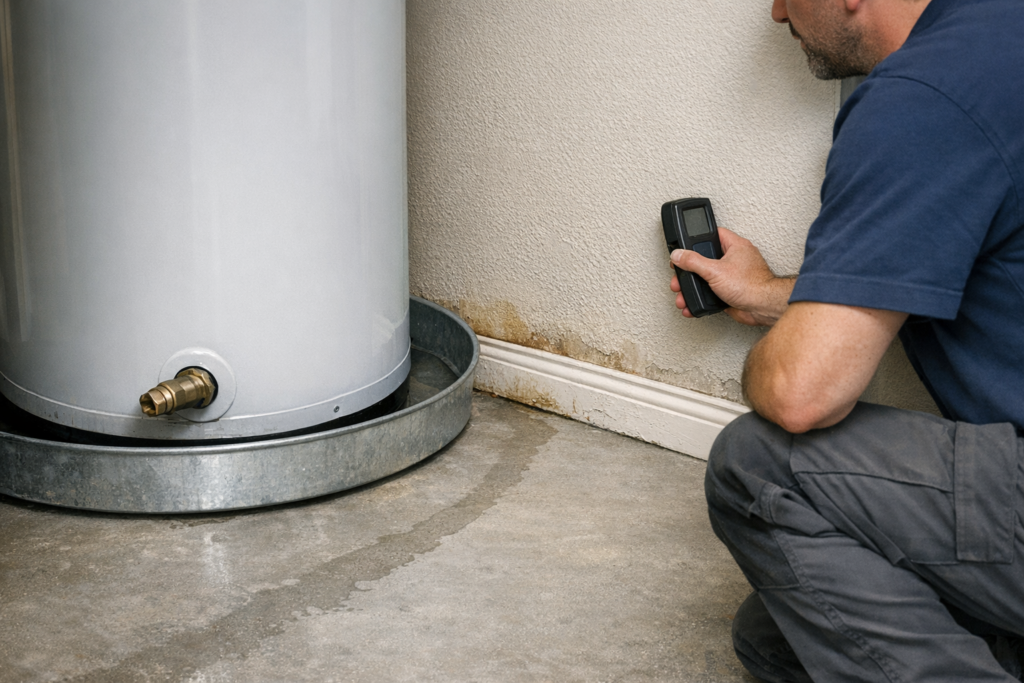
When assessing water heater pan overflow damage, the restoration question is specific: did water remain on an exposed surface, or enter porous materials and concealed layers? That distinction guides moisture mapping and material decisions. A small visible overflow can deserve investigation when it reached a drywall base, enclosed platform or flooring seam.
2. Set safe observation boundaries before approaching
Do not enter standing water to inspect the pan, reach a valve or retrieve belongings. Water near a heater may be hot, and electrical components or nearby powered equipment may be affected. Avoid touching the appliance, wet cords, outlets or controls. Have qualified personnel determine safe access and handle electrical isolation when needed; do not test whether equipment still works.
If you already know how to operate an accessible water shutoff and can reach it entirely from a dry, safe location, source control may be possible without approaching the heater. If access or the procedure is uncertain, leave it to a qualified professional. Turning off the water supply is not the same as safely shutting down every type of heater. Follow appliance-specific professional guidance rather than experimenting with controls.
- Keep people and pets away from the wet area and any suspected hot discharge.
- Do not lift, shift or tilt the water heater to inspect beneath it.
- Do not operate a relief valve, cap a discharge pipe or probe the pan drain.
- Stay away from sagging ceilings or visibly unstable flooring.
- If you smell gas, leave the area and contact the gas utility or emergency services from a safe location.
You do not need a close-up of every component before requesting help. A doorway photograph and a description of active flow can be enough to start the conversation. Where pooled water requires removal, professional water extraction should follow a safe-access assessment, not substitute for one.
3. Record the pan, water path and neighboring changes
From a safe position, begin with a wide view showing the heater, pan and surrounding floor. Then record whatever is already visible: water inside the pan, an apparent trail beyond one edge, droplets from above, or water near the drain connection. Do not reach behind the tank or clear an obstruction yourself to improve the photograph.
Describe the water path using fixed landmarks. “Water extends from the closet doorway to the hallway flooring seam” is more useful than “the whole area is flooded.” Note whether water is still moving, the apparent boundary is changing, or a second wet area has appeared. Photographs taken from the same dry position can help show changes without marking or touching affected surfaces.
- Wall bases: Record visible staining, peeling paint, swollen trim or separated joints.
- Flooring: Note raised seams, darkened edges, ripples or water emerging at a transition.
- Platforms: Describe exposed finishes and visible staining without removing a covering.
- Adjacent spaces: Report changes on the opposite side of a shared wall or at a nearby doorway.
- Stored items: Identify wet boxes or belongings without moving suspected contaminated items.
Report odors or suspected growth separately from moisture observations. Neither an odor nor a stain identifies mold by itself. Avoid disturbing suspicious material or directing household fans at it while awaiting assessment.
4. Ask the plumber to explain the source and pan drainage
A plumbing visit after water heater pan overflow damage should answer more than whether the floor has stopped getting wet. Ask what released the water, how it reached or bypassed the pan, and what source-related work was completed. An overflow can stop temporarily while the underlying fault remains. Conversely, an appliance repair can be complete while nearby building materials still need drying.
A water heater leak assessment should keep source findings separate from the restoration scope:
- Which component was identified as the source, and what evidence supports that finding?
- Did water enter the pan from the tank, a connection or another location?
- Was the pan damaged, or did water escape somewhere other than over the rim?
- If a pan drain is present, was its route and function evaluated?
- Is there an unresolved concern about intermittent discharge or continued leakage?
- What work remains before the heater can be returned to normal operation?
Ask the plumber to distinguish the pan drain from the heater’s temperature-and-pressure relief discharge arrangement. They serve different purposes and should not be treated as interchangeable. Do not request a makeshift connection or obstruction to stop visible water. The appropriate configuration depends on the actual equipment, installation and applicable requirements, which a qualified professional must evaluate.
5. Map moisture after water heater pan overflow damage
A water heater pan overflow damage assessment should follow the probable water path while checking its boundaries. That can include the floor around the pan, the wall base behind it, a support platform, nearby thresholds and adjoining rooms. If the heater is above another occupied space, report any staining below without entering a hazardous area or opening the ceiling.
When checking hidden moisture after overflow, ask:
- Where were elevated moisture indications found, and where did the inspected boundary end?
- Were comparable, apparently unaffected materials checked for context?
- What instrument and method were appropriate for each material?
- Could metal, material composition or installation details affect the readings?
- What additional inspection is recommended, and why?
- Will monitoring return to identifiable locations so progress can be compared?
Moisture meter readings need interpretation. They do not independently prove the source, exact leak duration or presence of mold. The explanation of what moisture meter readings can establish helps owners ask for material-specific findings rather than a single unexplained number.
Water may also travel under a floor covering while its top looks dry. Ask about seams, perimeter gaps and adjoining assemblies when the path reached those locations. See how moisture spreads beneath flooring for the distinction between surface appearance and concealed moisture. Request findings tied to the actual installation, not assumptions about every floor of that type.
6. Repair materials affected by water heater pan overflow damage
For water heater pan overflow damage, material retention should depend on condition, water contact history, accessibility and whether drying can be verified. The heater’s supply water origin alone does not settle every cleanup question after contact with a dirty pan, stored chemicals or other materials. Tell the assessor about anything the water encountered. Do not disturb suspected contamination or run fans across sewage or suspected mold.
Wet drywall near water heater installations may be suitable for drying in place when its condition and the assessment support retention. Softness, deterioration, affected insulation or inability to verify concealed drying may change that decision. Ask for the reason behind proposed removal boundaries. The discussion of when wet drywall can be retained explains why repainting a stain is not the assessment itself.
Extraction removes accessible water. Structural drying and dehumidification address moisture in materials selected for retention. Ask how progress will be monitored, what drying goals apply to those materials and how inaccessible areas will be handled. There is no reliable universal drying deadline for every pan overflow.
Rebuild follows the appropriate drying verification and source correction. It can include drywall, trim, flooring and finish work, but a new surface does not demonstrate that the concealed assembly was dry. Keep the repair and reconstruction scope distinct from mitigation, including any optional improvements you choose.
7. Preserve records and reduce the chance of another overflow
Document water heater pan overflow damage with a short, accurate timeline: when the area was last known to be dry, when water was discovered, what was observed and when professionals attended. Label unknowns as unknown. Keep photographs, plumbing findings, extraction records, material decisions and drying reports together. You should be able to connect an affected location with its assessment and final disposition.
If insurance may be involved, ask your insurer what records it needs and follow its reporting process. Restoration documentation describes observed conditions and work; it does not guarantee coverage or claim acceptance. Policy terms and the insurer’s review determine those questions.
Ask your plumber for tips for water heater maintenance after repairs, including pan-drain checks appropriate for the installation. Discuss leak detection or automatic shutoff options where suitable, including who maintains them. These measures can help identify or limit a future release but do not make the pan fail-proof.
Keep the area accessible without obstructing appliance clearances or drainage. From a dry, safe position, look periodically for new pan water, staining or wet floor edges. Report recurrence rather than repeatedly wiping it away. In managed properties, give occupants a clear reporting contact and retain the source-repair history for the next inspection.
8. Water heater pan overflow damage: common questions
Does water in the pan mean the water heater needs replacement?
Not necessarily. Water may come from the tank, a connection or another source. A plumber should identify the cause and explain the repair or replacement recommendation. Separately, ask whether water escaped into building materials; appliance replacement alone does not resolve that damage.
If the pan is empty now, can moisture still be nearby?
Yes. Water may have drained, evaporated from exposed surfaces or moved into surrounding materials. Report the earlier overflow and its visible path even when the pan is empty at the visit. Moisture assessment can help determine whether adjacent assemblies need further work.
Can I clear the pan drain myself to see whether that fixes it?
Avoid probing, disconnecting or altering the drain during an active loss. Water may be hot, access may be unsafe and the drain may not be the original problem. Ask a qualified plumber to evaluate both the incoming leak and the drainage arrangement.
Will nearby flooring always need to be removed?
No. The decision depends on the flooring assembly, condition, exposure history and access for drying and verification. Ask which layers were evaluated and what supports retention or selective removal. Surface dryness or a product’s water-resistance description is not enough by itself.
Who confirms that the work is finished?
Ask each provider to document its part: the plumber addresses source correction, the restoration team records mitigation and drying verification, and the repair scope covers replacement and finishes. Clarify remaining limitations or follow-up work before treating the entire event as closed.
For help with water heater pan overflow damage, Presto Water Damage can discuss the affected materials and the next restoration steps. Learn about water damage restoration in Las Vegas, or call with your safe observations and any available plumbing findings. Contact Presto Water Damage at 725-529-5195.
For independent background on moisture control, see the EPA guide to moisture and mold prevention. It explains why correcting a water source and drying affected materials are both important.