
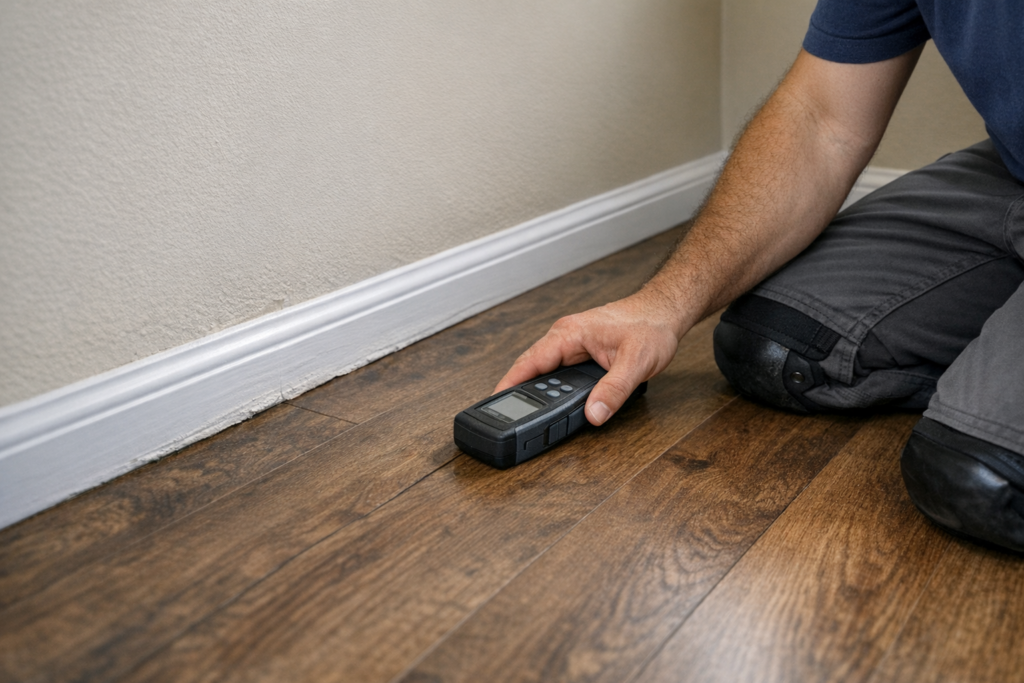
A slab leak affected flooring assessment in Henderson 89012 should establish which floor layers are affected, whether the water source has been corrected, and what evidence supports drying or replacement. A dry-looking surface alone cannot answer those questions. Homeowners and property managers can help by recording visible changes from safe, dry locations, collecting flooring information and asking how concealed moisture will be evaluated.
The practical answer is to arrange source investigation and a material-based restoration assessment before authorizing cosmetic floor repairs. Do not pull up planks, drill into concrete or test the floor by walking over raised areas. The work may require professional access to hidden layers, but that decision should follow an explained assessment rather than guesswork.
This guide focuses on choosing the next step for an affected floor, not diagnosing underground plumbing from surface clues. Presto Water Damage provides slab leak water damage cleanup and water damage restoration in Henderson. The ZIP identifies the postal area for this guide; it does not establish a particular building type, jurisdiction or special flooring risk.
1. Begin with the source history, not a flooring verdict
A suspected slab leak and a confirmed slab leak are different starting points. Damp flooring, discoloration or an unusual warm area may justify investigation, but none establishes the exact source by itself. Water from another location can also travel beneath a floor covering. Tell the assessor what has been observed and what a plumber has actually confirmed.
Keep four stages separate. Source repair corrects the plumbing problem. Mitigation limits damage through measures such as extraction, protection and appropriate material removal. Drying verification checks whether retained materials have reached the documented drying goals. Rebuild restores floor coverings, trim and other finishes once the assembly is ready.
Ask the plumber for the location and nature of the confirmed problem, the repair performed and any remaining uncertainty. Ask the restoration team how that information changes the flooring inspection. Repair access and water damage can create different work boundaries: a small plumbing opening does not prove that moisture stayed within that opening.
Conversely, a broad flooring stain does not establish that the entire slab needs demolition. The useful question is which findings support the proposed boundary. Keep the plumbing report available so the source and restoration teams can coordinate access without assuming they are performing the same scope.
2. Record useful observations without disturbing the floor
Observe only from stable, dry areas with safe access. Do not enter standing water, approach potentially wet electrical equipment or operate electrical devices to see whether they still work. Keep people away from buckled flooring, loose tile and unstable transitions. If there is no safe route, describe what you can see remotely and wait for professional direction.
Useful observations are specific enough to locate again. Instead of reporting that the whole room is damaged, identify the doorway, wall or furniture position beside the visible change. Photographs taken from the same safe viewpoint can help distinguish a new change from an old one.
- Floor surface: Photograph lifted seams, edge swelling, staining, cupping, loose pieces or changes in sheen.
- Room edges: Record visible baseboard swelling, gaps at transitions and discoloration where the floor meets the wall.
- Timing: Note when you first noticed the condition and whether it appeared to spread before or after source repair.
- Nearby materials: Identify adjoining carpet, cabinets, closets or another flooring product that may need separate assessment.
- Previous conditions: Mention known old stains, prior leaks or earlier flooring repairs without assuming they explain the current damage.
Do not pry off trim, lift carpet corners or force swollen joints back together. Avoid sanding, scraping or disturbing unfamiliar flooring and adhesive layers; professional review may be needed before removal. If you notice suspected growth or contamination, leave it undisturbed and report it. Do not direct fans across sewage or suspected mold.
Record odors as observations, not diagnoses. An odor may help identify where further evaluation is needed, but it cannot establish the water source, contamination level or condition of the concealed floor assembly.
3. Questions for a slab leak affected flooring assessment in Henderson 89012
A meaningful assessment describes the assembly, not just the finish. Depending on the installation, that may include flooring, adhesive, underlayment, a moisture-control layer and concrete. Some layers may be inaccessible initially. Ask the assessor to identify what was inspected directly, what was screened through a covering and what remains unknown.
Moisture mapping should connect observations with repeatable locations. A room sketch can show affected areas, comparison locations and places blocked by furniture or fixed cabinets. The boundary should follow the evidence across doorways and transitions rather than stop automatically at the most visible wet spot.
- Which flooring product and installation method are present?
- Which layers have been evaluated, and which cannot yet be reached?
- What instruments and methods suit each material?
- Where were suitable comparison readings taken?
- Could metal, adhesive or the assembly itself influence screening results?
- What finding would justify selective access or a larger inspection area?
- How will the team explain changes between visits?
Noninvasive screening can help locate areas for closer investigation, but it does not always establish the condition of every buried layer. Thermal imaging, if used, shows temperature patterns rather than proving moisture or pinpointing a leaking pipe by itself. Ask how findings are confirmed.
The guide to what moisture meters can and cannot establish explains why readings need material and location context. For this floor, request an interpretation rather than an unexplained number or a simple wet-or-dry label.
4. Make retention decisions layer by layer
Whether flooring can remain depends on water history, material condition, access for drying and the ability to verify the result. The source may have been a supply pipe, but the team still needs to evaluate the water’s path and contact history. Clear appearance is not enough to establish that every affected material is suitable to retain.
Laminate and floating vinyl: Identify the actual product rather than relying on appearance. Swollen laminate cores and damaged locking joints may remain damaged after moisture is removed. A water-resistant vinyl surface does not prove that its backing, underlayment or concrete beneath it is dry. Ask whether selective disassembly is practical and whether components can be reused without damage. Our LVP and laminate water damage guide explores those concealed-layer questions.
Wood flooring: Solid and engineered products may respond differently. Cupping, separation and finish changes should be documented, but immediate sanding is not a substitute for assessing moisture balance and condition. Ask what should be monitored before a repair or refinishing decision is made.
Carpet and padding: Treat the carpet, pad and underlying surface as separate components. A carpet surface can feel dry while the pad remains affected. Retention also depends on contamination concerns, deterioration and whether cleaning and drying can be completed and verified.
Tile assemblies: Intact tile does not establish that everything underneath is unaffected. The assessor may need to consider grout changes, bond condition, adjacent walls and the actual setting materials. Loose tile needs evaluation rather than an assumption that drying will restore adhesion.
Ask for the reason behind each removal or retention recommendation. Flooring and contents restoration decisions should distinguish a salvageable finish from an underlying layer that cannot reasonably remain.
5. Use a decision guide before approving the next step
For an owner or manager coordinating a Henderson 89012 property, the immediate decision is often who needs access first and what can safely wait. The following guide connects common findings with the next question, without treating any visible symptom as a diagnosis.
- Water is still appearing or the source is unconfirmed: Arrange plumbing investigation and restoration coordination. Ask what can be done to limit damage while source correction is underway.
- Standing water blocks access: Keep occupants out and request professional evaluation. Water extraction may be needed, but extraction alone does not verify concealed drying.
- The surface looks normal but moisture is suspected below: Request a layer-specific assessment and an explanation of the limitations of screening through the covering.
- Planks are buckled, tile is loose or transitions are raised: Restrict traffic. Ask about safe access and material condition before discussing appearance repairs.
- The source is repaired but readings are not improving: Ask whether access, trapped layers, drying conditions or another moisture source needs reassessment.
- Replacement is proposed: Request documented removal boundaries, substrate preparation requirements and the evidence needed before installation.
Property managers should also identify who can authorize inspection, selective removal and later reconstruction. Arrange access to adjoining rooms when needed, and tell occupants which routes are restricted. Do not assume that permission to inspect also authorizes demolition or finish replacement.
Where only part of a continuous floor is affected, separate moisture boundaries from matching decisions. Replacement may extend farther for product availability or installation reasons, but that is a different explanation from saying every area sustained water damage.
6. Verify drying before installing another floor
Concrete can retain moisture after visible water is removed, and floor coverings can restrict access to the affected surface. A room feeling comfortable does not establish that the slab is ready for a new adhesive or floor system. Likewise, the amount of equipment present does not demonstrate completion.
A structural drying and dehumidification plan should explain which materials are being retained, how moisture will be managed and how progress will be evaluated. There is no universal drying duration that fits every slab leak. Assembly thickness, exposure history, access and conditions all affect the plan.
Request records tied to consistent inspection locations and appropriate material comparisons. Ask what the completion criteria are and which inaccessible areas remain a limitation. If readings stall or new damage appears, the team should explain whether the plan or inspection boundary needs adjustment.
Distinguish restoration drying goals from flooring installation requirements. The flooring installer should identify the substrate testing and preparation required for the selected product and adhesive. Meeting one set of restoration observations does not automatically satisfy every manufacturer’s installation requirement.
Before water damage repair and reconstruction, confirm source correction, retained-material findings, slab readiness and the intended floor assembly. New flooring should not be used to conceal unresolved uncertainty about the substrate.
7. Keep records that support repairs and future monitoring
Build one file with the discovery timeline, room photographs, plumbing findings, assessment map, drying records and written scope changes. Separate the date you discovered the condition from the unknown date a concealed leak may have started. If the duration is uncertain, say so rather than estimating it as fact.
Preserve available flooring invoices, product labels, installation details and leftover-box information. These can help identify the material and appropriate installation guidance. Do not enter an unsafe storage area or move heavy furniture just to retrieve them.
The water damage documentation checklist can help organize photographs and reports without delaying necessary mitigation. Record why materials were removed, what remained and any new findings uncovered during access. Insurance decisions depend on policy terms and the facts of the loss; restoration records do not guarantee coverage.
Prevention begins with correcting the confirmed source and following the plumber’s recommendations. Ask whether monitoring or leak detection options are appropriate for the property. No device eliminates every concealed-leak risk, so occupants should still report unexplained dampness, changing floor joints or recurring wall-base stains promptly.
After rebuild, retain completion records and product care instructions. Managers can give occupants a simple reporting contact and request dated photographs of new changes from safe locations. Do not dismiss recurrence as leftover damage without checking it against the completed work and earlier observations.
8. Frequently asked questions about slab leak flooring assessment
Does every floor above a slab leak need replacement?
No. The affected assembly, water history, material condition and ability to dry and verify retained layers guide that decision. Some components may remain while others require removal. Ask for findings by component and location rather than a blanket conclusion based only on the leak’s label.
Can I check beneath the flooring myself?
Do not pull up flooring or drill into the slab to investigate. You could damage joints, disturb unfamiliar materials or encounter concealed hazards. Record visible changes and ask the professional whether selective access is necessary, who will perform it and how it will be documented.
If the plumber repaired the pipe, why is another assessment needed?
Plumbing repair addresses the source. It does not establish the moisture condition of underlayment, adhesives, concrete or neighboring wall bases. The restoration assessment determines the affected materials and appropriate mitigation, while later verification supports the handoff to finish repairs.
Does waterproof flooring mean the slab is protected?
No. A product’s resistance to water does not establish that water could not reach its edges, backing or substrate. Ask about the complete installation, including seams, underlayment and perimeter conditions. Product terminology should not replace inspection of the layers affected by this particular leak.
What should I have ready when I call Presto Water Damage?
Provide the property location, safe access details, rooms involved, visible flooring changes and any plumbing findings. Explain whether water is still appearing and whether the floor is raised or unstable. Photographs and product information help, but do not delay the call to collect them.
If a suspected or confirmed slab leak has affected flooring at your Henderson 89012 property, contact Presto Water Damage to discuss assessment and restoration next steps. Tell us what you can safely observe and what remains uncertain. Call 725-529-5195.