
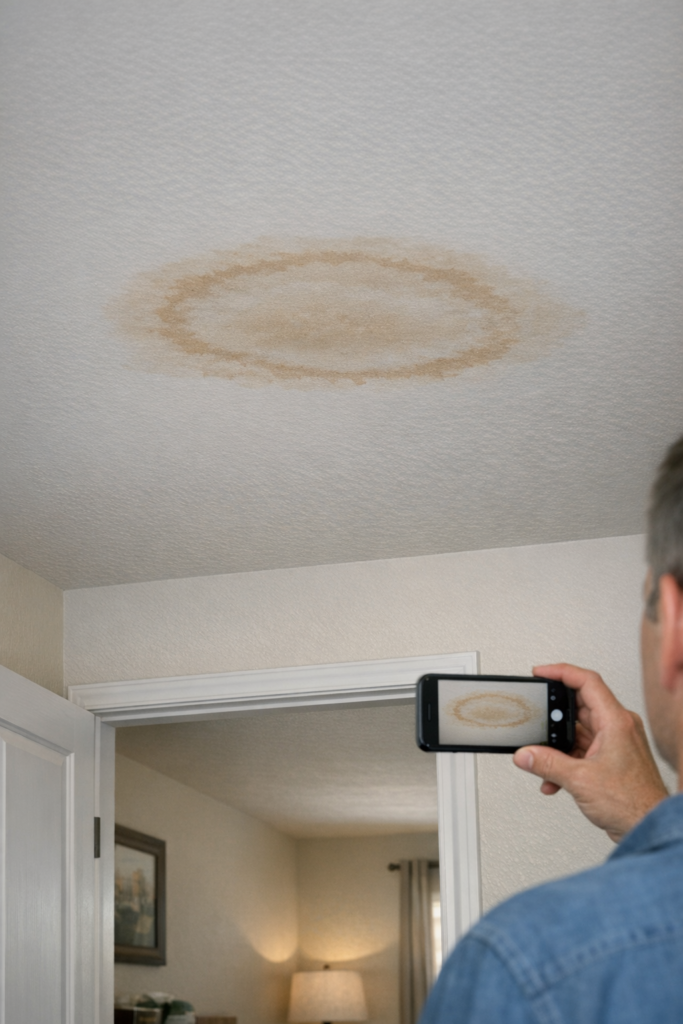
Ceiling stain monitoring after source repair in North Las Vegas 89030 means tracking visible changes safely while using professional moisture assessment—not stain color alone—to decide whether drying or repairs are still needed. A brown ring may remain after materials have dried. An unchanged stain can also sit beneath damp insulation or other concealed materials. Neither appearance establishes the condition of the whole ceiling assembly.
The useful question in ceiling stain monitoring is not simply whether the spot looks better. It is whether the source was corrected, the affected materials were assessed, and any retained materials have documented drying verification. This guide focuses on that post-repair decision rather than diagnosing every possible ceiling leak.
For homeowners and managers arranging water damage restoration in North Las Vegas, provide the property location, room involved, repair history, and safe access details. ZIP 89030 identifies the postal area; it does not establish a particular building type, jurisdiction, or ceiling construction.
1. Separate source repair from ceiling recovery
Source repair stops the water entry problem. A plumber may correct a leaking supply connection, a roofer may address an entry point, or an HVAC contractor may repair a condensate problem. Those tasks do not automatically remove water already absorbed by drywall, insulation, or framing.
Mitigation addresses the damage and limits further spread. It may include extraction where needed, protection of unaffected areas, moisture mapping, and decisions about damaged materials. Structural drying manages moisture in materials suitable to retain. Drying verification evaluates their condition before reconstruction proceeds. Rebuild restores the ceiling and finishes after the preceding issues are resolved.
To support ceiling stain monitoring, ask the source contractor what was repaired, when the work was completed, and what checks supported that conclusion. If the repair is temporary or further investigation remains necessary, record that plainly. Do not describe a temporary stop as a confirmed permanent correction.
Presto Water Damage’s ceiling and roof leak water damage service concerns affected building materials and restoration needs. Clarify separately who is responsible for plumbing, roofing, or HVAC source work. A clean handoff helps avoid a ceiling being painted while everyone assumes another contractor verified the concealed moisture.
2. Establish safe observation boundaries first
Look from a stable floor position outside any questionable ceiling area. Do not stand beneath bulging drywall, reach up to press a stain, or climb onto furniture for a closer photograph. A ceiling that appears intact from a distance may still have weakened layers or attachments.
Stop routine observation and restrict access if you see sagging, a growing bulge, falling material, active dripping, or water near a light fixture. Arrange professional evaluation rather than waiting for the next scheduled photograph. If there is an immediate danger, leave the affected area and seek appropriate emergency assistance.
- Do not puncture a bubble or open the ceiling to release water.
- Do not touch wet fixtures, operate affected electrical equipment, or attempt electrical testing.
- Do not enter standing water to reach the room or photograph the stain.
- Do not scrape, brush, or disturb suspected mold or contaminated materials.
- Do not aim household fans at suspected mold or sewage-affected materials.
Observe nearby wall finishes and floor areas only where access is safe. New paint separation at a ceiling corner or water appearing on an adjacent wall is worth reporting, but it is not an invitation to trace the path inside the assembly yourself.
If the original cause was never established, the guide to possible ceiling stain sources can help organize questions. Timing clues are useful evidence, not a substitute for source investigation.
3. Make ceiling stain monitoring after source repair repeatable
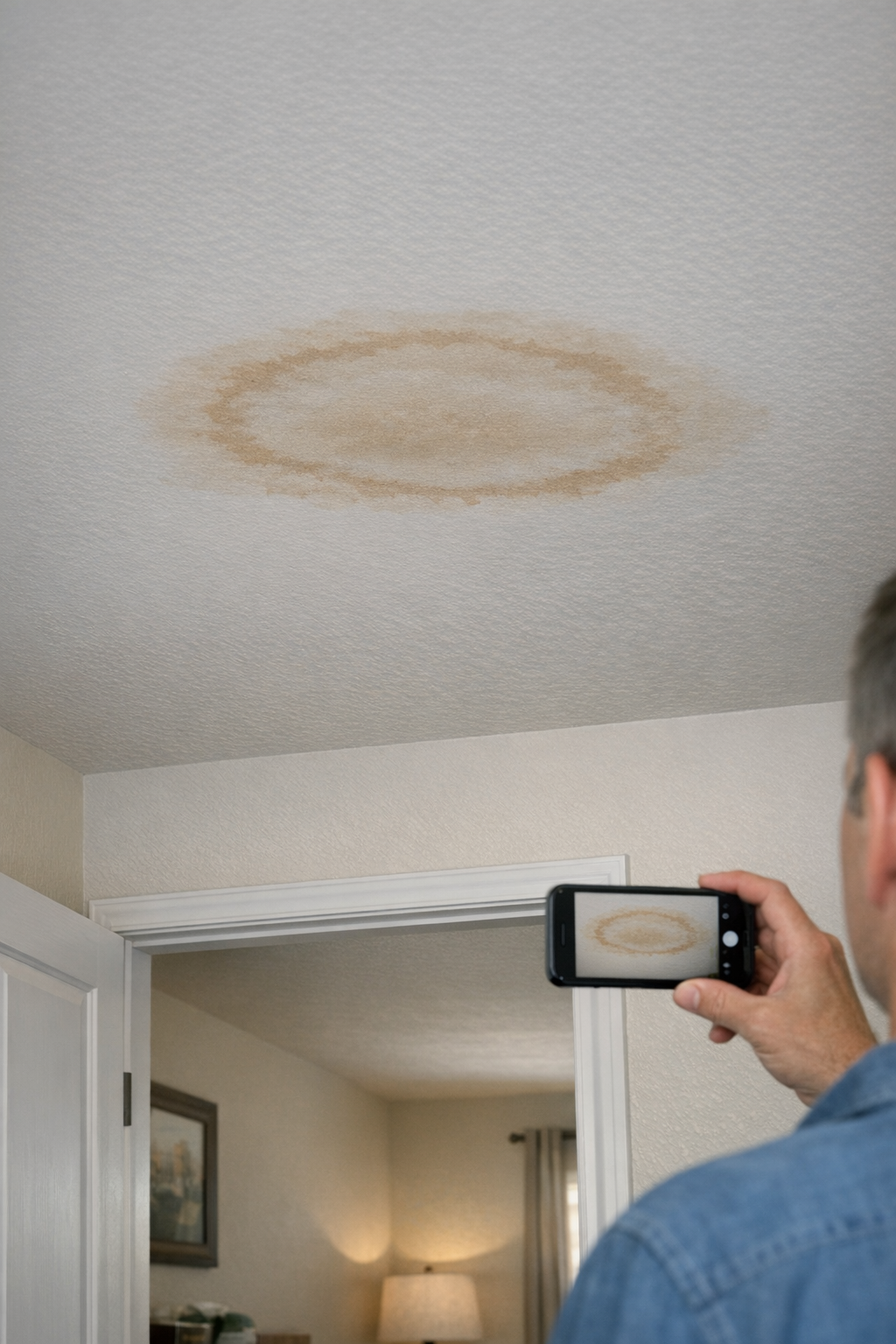
Ceiling stain monitoring compares the same location under similar conditions. For ceiling stain monitoring, take one wide photograph showing the ceiling in relation to walls, doors, and room features, then a closer photograph from a safe position. Keep the original files so dates and image detail remain available.
Use approximately the same viewpoint and lighting on later checks. Daylight, shadows, camera exposure, and room lighting can make an old ring appear darker or larger. Compare its boundary with fixed ceiling features instead of judging color from memory.
- Location: Identify the room and position, such as the ceiling near the hallway-side wall.
- Boundary: Note whether the visible edge appears unchanged or extends toward a fixed feature.
- Surface condition: Record visible peeling, blistering, seam changes, cracking, or deformation without touching.
- Water activity: Record dripping or new damp-looking areas and when they were noticed.
- Context: Note recent rain or normal use of an upstairs fixture if known, without intentionally recreating a leak.
Ask the assessor to recommend an observation schedule suited to the findings. There is no universal number of days that proves a ceiling is dry. During active restoration, professional progress checks should guide decisions; homeowner photographs supplement those checks rather than replace them.
Avoid drawing outlines on the ceiling or applying tape to damaged finishes. Annotate a copy of the photograph instead. Keep your description factual: “the visible edge extends past the seam in today’s image” is more useful than “the whole ceiling is wet.”
4. Use a decision guide: observe, reassess, or restrict access
For a homeowner or manager in 89030, the practical decision is what action the current evidence supports. A stable-looking stain with no moisture assessment belongs in a different category from a stable stain with documented drying completion.
- Stable stain, source repair documented, drying verified: Discuss finish repair and any recommended follow-up observations. The remaining discoloration may be cosmetic, subject to material condition.
- Stable stain, but no moisture assessment or drying record: Arrange an assessment before painting. A lack of visible change does not establish that insulation or framing is dry.
- Expanding edge, new stain, renewed dripping, or new odor: Request reassessment of the source and affected materials. Do not assume either that the repair failed or that old water is harmlessly finishing its movement.
- Sagging, bulging, falling debris, or wet electrical fixtures: Keep people away and arrange urgent evaluation. Do not continue close monitoring beneath the area.
A changing stain can reflect renewed entry, moisture moving through layers, or differences in how the surface dries. Photographs alone cannot reliably distinguish these possibilities. Report the observation and let the appropriate contractors investigate.
Managers should assign one person to collect reports and one person to authorize access and work. Tell occupants which room or area must remain unused and how to report changes without approaching it. Do not make tenants responsible for deciding whether a ceiling is structurally sound.
If the affected ceiling is below another occupied space, coordinate access through the responsible parties. A source-side repair report and a damage-side assessment should refer to corresponding locations, even if each contractor uses different room names.
5. Ask how the professional assessment reaches beyond the ring
A moisture assessment should consider the assembly and likely water path, not only the darkest spot. Water may move along framing or spread across insulation before showing on the underside of drywall. Ask what was evaluated around the perimeter, at nearby seams, and in adjoining materials.
Useful assessment questions include:
- Which ceiling materials were identified, and which remain concealed or inaccessible?
- Where were moisture observations recorded relative to the visible stain?
- What comparable, apparently unaffected material was used to help interpret readings?
- Were insulation, framing, and adjacent wall areas evaluated separately where accessible?
- What limitations could affect the readings or conclusions?
- What would trigger additional investigation or a change in the drying plan?
As explained in the guide to moisture meter readings, a number needs material and location context. Different instruments and assemblies do not support one universal pass-or-fail reading. Surface coatings, metal, and layered construction may also affect interpretation.
Thermal imaging, when used, shows temperature patterns rather than directly proving that an area contains water. Ask how any suspected pattern was checked and what uncertainty remains. A useful report can state limitations without pretending every concealed surface was inspected.
If retained materials need drying, ask how structural drying and dehumidification will address them, how progress will be compared, and what completion criteria apply. Equipment placement or operating time alone does not demonstrate that the ceiling is ready for repairs.
6. Decide what can remain before planning paint
Staining does not automatically require replacing an entire ceiling. Conversely, a small stain does not guarantee a small repair. Retention depends on material condition, water contact history, contamination concerns, access, and whether drying can be achieved and verified.
Drywall that has lost integrity, deformed, or developed damaged facing needs a different evaluation from sound material with residual discoloration. An overhead assembly also raises attachment and support questions that cannot be resolved by checking whether the painted surface looks smooth.
The discussion of saving wet drywall explains why drying in place and replacement are conditional decisions. Ask the contractor to identify which findings support each proposed repair boundary. Do not press on the ceiling to test softness yourself.
Insulation requires its own decision. Its type, condition, exposure, and accessibility affect whether retention is practical. A dry-looking ceiling face does not verify insulation above it. Review the questions in the wet insulation assessment guide when that layer may have been affected.
Any opening or removal should be professionally planned, including evaluation of material-related hazards where relevant. Homeowners should not cut an inspection hole or disturb older texture to investigate a stain.
Once source control, material decisions, and drying verification are documented, discuss drywall water damage repair in North Las Vegas. The finish scope may include patching, texture matching, suitable stain-blocking preparation, and paint. Primer can address residual discoloration on an appropriate substrate; it cannot correct moisture, weakened drywall, or an unresolved source.
7. Keep a clear handoff record and prevent missed recurrence
Organize the ceiling stain monitoring file by stage: discovery, source work, assessment, mitigation and drying, verification, then finish repairs. This prevents a plumbing invoice from being mistaken for a drying completion record. Keep estimated dates clearly separate from events someone actually observed.
A concise ceiling stain monitoring file should contain the original photographs, dated observation notes, source contractor findings, moisture assessment locations and results, material decisions, drying progress records, and the approved repair scope. The water damage documentation checklist provides a broader framework without requiring unsafe access or delaying necessary work.
For ceiling stain monitoring, ask for a written handoff stating what was retained, what was removed, how retained materials were evaluated, and whether any limitations remain. Where work is incomplete, identify who will resolve the outstanding item. Records can support discussions with owners, contractors, or insurers, but they do not establish insurance coverage or guarantee claim acceptance.
Before closing the ceiling stain monitoring file, agree on a practical recurrence plan. Keep the source repair information available, follow the source contractor’s maintenance recommendations, and retain baseline photographs taken before repainting. Ask whether follow-up is appropriate after ordinary system use or future rain; do not deliberately flood a fixture or hose a roof to test the repair yourself.
For managed properties, include ceiling stain monitoring instructions, the affected room and reporting instructions in the maintenance record. New staff should be able to distinguish an old repaired stain from a newly reported change. Once finishes are restored, document ceiling stain monitoring findings and completion so future observations have a reliable reference.
8. Frequently asked questions about post-repair ceiling stains
Does a brown ring mean the ceiling is still wet?
No. Discoloration can remain after materials dry, but the ring also cannot prove dryness. Treat appearance as one observation. Source history, material condition, moisture assessment, and documented drying findings provide the stronger basis for deciding whether finish work can proceed.
Should I wait for the stain to disappear before calling?
No. A stain may not disappear without finish repair, and waiting for a cosmetic change can leave moisture questions unresolved. If no assessment has occurred, arrange one. If the ceiling changes shape, drips, or sheds material, restrict access rather than continuing observation.
Can I use a household moisture meter to approve painting?
A household meter reading alone is not a reliable approval for an overhead assembly. Material type, measurement depth, comparison locations, and concealed layers matter. Do not climb beneath damaged drywall to take readings. Ask a restoration professional to explain the assessment and its limitations.
What if the stain grows after the source was repaired?
Photograph it safely and contact the source contractor and restoration assessor. Provide the repair date, when the change appeared, and any relevant ordinary use or weather observations. Growth warrants reassessment, but it does not by itself identify whether the cause is renewed entry or moisture already within the assembly.
When is it reasonable to repaint?
Repaint when source correction is supported, affected materials have been evaluated, retained materials meet the project’s drying criteria, and required material repairs are complete. Ask the finish contractor about preparation and paint boundaries. A promised calendar date should not replace those decisions.
For additional background on moisture control and concealed mold, see the EPA guide to mold and moisture. General guidance does not replace assessment of the affected materials at your property.
If a repaired leak has left an uncertain ceiling stain, Presto Water Damage can help assess affected materials and discuss drying and restoration needs. Have your room photographs, source repair details, and access information ready, and call 725-529-5195.