
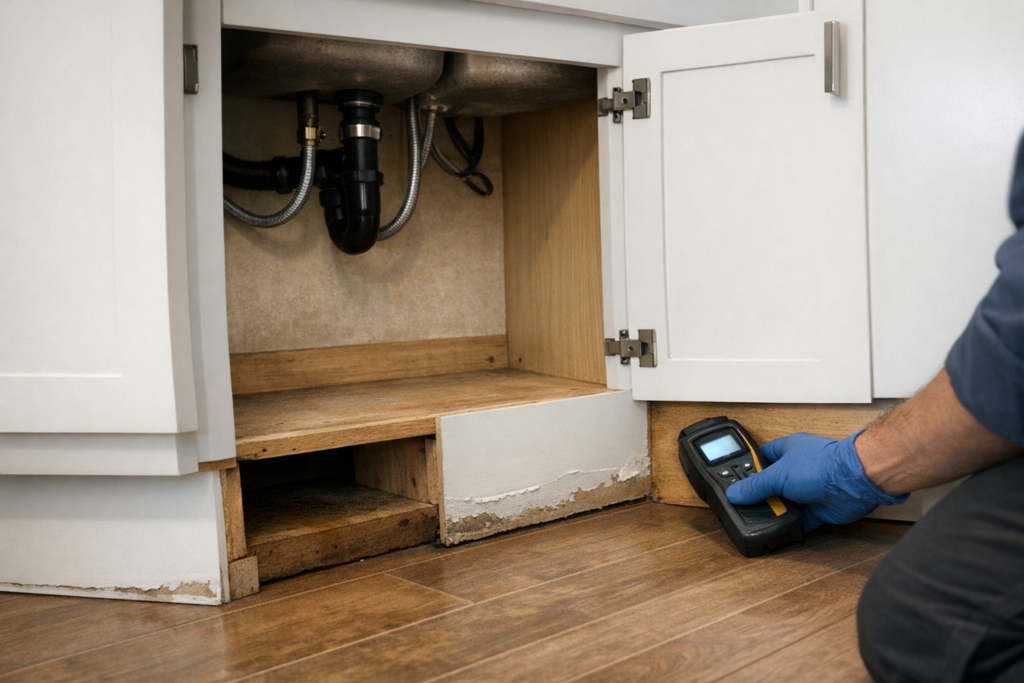
Cabinet toe kick water damage in North Las Vegas 89031 calls for an assessment of the cabinet base and adjoining floor—not just replacement of the visible strip. Safely record swelling, peeling finishes, open joints, and the known leak history. Have the source corrected, then ask a restoration professional which concealed materials are wet, whether access is needed, and how drying will be verified before the recess is closed again.
The toe kick is the recessed area beneath the cabinet front, often covered by a narrow decorative panel. That panel may be separate from the cabinet’s supporting base, or its construction may make access more complicated. A damaged facing does not automatically mean the entire cabinet needs replacement. Equally, a new facing does not establish that the space behind it is dry.
This guide focuses on deciding what to report and what to ask before work begins. Presto Water Damage provides water damage restoration in North Las Vegas. Provide the actual property location and access details when requesting help; ZIP 89031 is a postal reference, not evidence of a particular building type or unique water-damage risk.
1. Understand what the toe kick can—and cannot—reveal
A toe kick panel sits close to the floor, where water from a sink supply connection, dishwasher leak, or nearby plumbing problem may collect. Its lower edge can absorb moisture even when the finished face initially looks unchanged. Later, a painted edge may thicken, a laminate facing may lift, or a joint may become more noticeable.
Separate three components in your description: the decorative facing, the supporting cabinet base behind it, and the floor beneath or beside the cabinet. They may use different materials and may require different decisions. A thin replaceable strip could be damaged while a support remains usable. A relatively intact strip could also conceal wet cabinet sides or flooring.
Visible damage is useful evidence, but it cannot establish the full moisture boundary, identify contamination, or prove when the leak began. A dark mark may have several explanations. Describe its location and changes rather than labeling it mold from appearance alone.
For context on concealed assemblies, read how moisture gets trapped under cabinets. The practical distinction here is narrower: what must be established before someone removes, retains, or replaces the toe kick facing.
2. Make safe observations without pulling panels away
Observe only from a dry, stable, safely accessible location. Do not enter standing water, reach behind an appliance, test electrical components, or remove covers near wiring. If water may have contacted electrical equipment, keep away and arrange appropriate professional evaluation. Do not run a dishwasher again simply to reproduce the leak.
If sewage, suspicious growth, or an unknown contaminated water source may be involved, avoid touching or disturbing the area. Do not aim household fans into the recess. Tell the restoration provider about those concerns before anyone starts opening cabinet components.
Useful observations do not require tools or demolition:
- Panel shape: Note bowed sections, swollen bottom edges, or corners that no longer meet evenly.
- Finish condition: Photograph peeling paint, lifting veneer, bubbles, and staining without scraping them.
- Location: Identify whether changes are beneath the sink, beside the dishwasher, at a cabinet end, or across multiple sections.
- Floor changes: Report visible lifting, gaps, discoloration, or water emerging at the floor-panel junction.
- Other clues: Mention an odor noticed during ordinary use, new door misalignment, or water sounds without searching inside concealed spaces.
Take one wide photograph showing the cabinet run and several closer photographs of affected sections. Repeat photographs from similar positions if conditions change. Do not press softened material to see whether it crumbles or force doors that bind.
Keep observations separate from conclusions. “The lower edge beside the dishwasher is thicker than yesterday” is more useful than “the whole kitchen is ruined.” Also say what you could not see. A closed recess is an inspection limitation, not proof that the concealed area is unaffected.
3. Connect the damage with the source history
The toe kick shows where a symptom appeared, not necessarily where water originated. Water can travel along a cabinet base or floor joint before becoming visible. A sink connection, appliance hose, drain issue, or water arriving from elsewhere may require investigation by the appropriate repair professional.
Report when you first noticed the damage and when water was last observed. If the start time is unknown, say so. Explain whether water appeared during appliance operation, while the sink was used, or when neither was in use. Those clues help organize the investigation but do not confirm the cause.
For a dishwasher-related concern, the guide to where dishwasher leak water can spread explains why neighboring cabinets and flooring may need attention. Leave appliance movement and connection inspection to qualified people; pulling a machine out can damage connections or expose hazards.
Ask for a clear account of source correction: what failed, what was repaired, and how the repair was checked. Keep that information separate from the restoration findings. A repaired hose does not dry a cabinet base, and a dry cabinet does not prove a plumbing defect has been repaired.
For a rental or managed property, identify who can authorize source work and who can approve cabinet access. Give occupants a reporting contact and instructions not to use the suspected fixture or appliance until the responsible professional confirms the next step. Avoid assigning blame before the cause is established.
4. Use a cabinet toe kick water damage decision guide for 89031
For a North Las Vegas 89031 homeowner or manager, the immediate decision is not simply “dry or replace.” First decide whether access is safe, whether the source remains active, and whether the visible damage needs concealed-moisture assessment. Use the following conditions to organize that conversation.
- Water is still appearing: Prioritize safe source control and professional help. Do not wait for a cabinet estimate while the affected area continues expanding.
- The source is repaired, but swelling or staining is new: Request moisture assessment before covering or repainting the panel. Record the repair date and subsequent changes.
- Damage appears limited to one facing: Ask whether the base and floor behind it were checked. Limited visible damage may support a limited scope, but only after the concealed boundary is considered.
- Several panels or floor joints have changed: Request evaluation beyond the first damaged section, including cabinet ends and adjoining materials.
- There is suspected contamination, growth, or unsafe flooring: Restrict access and report the condition. Do not remove the strip or direct airflow into the opening.
If the condition is an old, unchanged mark with no known recent leak, it may not require the same response as active water. Still, appearance alone cannot establish dryness. Ask what investigation is appropriate rather than assuming the stain is harmless or authorizing wholesale cabinet removal.
For managers coordinating remotely, request a photo overview identifying each affected cabinet section and any inaccessible areas. Confirm who will admit the source-repair and restoration providers. A useful authorization distinguishes initial assessment from destructive access, equipment placement, and later finish work.
5. Ask how the professional assessment reaches behind the facing
A professional assessment should explain both findings and limitations. Ask which materials were evaluated: the toe kick facing, supporting base, cabinet side panels, cabinet bottom, wall base, and adjacent flooring. A single reading on the decorative face cannot describe every layer behind it.
Moisture mapping after a cabinet leak connects observations to specific locations. Ask for that location-based explanation rather than an unexplained statement that the kitchen is wet. Where suitable, comparable unaffected materials can help technicians interpret results.
Useful assessment questions include:
- What is the facing made of, and is it separate from the supporting cabinet base?
- Which affected locations are accessible now, and which remain concealed?
- Would selective toe kick removal improve inspection or drying access?
- Could removal affect cabinet support, an appliance connection, or adjacent finishes?
- What findings suggest moisture continues beneath the floor or into the wall base?
- What additional precautions are needed because of water contact history or suspected growth?
Ask the technician to explain instrument limitations. Moisture readings depend on the material, measurement method, and location; metal or layered construction can complicate interpretation. Thermal imaging, if used, shows temperature patterns that require further interpretation, not a direct picture of water.
If access is proposed, request the reason, approximate boundary, and authorization process before removal begins. Ask how exposed areas will be protected and how new findings will be communicated. A revised scope should follow actual discoveries rather than assumptions about the entire cabinet run.
6. Decide what to retain, dry, or replace
Material condition and access matter alongside moisture. MDF and particleboard can swell and lose their original shape after wetting. Drying may reduce moisture without reversing that damage. Solid wood or plywood components may sometimes be retained, but their joints, layers, finishes, and function still need evaluation.
Ask for component-level decisions rather than one blanket recommendation. The guide to cabinet drying and replacement decisions provides broader context. For the toe kick, distinguish replacing a damaged decorative strip from repairing the cabinet base or removing a larger cabinet section.
Retention is more defensible when the material remains functional, the water history supports it, and affected areas can be dried and checked. Replacement may be appropriate when a panel has permanent deformation, separated layers, deteriorated edges, or cannot be adequately addressed under the assessed conditions. No material should be retained solely because the visible face looks acceptable.
Keep the restoration stages clear:
- Source repair: Correct the leaking plumbing or appliance problem.
- Mitigation: Address water and affected materials to limit further damage.
- Drying and verification: Manage retained wet materials and document their progress toward suitable drying goals.
- Rebuild: Restore panels, cabinetry, flooring, and finishes after the affected assembly is ready.
Structural drying and dehumidification should be matched to the materials and available access. Equipment running nearby is not proof that a closed cabinet recess is dry. Ask where follow-up measurements will be taken and what supports completion; there is no universal drying deadline for every cabinet assembly.
Before water damage repair and reconstruction, clarify panel dimensions, finish matching, floor transitions, and whether access components will be reinstalled or replaced. Do not seal, paint, or install a new facing over unresolved moisture merely to restore appearances.
7. Keep a useful record and prevent hidden recurrence
Create one file containing the discovery timeline, photographs, source-repair report, assessment findings, removal approvals, drying records, and repair scope. Label locations in everyday language, such as “sink cabinet, left toe kick corner.” Separate pre-existing wear from newly observed changes wherever you can do so reliably.
Ask that records identify uninspected areas and explain why access was limited. If a panel is removed, request photographs of its concealed side and the exposed assembly before later work hides it. Do not delay necessary mitigation to collect perfect photographs. The water damage documentation checklist can help organize the file.
If an insurance review is involved, provide accurate facts and retain communications and receipts. Coverage depends on the policy and circumstances; photographs or a restoration report do not guarantee acceptance. For managed properties, record who approved each stage and which findings changed the original scope.
After repairs, make the toe kick part of ordinary visual checks. Look for renewed edge swelling or staining, keep safely accessible sink storage organized so leaks are noticeable, and report recurring moisture promptly. Have appliance and plumbing connections maintained according to their applicable instructions rather than tightening or altering unfamiliar fittings yourself.
Ask the repair professional whether a suitable leak alarm could be placed in an accessible location. It supplements observation; it does not monitor every concealed surface. If symptoms return, revisit source investigation and moisture assessment instead of repeatedly replacing the facing.
8. Frequently asked questions about damaged toe kicks
Can only the toe kick panel be replaced?
Sometimes. A separate decorative panel may be replaceable without replacing the cabinet. First establish that the supporting base, adjoining floor, and other affected components are suitable to retain and ready to close. Matching the visible strip is a finish decision, not drying verification.
Does a swollen toe kick mean the dishwasher is leaking?
No. A dishwasher is one possible source, but sink plumbing or water traveling from another location can affect the same panel. Report the timing and visible water path. Do not operate the appliance again to test the theory; arrange appropriate source investigation.
Should I remove the panel to let air underneath?
Not without an assessment of its construction and the conditions behind it. Some facings are attached differently than expected, and removal can disturb damaged material or expose hazards. Ask whether selective access is necessary and who should perform it safely.
How can I tell whether the area is dry enough to rebuild?
Ask for material-specific measurements, the locations checked, the drying goals used, and the explanation for completion. A dry-feeling face or elapsed time is insufficient. The record should address retained affected materials and acknowledge any remaining assessment limitations.
What should I have ready when calling Presto Water Damage?
Provide the property location, callback number, known source history, whether water is still appearing, and the affected cabinet sections. Mention electrical concerns, suspected contamination, occupancy, and access restrictions. Photographs taken safely can help explain the concern without dismantling anything.
If you have a swollen or stained toe kick in North Las Vegas 89031, Presto Water Damage can discuss assessment, mitigation, drying, and repair needs. Share what you can safely observe and ask what should be checked before the panel is replaced. Call 725-529-5195.