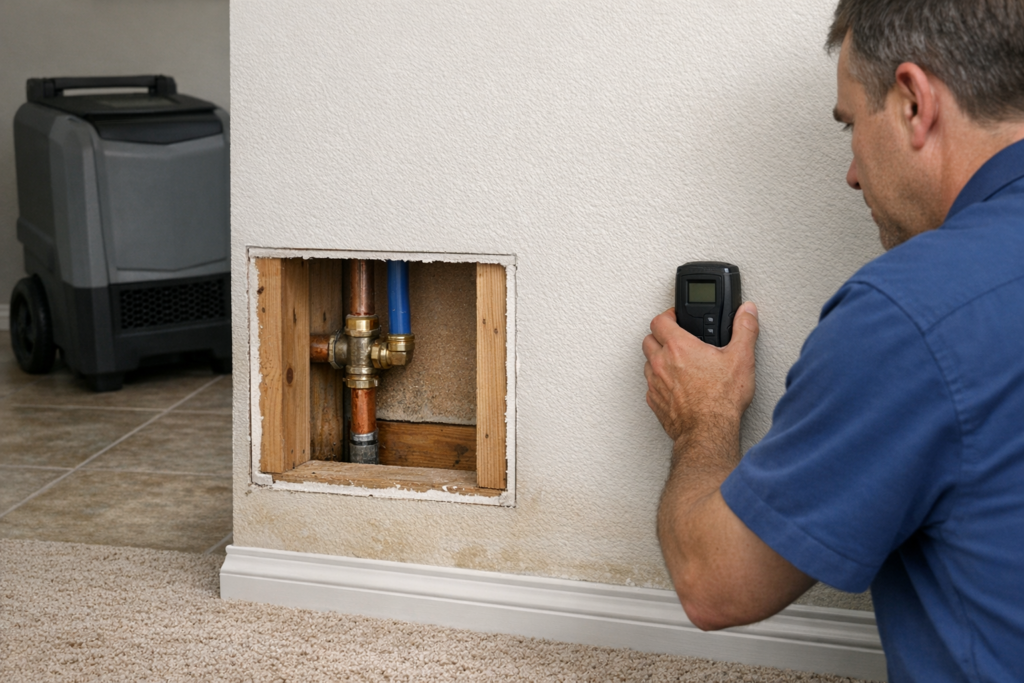
Drying verification before drywall repairs means checking and documenting whether affected materials have reached appropriate drying goals before they are patched, enclosed, textured, or painted. A dry-looking surface, a repaired pipe, or the removal of drying equipment does not establish that on its own. The decision should connect material-specific moisture observations, the condition of retained materials, the water exposure history, and any inspection limitations.
For Las Vegas homeowners, the useful question is not simply, “Does the wall look better?” It is, “What evidence supports repairing this wall now?” Dry outdoor weather cannot establish the condition of insulation, framing, or a wall base behind paint and trim. This guide focuses on the handoff from drying to finish repairs, rather than explaining how to perform drywall work yourself.
1. What drying verification before drywall repairs should establish
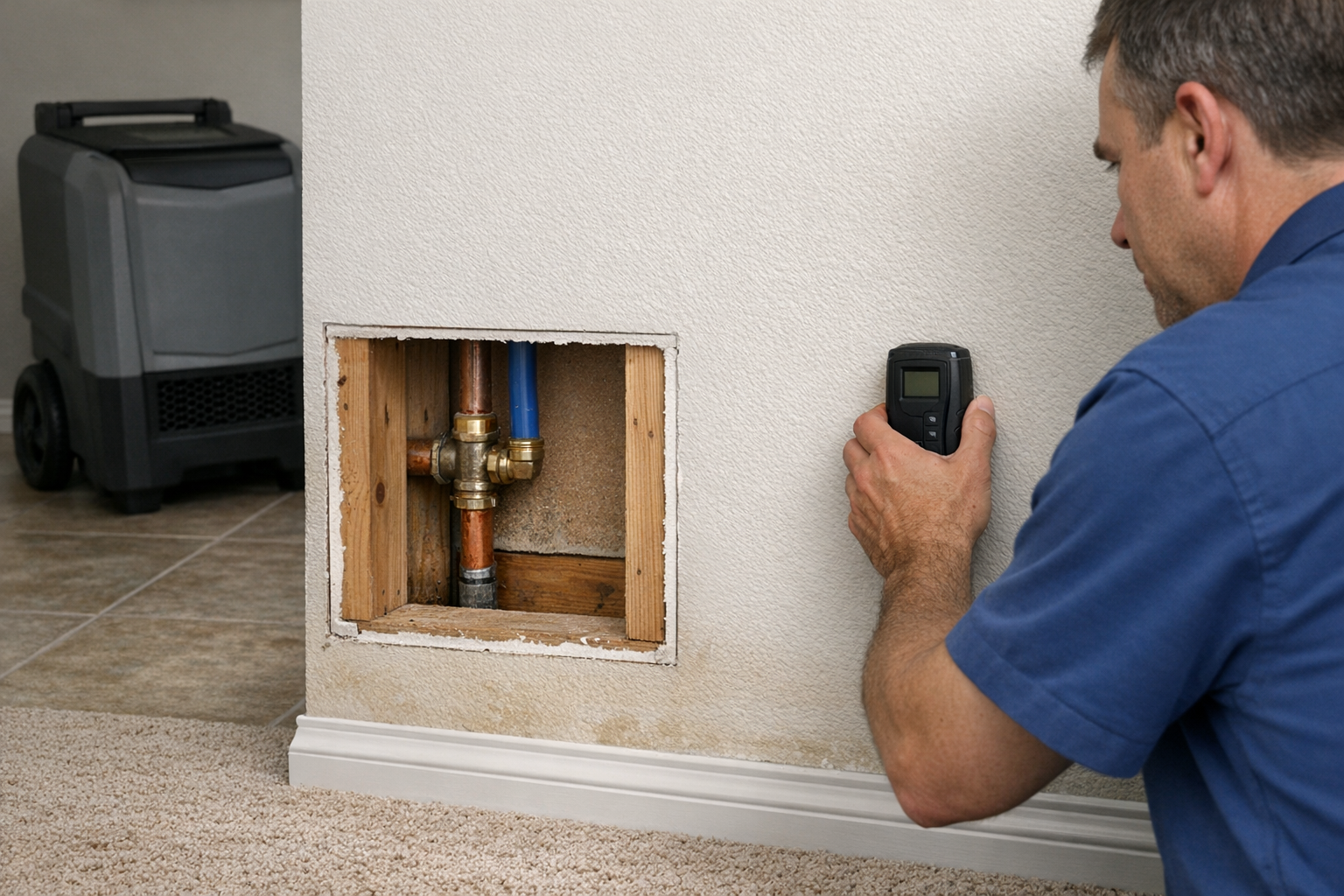
Drying verification before drywall repairs identifies which parts of the affected assembly were checked and why the findings support the proposed next step. Drywall, wood framing, insulation, trim, and adjoining flooring do not necessarily respond to water or dry at the same rate. One acceptable surface reading should not be treated as a conclusion about every concealed layer.
Ask the restoration professional to describe the drying goal for each retained material and the basis for that goal. Depending on the material and measurement method, the assessment may use comparable unaffected materials, documented reference conditions, or other appropriate criteria. There is no single moisture number that a homeowner can apply to every wall and meter.
Drying verification before drywall repairs should also distinguish moisture condition from physical condition. Drywall can become dry yet remain swollen, weakened, separated at its paper facing, or otherwise unsuitable to retain. Likewise, a dry reading does not resolve contamination concerns. Moisture verification is one part of repair readiness, not a substitute for the rest of the assessment.
Presto Water Damage’s structural drying and dehumidification service addresses moisture remaining in building materials. Before finishes are scheduled, ask how the drying findings will be communicated to whoever performs the repairs.
2. Keep source correction, mitigation, drying, and rebuild separate
Source correction stops the event that introduced water. For a supply-pipe leak, an appropriate plumbing professional should identify and correct the failed component. That repair does not remove water already absorbed into drywall or surrounding materials. Obtain the source-repair information rather than assuming that the disappearance of visible dripping proves the problem is resolved.
Mitigation addresses the resulting damage through work such as water extraction, moisture mapping, protection of unaffected areas, and appropriate cleaning or material removal. Structural drying manages moisture in materials suitable to retain. Verification then evaluates the drying results. Rebuild restores the wall assembly and finishes after the relevant conditions have been addressed.
These stages can require coordination rather than a perfectly straight sequence. Source access may require professional removal of damaged material, and an assessment may uncover a wider affected area. The important distinction is that an opening made for access is not permission to close the wall immediately afterward.
To coordinate drying verification before drywall repairs with drywall water damage repairs in Las Vegas, ask who is responsible for confirming readiness and whether any source-related questions remain unresolved. If the source is uncertain or new moisture appears, the repair plan needs reassessment rather than another coat of paint.
3. Make safe observations without testing the wall yourself
Your observations can help a professional find patterns, but they should not require contact with damaged materials. From a safe, dry location, photograph the affected wall and note whether visible changes are stable, shrinking, or spreading. Use a doorway, corner, or other fixed feature to identify the location consistently.
- Record new staining, paint blisters, joint changes, or visible distortion.
- Note gaps or swelling at baseboards and changes at the floor edge.
- Describe when an odor is noticed without treating it as proof of mold.
- Record renewed dripping or changes after plumbing fixtures are used, without deliberately recreating the leak.
- Report equipment shutdowns or access interruptions to the restoration team.
Do not press on soft drywall, scrape paint, pull trim, drill inspection holes, or open ceilings. Avoid the area below sagging ceiling materials. Do not enter standing water or touch wet outlets, switches, cords, or electrical equipment. Electrical safety questions belong with an appropriate professional, not a homeowner test.
If sewage exposure or suspected mold is involved, avoid disturbing the area and do not direct household fans at it. Tell the assessor about those concerns before work begins. Where safe access is uncertain, photographs from farther away and a clear description are more useful than a close inspection.
The guide to visible signs of hidden water damage offers additional observations to report. None of those signs, including their absence, replaces a moisture assessment.
4. Ask what the moisture assessment actually measured
A moisture reading needs context. Ask which material was measured, where the instrument was placed, what type of measurement was taken, and how the result was interpreted. Some readings are comparative rather than literal moisture percentages. Numbers from different materials, instruments, or measurement modes may not be directly comparable.
Ask how repeated checks follow the same locations. A labeled room sketch or photograph can connect the original affected area with subsequent readings. Without that connection, a lower number may reflect a different measurement point rather than progress at the previously wet location.
- Coverage: Were checks limited to the stain, or did they include the wall base, adjoining wall, and relevant floor edge?
- Comparison: What comparable unaffected material helped establish the reference condition?
- Concealed layers: How were framing and insulation evaluated where exposure suggested they could be wet?
- Limitations: Which areas could not be assessed, and what does that uncertainty mean for closure?
- Completion: What findings support ending drying for each retained material?
Surface scans can help identify areas that deserve further evaluation, but they do not automatically describe every layer behind the finish. Infrared observations, if used, show temperature differences that require interpretation; an image alone does not prove moisture or dryness. A professional should explain how different observations support the conclusion.
For more context on drying verification before drywall repairs, read what moisture meters can and cannot establish. You do not need to operate the equipment yourself to ask for a clear explanation of its findings.
5. Match material decisions to the whole assembly
The repair decision should identify what will remain, what will be removed, and why. Retaining drywall may be reasonable when its condition, exposure history, and verified drying support that choice. Replacement may be appropriate when the board has lost integrity, the facing has separated, contamination affects the decision, or concealed conditions cannot be adequately addressed with it in place.
This is different from deciding whether a stain can be covered. A finish repair changes appearance; it does not restore the strength of damaged gypsum or establish the condition behind it. The article on when wet drywall may be saved explains that broader retain-or-replace assessment.
Insulation deserves a separate discussion. Ask what type is present, what is known about its water contact, and whether its condition and dryness can be evaluated adequately. Do not accept a conclusion about insulation based only on the front face of the wall. Review the relevant questions about wet insulation after a leak with the assessor.
At the bottom of a wall, include trim, framing, and neighboring floor materials in the discussion. A baseboard may hide a damp edge even after the exposed paint looks normal. The explanation of water damage behind baseboards shows why these boundaries matter.
If professional removal is proposed, ask how its boundaries relate to the findings rather than assuming every room needs identical work. Where older or otherwise suspect materials require evaluation before disturbance, that question should be resolved before cutting or sanding begins.
6. Request a usable drying-to-repair record
A useful record of drying verification before drywall repairs lets the repair team understand the affected area without reconstructing the entire event from memory. Ask for a summary that connects source information, inspected materials, drying observations, removal decisions, and any unresolved limitations. The format may vary, but the conclusion should be understandable.
- Identify affected rooms and specific walls or ceiling areas.
- Keep initial, progress, and final observations tied to locations and dates.
- Record the drying goals and the basis used to evaluate completion.
- Separate removed materials from materials retained and checked.
- List inaccessible areas or outstanding source and contamination questions.
- Clarify who receives the findings before wall closure or finish work.
Keep source-repair invoices or reports with restoration documents, but label their purposes separately. A plumbing invoice supports the source history; it is not a drying report. Similarly, a photograph of equipment does not establish the moisture condition of the wall when equipment was removed.
The guide to organizing water damage photos, readings, and scope records can help keep this file coherent. Documentation may support a review, but coverage and payment decisions depend on the applicable policy and circumstances. Neither complete records nor a drying conclusion guarantees claim acceptance.
For owners or managers coordinating separate contractors, designate a contact who can answer questions before closure. A clear handoff reduces the chance that a repair crew interprets an empty room or removed dehumidifier as authorization to proceed.
7. Plan closure and prevention around the findings
Before the wall is enclosed, review whether the retained assembly has met the stated drying goals, whether damaged or unsuitable materials have been addressed, and whether remaining uncertainty affects the work. If a particular area still needs evaluation, ask whether it can remain accessible while unrelated approved repairs move forward.
Finish choices can be discussed while drying is underway, but scheduling should remain conditional on assessment findings. Texture, primer, paint, and trim replacement belong after the relevant substrate and assembly decisions. They should not be used to hide a condition that has not been explained.
Prevention starts with the actual source. Ask the source-repair professional what follow-up or maintenance applies to the repaired pipe, appliance connection, or other component. Keep serviceable connections accessible where practical, and avoid storing belongings so tightly against affected areas that future changes become difficult to notice.
Following drying verification before drywall repairs, retain baseline photographs and report new staining, distortion, or recurring odor. Do not assume a later change is merely an old mark, but do not diagnose it from appearance alone. Give the team the earlier records so new observations can be compared with the original findings.
Presto Water Damage provides water damage restoration support in Las Vegas. When arranging an assessment, describe the source history, current work stage, and whether anyone has already scheduled wall closure. Those details help frame the right questions before repairs begin.
8. Frequently asked questions before drywall repairs
Can I approve repairs because the drywall feels dry?
No. Touch cannot establish concealed moisture or the condition of the full assembly, and pressing damaged board can disturb it. Drying verification before drywall repairs needs material-specific findings and a clear basis for the drying conclusion. A normal-looking surface is useful context, but it is not verification of the framing, insulation, or opposite wall face.
What moisture percentage is acceptable before patching?
There is no universal percentage for every material and instrument. Some meter scales are relative, and readings require interpretation for the material being checked. Ask what goal applies, how it was established, and whether the reported results are percentages or comparative values. Avoid comparing a drywall reading directly with a wood reading.
Does removing the dehumidifier mean the wall is ready?
Not necessarily. Equipment removal is an operational event, not the explanation for repair readiness. Ask whether drying goals were met in the relevant materials and whether any areas remain unresolved. Do not disconnect or relocate equipment yourself to make room for repairs; coordinate access and equipment decisions with the restoration team.
Can a stain remain after the materials have dried?
Yes. Discoloration can remain after moisture has been addressed, so a persistent mark does not by itself prove active wetness. Conversely, a fading stain does not prove the assembly is dry. Drying verification before drywall repairs should guide the finish plan and material assessment. Report a new or expanding mark before covering it.
What should happen if final readings are still elevated?
Ask the assessor to explain the likely reason and the proposed next step. Possibilities include incomplete drying, limited access, renewed water entry, or measurement interference requiring clarification. Do not simply cover the area to meet a finish schedule. The next action should follow the findings, which may require further assessment or a revised material plan.
For additional background on moisture control and concealed mold, see the EPA guide to mold and moisture. General guidance does not replace assessment of the affected materials at your property.
Before your wall is patched or closed, make sure the drying conclusion is clear enough to explain what was checked and what remains uncertain. To discuss drying verification before drywall repairs and the next repair stage with Presto Water Damage, call 725-529-5195.