Carpet pad water damage decisions should depend on the water contact history, the pad’s condition, and whether the underlying floor can be inspected and dried—not on how dry the carpet feels. Some padding may be considered for retention after assessment, while contaminated, deteriorated, or impractical-to-dry padding may need removal. Carpet, cushion, and the floor beneath them require separate decisions.
For Las Vegas homeowners and property managers, the useful first step is to record what is known without lifting carpet or disturbing wet materials. This guide focuses on observations and questions that help you understand a proposed pad decision. It complements the broader discussion of when wet carpet and padding may be dried, rather than treating every carpeted loss as the same problem.
1. Start Carpet Pad Water Damage Decisions With the Water History
Before discussing a replacement pad, establish how water reached the carpet. A plumbing supply leak, washing machine discharge, toilet overflow, and outdoor floodwater do not present the same conditions. Water can also travel through other materials before reaching a carpeted room. Its original source is important, but so are its route, contact history, and the uncertainty surrounding the event.
Consider a stopped plumbing supply leak that spread from a hallway into an adjoining carpeted bedroom. The visible wet edge might be small, but the pad could have absorbed water farther beneath the carpet. This is an assessment scenario, not a reason to assume that either the entire room must be replaced or the affected cushion can automatically remain.
- Record when water was discovered and when the room was last known to be unaffected.
- Identify the suspected source, distinguishing a confirmed finding from a guess.
- Note whether water crossed a bathroom, laundry area, wall cavity, or another floor covering.
- Report previous wetting, cleaning attempts, odors, or known flooring repairs.
Do not describe discovery time as the leak’s start time unless you actually know both. An unattended loss may have a longer exposure history than the visible puddle suggests. The explanation of water damage categories and contact history can help you prepare source-related questions without trying to classify the loss yourself.
Source correction is a separate task from restoration. A plumber or appropriate repair professional should address the failed supply connection or other cause. Stopping that leak does not establish that the pad, carpet backing, or supporting floor has recovered.
2. Make Useful Observations Without Pulling Up Carpet
Keep observations within a dry, stable, accessible area. Do not enter standing water, touch wet electrical equipment, or cross a questionable floor to obtain photographs. If electrical exposure or structural stability is uncertain, keep people out until the relevant professional establishes safe access. Documentation can wait when access is unsafe.
From a safe location, photograph the room and visible changes. Useful details include a darkened carpet edge, staining near a doorway, wrinkles that appeared after the loss, swollen trim, and marks on furniture bases. Describe their location using fixed references: the bedroom side of the hallway doorway, for example, is more useful than simply saying the carpet is wet.
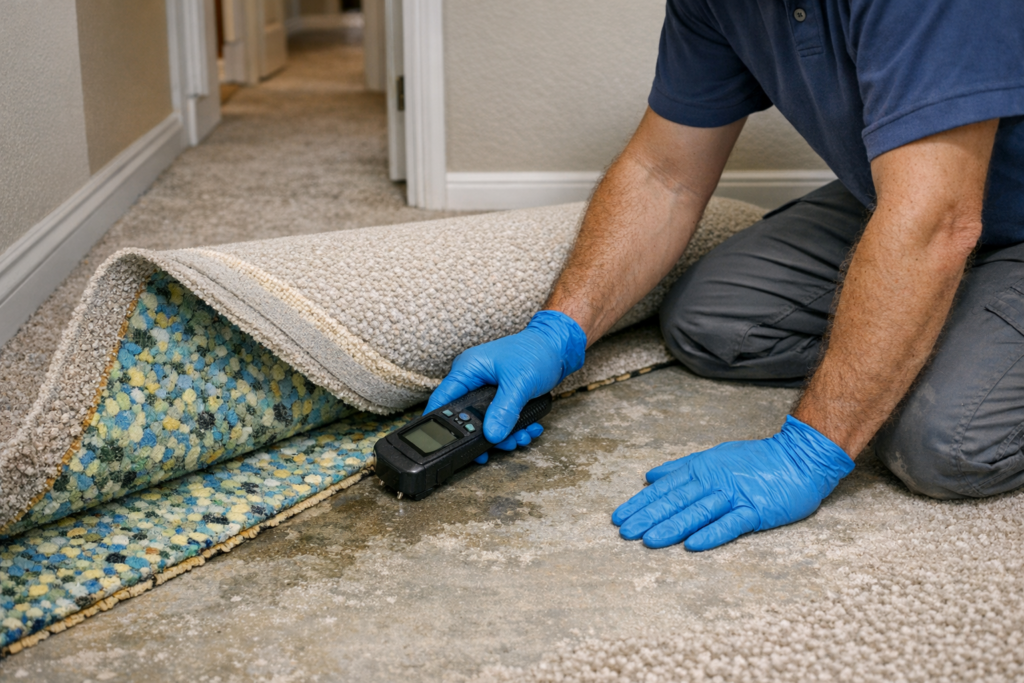
Avoid walking across the carpet to test for squishing or pressing towels into it to estimate moisture. Do not pull it from tack strips, cut out a pad sample, or reach underneath. Those actions can expose sharp fasteners, damage otherwise retainable carpet, and disturb materials whose contamination status has not been assessed.
- Note visible changes and their discovery date.
- Report odors noticed during ordinary use; do not approach materials to smell them closely.
- Identify furniture or stored items that may obstruct professional access.
- Tell the team about visible spotting without brushing, scraping, or treating it.
If sewage, outdoor floodwater, or suspected mold is involved, limit access and do not direct household fans at the area. Avoid moving affected belongings into unaffected rooms. Ask the restoration team for handling instructions before attempting cleanup or rearranging the space.
3. Ask How the Pad and Underlying Floor Will Be Assessed
The carpet face is only one part of the assembly. Beneath it may be backing, cushion, attachment materials, and a concrete slab or wood-based subfloor. Different layers can retain moisture differently. A surface observation cannot show whether water has reached the pad’s underside or spread along the supporting floor.
Ask the assessor to explain the inspection boundary and any limits on access. A bed, built-in storage unit, or continuous carpet installation may prevent an immediate view of every affected location. Those limitations should be identified rather than treated as proof that inaccessible material is unaffected.
- Which carpeted rooms, closets, and transitions are included in the assessment?
- What pad type is present, and does it have a facing or moisture-resistant layer?
- How will the pad’s condition and the floor beneath it be evaluated?
- Are readings being recorded at repeatable locations?
- Which findings would change the initial retention or removal recommendation?
Moisture readings need context. Ask which material each reading represents and what comparison supports its interpretation. A reading through multiple layers may not identify which layer is holding moisture. The guide to what moisture meters can and cannot establish explains why a number alone is not a complete material decision.
The assessment should also consider the room perimeter and adjoining flooring. Water may extend toward wall bases or beneath a transition even when the center of the room looks unchanged. Understanding how moisture spreads beneath flooring helps explain why the inspected area may exceed the visible stain.
4. Compare Retaining the Pad With Selective Removal
A useful recommendation states why retaining or removing the pad is appropriate for this loss. Potential retention depends on an acceptable water history, suitable material condition, and a drying approach that can address and verify the affected layers. A proposal to leave everything in place should explain how concealed moisture will be reached and checked.
Removal may be appropriate when the cushion has contamination concerns, has broken down, cannot be adequately cleaned, or prevents effective access to the supporting floor. Deterioration can include crumbling, separation, or loss of its cushioning function. Odor warrants investigation, but it does not independently identify the cause or establish the entire removal scope.
Ask whether removal is recommended because the pad itself is unsuitable to retain or because taking it out provides needed drying access. These are different explanations. Also ask whether the carpet can remain while affected cushion is replaced. The carpet’s backing, seams, dimensions, and overall condition may influence that separate decision.
Presto Water Damage’s carpet, floor, and contents restoration service addresses flooring and belongings within the restoration scope. Discuss the actual affected components rather than assuming that saving carpet means saving its pad, or that removing pad means discarding every item in the room.
If selective pad replacement is proposed, request a clear boundary and an explanation of compatibility. Thickness, density, installation requirements, and the retained carpet’s product guidance can matter. Keep available purchase records or installer information, but leave physical sampling and removal to the professionals handling the work.
5. Separate Extraction From Drying Verification
Extraction removes recoverable water; it does not by itself demonstrate that the pad or supporting floor is dry. A technician may use extraction as an early mitigation step while continuing to assess material suitability. The fact that water was successfully extracted does not settle whether a particular cushion should remain.
When retained materials require drying, ask how the plan addresses the complete affected assembly. Air movement and dehumidification serve different functions, and equipment placement should reflect the inspected conditions. Do not move equipment, close off its operating space, or change settings without discussing the change with the restoration team.
Presto Water Damage provides structural drying and dehumidification. In a carpeted room, ask which retained materials are being monitored, what drying goals apply to them, and how progress is being compared. Las Vegas weather does not eliminate the need to check concealed layers indoors.
- Request the locations and materials associated with progress readings.
- Ask what supports the drying goal for the substrate and any retained cushion.
- Clarify how inaccessible areas will be handled before installation.
- Report renewed dampness, equipment interruptions, or newly visible changes.
There is no universal number of days after which all wet padding is ready to keep or replace. Exposure, material construction, access, and environmental conditions affect the work. A schedule is useful for coordination, but readiness should be supported by findings rather than a calendar alone.
6. Document the Decision Before Materials Are Discarded
Ask for a room-specific explanation of the proposed scope. A note saying only “replace carpet pad” leaves important questions unanswered. The record should identify the affected area, describe the reason for removal, distinguish retained carpet from discarded cushion, and identify any supporting-floor work still needed.
Photographs should connect wide room views with closer material observations when professionals have safe access. You do not need to handle wet pad to create a useful record. Request that the team document relevant concealed conditions during its authorized inspection or removal work.
- Keep the discovery timeline and source-repair information together.
- Retain assessment findings, photographs, moisture records, and written scope changes.
- Record which rooms and pad sections are affected.
- Save available carpet and cushion product information.
- Clarify who authorizes removal, replacement selections, and additional repairs.
The checklist for documenting water damage before cleanup provides a broader framework. Do not delay necessary mitigation merely to perfect the file. If insurance is involved, ask the insurer what information it requests; restoration documentation does not establish coverage or guarantee claim acceptance.
For rentals or managed properties, identify the person authorized to approve work and coordinate occupant access. Keep observations separate from conclusions: “odor noticed near the closet doorway” is a reportable fact, while an unsupported diagnosis can confuse the scope. Request updates when newly exposed conditions change the recommendation.
7. Plan Reinstallation and Prevent Repeat Wetting
New pad should not conceal an unresolved leak or an inadequately evaluated substrate. Before installation, confirm that source correction has been addressed, mitigation work is complete for the area, and drying verification supports covering the floor. If a source remains uncertain, ask what investigation or follow-up is required.
Reinstallation also involves more than purchasing cushion. Ask the installer to confirm compatible pad specifications, carpet condition, seams, transitions, and attachment details. Discuss whether the retained carpet needs additional work before it can be reinstalled. Separately identify damaged trim or wall finishes so they do not disappear from the repair plan.
Where building materials require repair, water damage repair and reconstruction follows the appropriate mitigation and drying handoff. Rebuild restores removed or damaged finishes; it is not a substitute for confirming that retained materials are ready to be enclosed.
Prevention should target the actual cause. After a supply-line loss, arrange appropriate plumbing correction and ask about accessible connection checks. Keep repaired areas observable where practical, and report recurrent staining, dampness, or odor. Leak alerts may provide earlier notice in suitable locations, but they do not replace maintenance or confirm that concealed materials are dry.
Keep a completion file with source-repair records, drying information, pad specifications, and installation notes. Presto Water Damage’s Las Vegas restoration information outlines local service support. When requesting help, provide the property location and the specific carpeted areas involved without assuming that every room needs the same treatment.
Frequently Asked Questions
Can carpet padding still be wet when the carpet feels dry?
Yes. The carpet surface can feel dry while moisture remains in the cushion or at the supporting floor. Touch does not establish the condition of concealed layers. Ask which layers were assessed, how access was obtained, and what findings support retaining or replacing the pad.
Does wet carpet pad always need replacement?
No single answer applies to every loss. Water contact history, material condition, cleaning suitability, and drying access all matter. Contaminated or deteriorated padding may require removal. If retention is proposed, ask how the team will dry and verify the pad and substrate rather than relying on surface appearance.
Can the pad be replaced without replacing the carpet?
Sometimes the carpet can be retained while affected cushion is removed and replaced. That depends on the carpet’s contamination assessment, backing integrity, seams, and ability to be reinstalled properly. Request separate written decisions for the carpet and pad, including any installation limitations discovered during assessment.
Should I lift a carpet corner to check the pad myself?
Leave lifting and sampling to the restoration team. Tack strips and fasteners can be sharp, and pulling carpet can damage it or disturb suspect materials. From safe access, record visible changes and explain the leak history. Ask the assessor to document the concealed conditions during professional inspection.
What should I ask before new carpet pad is installed?
Ask whether the source has been corrected, which retained layers have been verified as dry, and whether any inspection limitations remain. Confirm replacement pad compatibility, installation boundaries, and related repairs. Keep the supporting records so the installation decision is tied to assessed conditions rather than an expected completion date.
If you need help evaluating wet carpet padding in Las Vegas, contact Presto Water Damage. Share the known water source, affected rooms, and observations you can make safely, then discuss assessment, drying, and material options. Call 725-529-5195.