Condo water loss responsibility documentation should record what happened, which materials were affected, who controls access and who authorized each stage of work—without treating those records as an automatic decision about who pays. In Las Vegas, a leak may involve an owner, an occupant, another unit, an association and multiple insurance contacts. A clear file helps those parties review the same facts while qualified professionals assess the damage.
The location of a stain does not establish ownership of the leaking component, legal fault or insurance coverage. Those questions may require governing documents, policy review, source findings and legal advice. Meanwhile, necessary assessment and damage control should be coordinated promptly through people with authority to approve the work.
This guide focuses on the responsibility record: safe observations, assessment questions, access decisions and documented handoffs. It is not a substitute for reviewing your association documents or obtaining advice about a disputed obligation.
1. Start Condo Water Loss Responsibility Documentation With Separate Questions
After a condo leak, the question “Who is responsible?” often combines several different issues. Separate them before collecting statements. The person who arranges entry may not own the affected assembly. The person who signs a restoration agreement may have contractual obligations even while reimbursement or coverage remains under review.
- Source: What component released water, and who confirmed that finding?
- Maintenance: Who is assigned to maintain or repair that component under the applicable documents?
- Access: Who can authorize entry into each unit or shared space?
- Work authorization: Who can approve assessment, mitigation, removal and reconstruction?
- Payment and coverage: Which agreements or policies apply, and who is reviewing them?
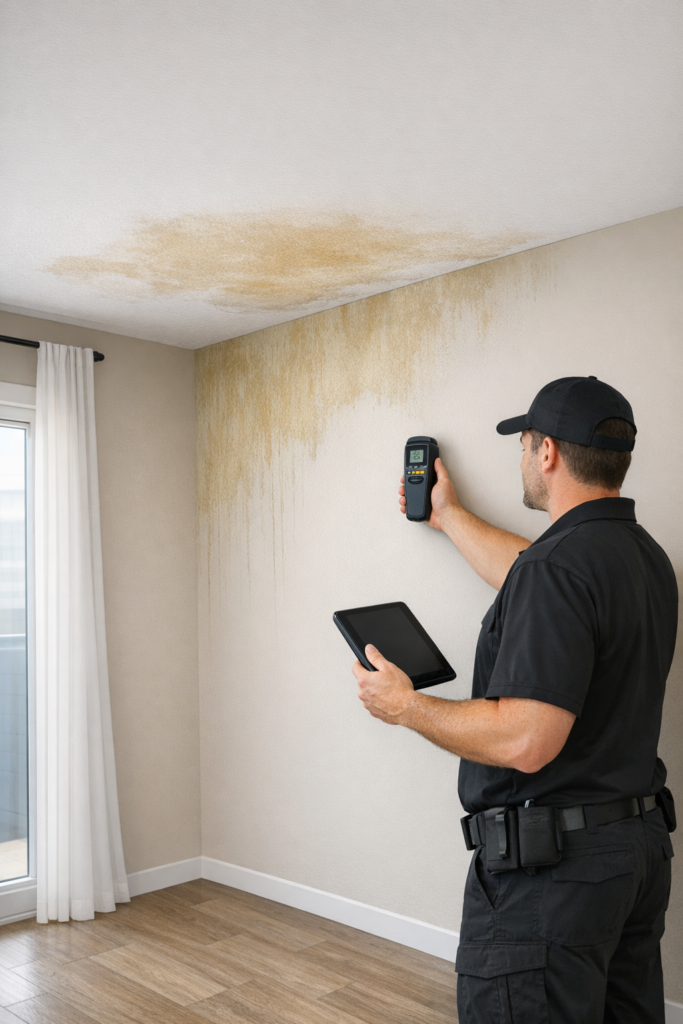
For example, water appearing on a lower unit’s ceiling may have traveled from plumbing above, but that observation alone does not identify whether the component serves one unit or several. Record “ceiling stain beneath upstairs bathroom” rather than “upstairs owner caused damage” unless a qualified investigation supports a more specific statement.
Ask management for the current governing documents, relevant maintenance provisions and the association’s loss-reporting procedure. Keep the version and date with your notes. If interpretations conflict, document the unresolved question and request clarification from the appropriate adviser. A restoration assessment can describe physical conditions; it does not settle a legal responsibility dispute.
2. Make Safe Observations Without Investigating Concealed Spaces
Photographs are useful only when they can be taken safely. Stay out of standing water and areas with electrical concerns, unstable finishes or suspected contamination. Do not operate switches or test electrical equipment in an affected area. A sagging ceiling is a reason to keep people away and seek professional evaluation, not a reason to approach for a closer photograph.
From a safe, dry location, record the room, the surface and the time of observation. Note visible staining, peeling paint, swollen trim, changes at floor joints or dripping you can see without entering the affected area. Do not press on drywall, pull off baseboards, lift flooring or open a ceiling to trace the water.
Use wide photographs to establish location and closer photographs only where safe access allows. Describe a stain relative to a doorway, window or wall corner so another person can identify it later. The guide to documenting water damage before cleanup explains how to organize those images.
Keep discovery time separate from the unknown start time. If you first noticed a stain in the morning, that does not establish when the leak began. Note earlier observations only if you actually made them. If sewage or suspected mold is involved, avoid contact and disturbance, restrict access and do not use household fans to move air across the affected materials.
3. Build a Shared Timeline and an Access Record
A condo file needs more than photographs of one room. Create a dated timeline showing discovery, notifications, source investigation, access attempts, work approvals and changes in visible conditions. Identify who provided each statement. “Manager reported source shutoff” is different from a plumber’s written confirmation that a particular connection was repaired.
Use consistent room descriptions across units. A lower bedroom ceiling and the upper bathroom floor may be related, but do not assume the rooms line up exactly. Ask the assessment team to confirm the relevant locations. With permission, connect reports using a loss reference or building-management reference rather than circulating occupants’ private information broadly.
- Record the management contact and authorized representative for each affected area.
- Note approved entry arrangements and whether someone must accompany the technician.
- List rooms, closets or shared spaces that could not be inspected.
- Record why access was unavailable and who will arrange another visit.
- Keep appointment confirmations and written follow-up messages together.
An inaccessible unit is an assessment limitation, not proof that it is dry or unaffected. Ask the report writer to identify what remains unknown and whether that gap changes the immediate plan. Do not enter a neighbor’s unit, unlock shared service areas or operate building valves without proper authorization.
Presto Water Damage’s property management restoration support is relevant when multiple decision-makers need coordinated assessment and restoration. Confirm the proposed scope and authorized contact rather than assuming one work order covers every affected unit.
4. Request Source Findings and a Material-Based Assessment
Source repair and restoration answer different questions. The appropriate repair professional should identify and correct the leaking component. Restoration assessment should establish where water traveled, which materials were affected and what can reasonably be inspected. A completed plumbing repair does not establish that surrounding drywall, insulation or flooring is dry.
Request a source report that names the component, its location, the observed failure and the work performed. Ask whether the source was confirmed or remains suspected. If the component is concealed or its service area is uncertain, have the report state that limitation instead of assigning ownership by guesswork.
For an upstairs plumbing leak affecting a lower ceiling, the restoration assessment may need to consider ceiling drywall, insulation, the floor assembly above and adjoining walls. The scope should follow findings rather than stopping at the visible stain. Presto’s ceiling water damage restoration page explains the affected-material side of this work.
- Which materials and locations were measured?
- Were nearby comparable materials used to help interpret findings?
- What areas were inaccessible, and what further access is proposed?
- Does the known water history create contamination concerns?
- Which findings support extraction, drying or selective removal?
Ask for a location-based moisture record, not an unexplained collection of numbers. Readings require material and instrument context; they do not establish fault or coverage. The explanation of what moisture meter readings can establish can help you prepare questions without trying to perform your own testing.
5. Document Material Decisions and Work Authorization Separately
Each proposed material decision should have a physical reason and an authorized scope. Drywall might be considered for retention when its condition, water history and drying access support that approach. Removal may be proposed because material has lost integrity, contamination is a concern or concealed layers cannot otherwise be addressed. Neither option should be selected solely because one party expects another party to pay.
Ask the restoration team to identify the actual component: ceiling board, insulation, trim, floor covering or underlying substrate. These may have different conditions and different ownership or maintenance treatment under the association documents. The guide to evaluating whether wet drywall can be retained offers useful questions about condition and cavity access.
Before destructive work, clarify who is authorizing it and what that authorization covers. A signature for inspection should not be assumed to approve all later removal or reconstruction. Read the agreement, ask about payment obligations and request written clarification of any uncertain terms before signing.
For shared wall or floor-ceiling assemblies, ask whether proposed work could affect fire-resistance, sound-control or other assembly features. The appropriate professionals and management should determine applicable requirements. Do not assume a standard patch detail is suitable for every condo assembly.
Keep the initial scope and dated revisions. If concealed damage is discovered during authorized work, request photographs, an explanation of the added work and confirmation of the required approval. The broader water damage documentation guide can help organize supporting records, but documentation does not guarantee reimbursement or claim acceptance.
6. Keep Mitigation, Drying Verification and Rebuild Records Distinct
Organize the restoration file by stage. Source correction stops the release of water. Mitigation addresses damage control, which can include extraction, cleaning and appropriate selective removal. Structural drying manages moisture in materials being retained. Drying verification evaluates whether those materials have reached the project’s documented goals. Rebuild restores the affected finishes and assemblies after the necessary handoff.
Ask what records will accompany each stage. An extraction invoice is not a drying completion report. Equipment running in a unit does not establish that concealed layers are ready to close. Similarly, a dry-looking ceiling can still require professional assessment before patching or paint.
During structural drying and dehumidification, request progress records tied to the same materials and locations whenever practical. Ask what changed, why equipment was adjusted and which areas remain unresolved. Report equipment interruptions to the restoration contact without changing the setup yourself.
Before reconstruction, request source-repair confirmation, final moisture findings for retained materials, a record of removed materials and any remaining inspection limitations. The guide to drying verification before drywall repairs explains this handoff in more detail.
Separate loss-related repairs from optional improvements in the written rebuild scope. Identify finish boundaries, materials, transitions and approval responsibilities. Keep unresolved financial questions visible rather than allowing a completed paint job to appear to settle them.
7. Close the File With Follow-Up and Prevention Responsibilities
At completion, assemble a concise index: discovery timeline, photographs, source findings, access notes, authorizations, moisture reports, scope revisions and completion records. Save original files where possible and identify later corrections as corrections. A short summary helps reviewers navigate the evidence, but it should not replace the underlying reports.
Confirm who receives the completion package. An owner, association representative and insurer may need different records. Share relevant information through agreed channels, with appropriate attention to occupants’ privacy. Record what was sent, to whom and when, particularly if multiple parties maintain separate loss files.
Prevention also needs assigned tasks. Ask who will maintain the repaired component, who will follow up on any adjacent system concerns and who should receive reports of new staining. Keep repair recommendations with the responsible party’s acknowledgment rather than assuming someone else received them.
After an upstairs plumbing leak, occupants can report recurring drips or visible finish changes from safe locations. They should not reopen repairs or disturb materials to check the cavity. Any leak alarm or shutoff proposal should be reviewed for suitability, access and building-management approval where relevant.
For local coordination, review Presto’s Las Vegas water damage restoration information. When contacting a restoration provider, explain the affected rooms, source status, management contact and access limits. These practical details help define an assessment without requiring you to decide responsibility first.
Frequently Asked Questions
Does water coming from the upstairs condo prove that owner must pay?
No. The water path is physical evidence, but it does not by itself establish legal responsibility, maintenance duties or coverage. Request confirmed source findings and review the applicable association documents and policies with the appropriate professionals. Record the upstairs connection as an observation or confirmed finding, depending on the evidence available.
What should I document if the neighboring unit cannot be inspected?
Record when access was requested, who was contacted, which areas remain inaccessible and the next proposed step. Ask the restoration report to describe the resulting assessment limitations. Do not describe an uninspected space as unaffected, and do not enter it without permission. Management can help coordinate authorized access through the applicable process.
Can mitigation begin while payment responsibility is still unresolved?
It may be possible to arrange necessary work through an authorized party while responsibility is reviewed, but do not assume reimbursement. Clarify the scope, contracting party and payment terms before authorizing work. Ask management and the relevant insurer about their notification and documentation procedures without delaying urgent safety communication or professional assessment.
Which records should explain a decision to remove ceiling drywall?
Request location photographs, material-condition findings, relevant moisture observations, known water-contact history and the reason removal is proposed. The record should also identify authorization and any concealed layers requiring assessment. If the ceiling is part of a shared assembly, clarify coordination and reconstruction requirements with management and the appropriate professionals.
Does a final drying report resolve the condo responsibility dispute?
No. It should explain the drying assessment, relevant locations, completion findings and limitations for the restoration scope. It does not decide ownership, fault, policy coverage or reimbursement. Preserve it alongside source reports, contracts and association correspondence so each decision-maker can review the evidence relevant to their role.
If a condo leak has affected your Las Vegas unit or a managed building, Presto Water Damage can discuss assessment, moisture mapping, extraction, structural drying and restoration needs. Have your safe observations, source information and authorized access contact ready. Call 725-529-5195 to discuss the next step.