
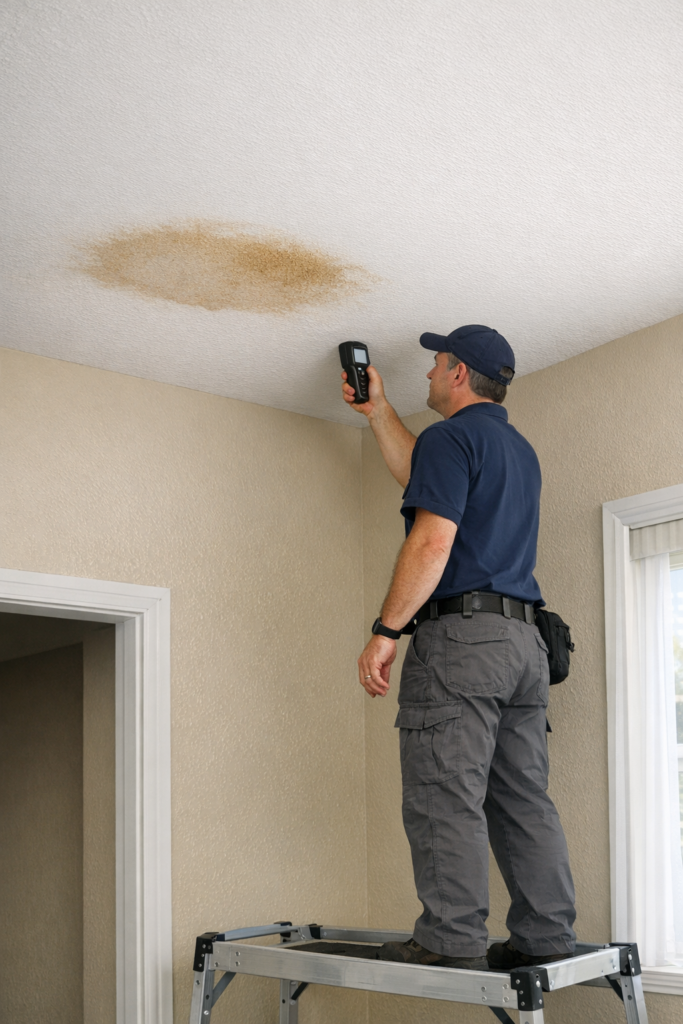
The roof leak interior drying sequence in North Las Vegas 89032 should begin with safe access and source control, followed by assessment of the affected ceiling and connected materials. Professionals then address recoverable water, make cleaning and material-removal decisions, dry suitable retained materials, and verify moisture conditions before rebuilding. Some steps overlap, but painting a stain or repairing the roof alone does not complete interior restoration.
The important homeowner or manager decision is not simply whether to run drying equipment. It is whether the water path has been understood well enough to choose what can stay, what needs professional access, and when finish repairs can proceed. A ceiling surface may look better while insulation or framing above it remains wet.
This guide focuses on those decisions rather than diagnosing a roof defect. For service information, see Presto Water Damage’s ceiling and roof leak water damage support. The ZIP identifies a postal area; it does not establish a particular roof design, building type, jurisdiction, or unique moisture risk.
1. Understand the roof leak interior drying sequence before approving repairs
A useful sequence separates four responsibilities: correcting the entry point, limiting interior damage, verifying drying, and restoring finishes. A roofer may address the exterior source while restoration professionals evaluate wet interior assemblies. Ask who is responsible for each part and how findings will be shared.
Source control and mitigation may proceed together when conditions allow. For example, interior professionals may be able to protect an unaffected area while exterior work is being arranged. However, an active or unresolved entry path needs to remain part of the drying plan. Newly entering water can undermine progress and change the work boundary.
- Safe access: determine where occupants and workers can safely go.
- Source assessment and control: identify the entry issue and document temporary versus completed correction.
- Interior assessment: map affected materials, including areas beyond the stain.
- Mitigation: address water, cleaning needs, and unsuitable materials as findings require.
- Controlled drying: manage evaporation and humidity for materials suitable to retain.
- Verification and rebuild: review moisture evidence before closing assemblies or applying finishes.
Ask for a written explanation if the proposed order differs. There may be a sound reason involving access, safety, or material condition. The objective is not a rigid schedule; it is avoiding a repair that conceals an unresolved problem.
2. Establish safe observation boundaries around the wet ceiling
Observe only from a dry, safe location outside the affected area. A sagging ceiling, bulging paint, falling debris, or water near lighting calls for restricted access and professional assessment. Do not stand underneath to take a better photograph. Keep other occupants away, and do not move furniture if doing so requires passing beneath damaged material.
Do not puncture a ceiling bubble, remove fixtures, open the ceiling, or enter an attic to trace the leak. Avoid switches, outlets, and equipment in affected locations; electrical concerns belong with an appropriate professional. Never enter standing water or test electrical components yourself. If conditions present an immediate danger, leave the area and seek appropriate emergency assistance.
Useful observations do not require touching the damage. Record which room is affected, where the stain sits relative to a doorway or wall, whether dripping is visible, and when the change was first noticed. If you can safely see adjoining rooms, note similar discoloration or wall changes without assuming they share the same source.
A stain is evidence to investigate, not proof that the roof is responsible. Plumbing and condensation can create similar interior signs. The guide to possible causes of ceiling water stains explains why source confirmation matters.
Report odors or suspected growth without scraping, wiping, or sampling materials. Do not aim household fans at suspected mold or contaminated materials. Tell the assessor what you observed and let the assessment determine the appropriate controls.
3. Build a source history that explains interruptions and uncertainty
Roof-related interior moisture can be intermittent. A room may stop dripping when rain stops even though the entry defect remains. Separate “no drip observed today” from “the source has been corrected.” Similarly, an old stain can remain visible after successful correction and drying.
Prepare a short timeline with the discovery date, known rain exposure, prior stains, previous repairs, and any changes since work began. If the property was vacant, distinguish the date of discovery from the unknown start of the leak. Do not fill gaps with guesses.
Ask the source-repair professional what was found and which area was addressed. Request photographs or written findings when available. If only temporary protection was installed, record that limitation and ask how permanent correction will be coordinated with interior work. Do not climb onto the roof to confirm the work yourself.
- What evidence connects this interior damage to the identified roof entry point?
- Is source correction temporary, complete, or still under investigation?
- Could water have traveled before reaching the visible ceiling stain?
- What should happen if dripping resumes while drying equipment is operating?
- Who will update the interior team when the source status changes?
For an occupied rental or managed property in 89032, give the team the exact service address, an authorized contact, and access restrictions. Presto’s North Las Vegas restoration information provides the city-level service connection without implying a ZIP-specific office or building condition.
4. Ask how the assessment follows water beyond the stain
A roof leak may affect ceiling drywall, insulation, framing, wall tops, and lower finishes along its path. Those components should not receive one blanket conclusion. Ask which were assessed, which remain concealed, and whether the visible stain is smaller than the measured moisture area.
Professional moisture mapping connects observations and readings to identifiable locations. A useful explanation names the room, material, inspection point, and comparison used. Infrared images can help identify areas for investigation, but temperature patterns alone do not prove that material is wet or establish the cause.
Questions about what moisture meters can and cannot establish are especially useful when the ceiling face and concealed layers may differ. Ask whether a reported reading represents the surface, a particular layer, or an accessible framing member. A single number without that context is difficult to interpret.
- Were adjoining ceiling areas and wall intersections included?
- What suggests that insulation above the ceiling may be affected?
- Which inspection areas could not be reached safely?
- Would professional selective access change the retention decision?
- If water reached the floor, which underlying layers need assessment?
Where access is limited, the report should preserve that uncertainty. “Not inspected” is not the same as “dry.” Ask what additional evidence or professional access would resolve the gap before approving closure. Owners should not create that access themselves.
5. Make retention decisions by material, not stain size
The assessment should explain why each material is suitable to retain, needs further investigation, or requires removal. Water contact history, physical damage, contamination concerns, and the ability to dry and verify the assembly all matter. Rainwater passing through a roof and building cavity should not automatically be treated as sanitary water.
Ceiling drywall: discoloration alone does not settle the decision. Softness, deformation, loss of integrity, condition of the paper facing, and concealed moisture can change the scope. Ask how ceiling attachment and stability affect the recommendation. The discussion of when wet drywall may be retained provides background without replacing an on-site evaluation.
Insulation: identify the actual material rather than assuming all insulation behaves alike. Ask about saturation, settling or compression, water contact history, and whether drying can be verified. Drying the room does not necessarily dry insulation enclosed above it. See the separate guide to wet insulation assessment and replacement questions.
Framing and connected finishes: exposed or accessible framing may need a different drying approach than painted drywall. Trim and composite materials may remain swollen after moisture is reduced. Flooring beneath a drip can also hide moisture between layers even when its top feels dry.
Request component-specific decisions and the reason for any scope expansion. If removal is proposed, ask how the work area will be controlled and how the newly accessible materials will be reassessed. Removal can improve access, but it is not itself proof that remaining materials have dried.
6. Use a decision guide during interior drying
For homeowners and managers arranging work in North Las Vegas 89032, the practical choice is often whether to restrict access, request reassessment, or proceed to the next stage. Use observable changes to communicate with the team, not to diagnose concealed conditions yourself.
- Sagging, debris, or water near electrical fixtures: keep people out of the affected area and arrange appropriate professional safety assessment. Do not wait for a routine progress visit.
- New dripping or an expanding stain: report it promptly to both the source-repair and restoration contacts. Ask whether renewed entry or moisture movement changes the plan.
- No visible dripping but unresolved source findings: continue coordination. A pause in dripping does not establish completed source correction.
- Equipment operating but material readings not improving: ask whether hidden layers, access limitations, or continued entry require a revised approach.
- Ceiling looks dry and repairs are proposed: request the material-specific verification and any unresolved limitations before authorizing closure.
Professional structural drying and dehumidification manages moisture in suitable retained materials and the surrounding air. Air movement and dehumidification have different roles; neither equipment presence nor room comfort proves completion. Equipment selection and placement should follow the assessed conditions.
Do not reposition equipment, change settings, or open windows to accelerate the process without discussing it with the team. Report stopped equipment, unusual operation, inaccessible routes, or new leaks rather than attempting electrical troubleshooting. Ask whom to contact between scheduled visits.
There is no reliable universal drying duration for a roof leak. Assembly thickness, water exposure, access, retained materials, and changing conditions influence progress. Ask what evidence will trigger a plan adjustment instead of relying on a promised number of days.
7. Document verification, rebuild boundaries, and prevention
Keep one file that distinguishes source findings, mitigation work, drying records, and reconstruction. Dated room photographs, a discovery timeline, access notes, and written material decisions make the sequence easier to understand. Documentation should support decisions without delaying necessary safety measures or mitigation.
Ask for progress records that connect repeated measurements to the same materials and locations. Suitable comparisons should account for the material and instrument method; there is no single moisture number that applies to every assembly. A clear completion note should identify what was verified and any remaining inaccessible areas.
The guide to documenting water damage before cleanup can help organize your own safe observations. Keep insurer communications separately from restoration findings. Coverage and reimbursement depend on the policy and loss circumstances; a drying report does not guarantee claim acceptance.
Before rebuilding, confirm that the source status, retained-material drying evidence, and repair boundaries have been reviewed. The article on drying verification before drywall repairs explains this handoff. Ask whether drywall replacement, insulation replacement, texture, paint, and connected trim are included or excluded.
Prevention should follow the actual source findings. Arrange roof maintenance or follow-up recommended by the appropriate source-repair professional, retain the repair record, and report renewed interior changes. Do not use repainting as a monitoring method or assume a recurring stain is merely cosmetic.
Managers should also establish who will observe the previously affected room after future rain, who receives reports, and how authorized access will be arranged. That communication plan helps address recurrence without asking occupants to inspect roofs, attics, or concealed cavities.
8. Frequently asked questions about roof leak interior drying
Can interior drying begin before permanent roof repair is finished?
Sometimes mitigation can begin while permanent correction is being arranged, provided professionals establish safe conditions and account for ongoing entry risk. Ask what temporary source control exists, what work can proceed, and how renewed water entry would affect equipment, materials, and progress records.
Does a small ceiling stain mean only a small area needs drying?
No. The visible mark does not reliably show the full moisture boundary. Water can travel along building components or collect above the ceiling. Assessment should explain the inspected area, affected layers, and any inaccessible locations rather than using stain dimensions alone.
Will a dehumidifier dry insulation above an intact ceiling?
Not necessarily. A dehumidifier manages moisture in the air it processes, while concealed materials may have limited drying access. The insulation type, condition, exposure history, and ability to verify drying determine whether retention is reasonable. Do not open the ceiling to improve airflow yourself.
Can I paint once the stain stops changing?
A stable stain does not establish dryness or source correction. Ask for the drying findings and confirmation that retained materials are ready for the proposed repair. Surface preparation and stain treatment belong to the finish-repair stage, not the moisture assessment.
What should I have ready when calling Presto Water Damage?
Provide the property location, callback number, affected rooms, discovery time, visible safety concerns, and known roof-repair status. Explain whether access requires a manager or occupant contact. Photographs can help if already taken safely, but do not enter a restricted area to obtain them.
If a roof leak has affected your interior in North Las Vegas 89032, contact Presto Water Damage to discuss assessment, moisture mapping, drying, and the next repair decisions. Tell us what you can safely observe and what remains uncertain. Call 725-529-5195.