
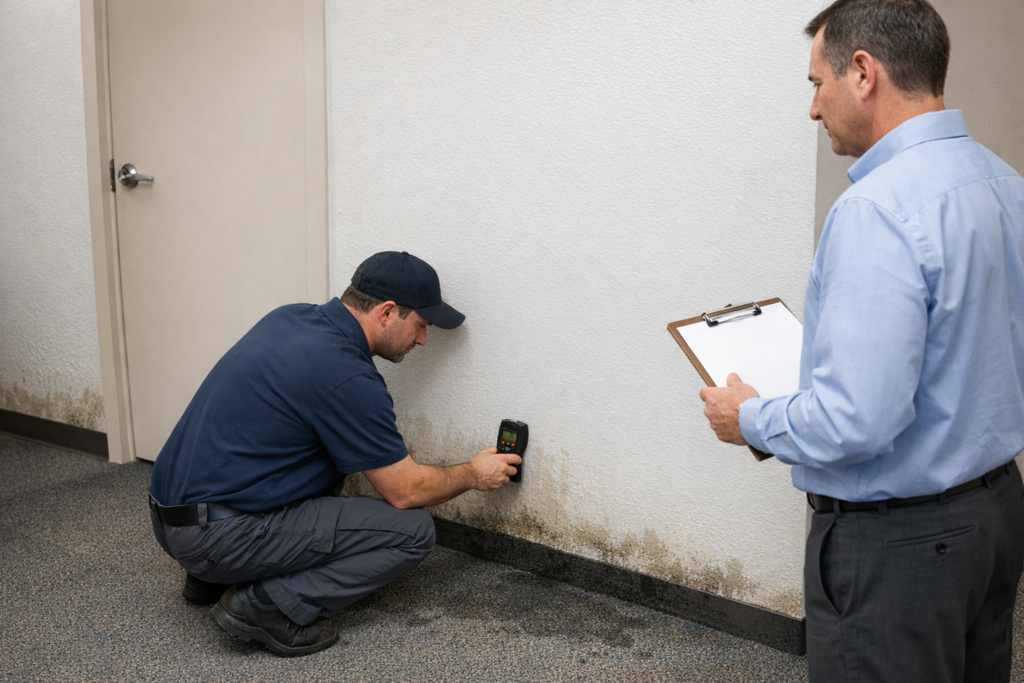
Commercial water loss access coordination in Las Vegas 89102 means arranging authorized, safe entry to every relevant space—not simply unlocking the room where water first appeared. Assign a primary contact and backup, explain known hazards, identify adjoining spaces that need assessment, and agree on who can approve work. Record any areas technicians cannot inspect so an incomplete assessment is not mistaken for a complete one.
This guide focuses on a plumbing supply leak affecting commercial wall bases and carpeted flooring, with possible spread into a neighboring suite or locked storage room. It is a planning example, not a report of a customer project. The same commercial water loss access coordination principles can help an owner managing a small commercial property or a homeowner handling a separate rental space.
The 89102 ZIP identifies a postal area; it does not establish building jurisdiction, lease responsibilities or a particular construction type. For broader service information, see Presto Water Damage’s commercial water damage restoration services and Las Vegas restoration service information.
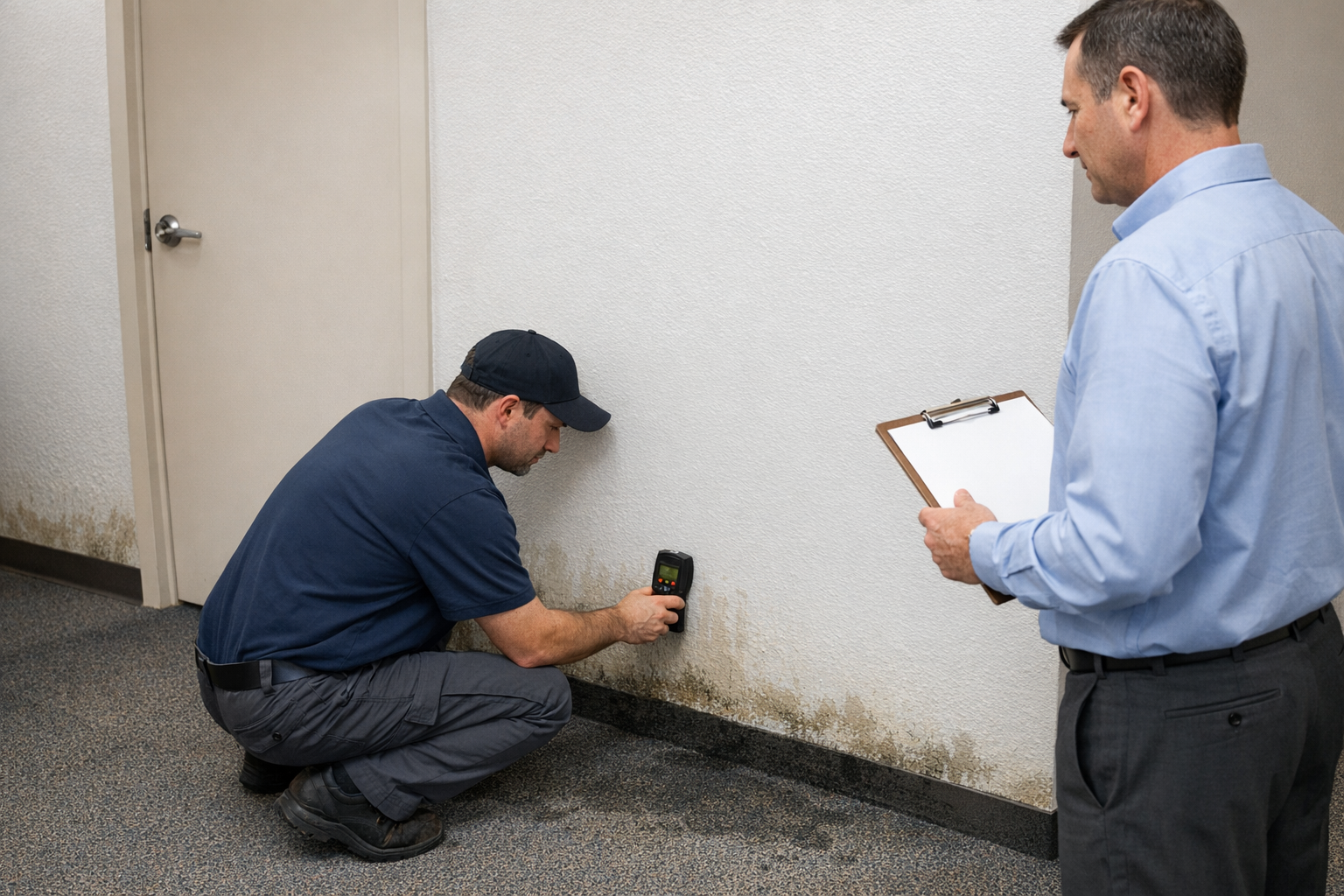
1. Establish safe observation boundaries before arranging entry
A key does not make a wet room safe to enter. Do not walk into standing water, approach wet electrical equipment, test outlets or reach behind furnishings near an uncertain electrical condition. Keep people away from sagging ceilings, unstable finishes and damaged flooring. If there is an immediate threat, leave the affected area and contact the appropriate emergency authority.
From a dry, established safe position, note where water is visible, whether it appears to be spreading and which doors or corridors it has reached. Describe observations rather than conclusions: “carpet is darker along the shared wall” is more useful than “the neighboring suite is flooded.” Photographs can show the observation without requiring closer investigation.
- Record the discovery time separately from the last time the area was known to be dry.
- Identify the reported source and whether a qualified person has confirmed it.
- Note affected doorways, wall bases, flooring transitions and nearby stored contents.
- Report unusual odors or suspected contamination without touching materials.
- Explain which routes are inaccessible or have not been evaluated.
Water from a supply line should not automatically be treated as suitable for ordinary cleanup regardless of its history. Tell the assessor what it contacted and how long exposure may have lasted. Do not disturb suspected mold or contamination, and do not aim fans at sewage or suspected mold. Uncertainty should shape access restrictions until professional assessment clarifies the conditions.
2. Build a commercial water loss access coordination plan for Las Vegas 89102
For commercial water loss access coordination, use a short contact-and-access sheet rather than relying on a group message alone. List the person who can authorize entry, the person meeting technicians, the backup contact and the decision-maker for changes in scope. These may be different people. A receptionist able to unlock a door may not be authorized to approve removal of wet finishes.
Provide the exact property location privately when arranging service, including the suite identifier and a practical meeting point. Explain any check-in, escort, loading or elevator arrangements that actually apply. Do not assume that an open business entrance gives permission to enter leased offices, storage areas or neighboring premises.
Commercial water loss access coordination separates entry permission from work approval. A manager might authorize non-destructive assessment while an owner must approve selective removal. Confirm the authorization process before work begins, including how urgent findings will be communicated if the main decision-maker is unavailable. Applicable lease terms and notice obligations need review by the responsible parties; restoration staff should not be expected to resolve a legal access dispute.
Share alarm instructions or temporary access details through a controlled channel, not in publicly circulated photographs or broad tenant emails. Establish who secures the property after each visit. For an overnight discovery, the commercial after-hours water damage checklist addresses the initial report and shift handoff; this access plan should continue through later inspections and drying visits.
3. Decide which rooms need assessment and what can wait
The visible wet room is a starting point, not a reliable boundary. A supply leak can wet carpet backing, wall bases and adjoining assemblies while the next room appears unchanged. Ask the assessor which neighboring spaces could help establish the extent of the loss. That question is more productive than opening every room without a reason.
Use this commercial water loss access coordination decision guide when arranging the first visit:
- Active water or uncertain hazards: restrict access and arrange appropriate source and safety help. Do not send staff through water to retrieve keys or inspect equipment.
- Source reportedly stopped, damage visible: arrange prompt professional assessment and explain whether source correction has actually been confirmed.
- Shared wall beside a locked suite: contact the authorized representative and ask the assessor whether that side needs inspection. Record any access delay.
- Water reached a flooring transition or storage partition: identify the adjacent room and stored items for assessment rather than assuming the boundary stopped the water.
- No safe or authorized entry: document the limitation and arrange follow-up; do not label the inaccessible area unaffected.
A partially accessible building needs a clearly qualified report. Ask which findings are confirmed, which are suspected and which remain unknown. If extraction is appropriate, discuss professional water extraction without assuming it completes the entire assessment. Removing accessible water does not establish that wall cavities or flooring layers are dry.
Coordinate with neighboring occupants using neutral language. Explain that inspection is intended to determine extent, not to assign responsibility. If permission is delayed, ask what work can proceed safely in the authorized area and what decisions depend on the missing inspection.
4. Ask how the assessment will reach concealed materials
For commercial water loss access coordination, provide a simple room sketch or existing floor plan if available. Mark the reported source, observed water path, locked rooms and affected wall lines. Avoid drawing a definitive damage boundary yourself. Technicians should be able to revise that boundary based on material observations and moisture measurements.
Ask how the assessor will distinguish surface appearance from moisture in the assembly. Carpet may feel different from its backing or padding; a wall finish may look intact while adjoining layers need investigation. Access around desks, cabinets and stored cartons may matter, but staff should not move heavy furniture or handle wet electrical devices to help an inspection.
- Which materials and locations will be measured, and how will those locations be identified?
- Will both sides of a shared wall need access?
- What comparable unaffected materials can support interpretation of readings?
- Which findings would justify additional investigation or selective removal?
- What cannot be concluded while a room or assembly remains inaccessible?
- How will new discoveries change the proposed scope and permissions?
The guide to interpreting moisture meter observations explains why readings need material and location context. A number without that context is not a complete finding. Likewise, an infrared image, if used, is not by itself proof of the exact moisture extent or cause.
Do not open ceilings, pry off trim or lift flooring to create access yourself. Ask the professional to explain the need, precautions and authorization for any investigative opening. An initial inspection may reasonably leave questions unanswered, provided those questions and the next steps are explicit.
5. Connect material decisions with the access they require
Retention decisions should consider water contact history, material condition, assembly construction and whether drying can be verified. Keeping everything in place may reduce immediate disruption but can leave important layers inaccessible. Removing everything without supporting findings can also expand the work unnecessarily. Ask for the reason behind each proposed material decision.
For carpeted commercial spaces, identify carpet, backing, any padding, adhesive and substrate separately where applicable. A surface that appears recovered does not settle the condition of underlying layers. Discuss whether furniture relocation or selective lifting is necessary, who is authorized to perform it and where contents can be placed without affecting unaffected areas.
Drywall and wall-base decisions require similar specificity. Swelling, softening, separation, contamination concerns or inaccessible wet insulation may affect the plan. The discussion should name the components being retained or removed and explain how the adjoining cavity will be assessed. The article on when wet drywall may be retained provides useful background without replacing an on-site evaluation.
For flooring, ask which layers can actually be checked and dried. The guide to moisture beneath flooring assemblies explains why a dry-looking surface can be misleading. Do not approve cosmetic replacement as a substitute for investigating concealed moisture.
Inventory contents before authorized relocation or disposal when conditions allow. Distinguish tenant-owned furnishings from building finishes, and identify records or equipment requiring special handling. Agree on who will approve disposal and retain the supporting record. Access permission alone should never be treated as blanket permission to discard property.
6. Preserve repeat access for drying and verification
The first appointment is only one part of commercial water loss access coordination. Structural drying and dehumidification may require equipment operation, progress measurements and adjustments. Before equipment is placed, discuss access windows, authorized escorts, door security, occupant movement and who receives reports if equipment stops or conditions change.
Ask the restoration team to identify equipment zones and a safe circulation arrangement. Do not relocate equipment, reroute cords, unplug units or change controls to accommodate a meeting or delivery. Report the conflict so the team can revise the setup appropriately. Qualified personnel should address electrical supply suitability; managers should not test wet circuits.
A neighboring suite that permits entry only once can create a verification gap. Arrange follow-up access to the same relevant measurement locations where feasible. If access is withdrawn, ask the team to explain what remains unverified and what alternative assessment, if any, is practical. A calendar deadline cannot replace evidence about material condition.
Keep four stages distinct: source repair stops or corrects the leak; mitigation limits damage and addresses affected water and materials; drying verification evaluates retained assemblies against the project’s documented criteria; rebuild restores finishes after the necessary conditions are established. None automatically proves the others are complete.
Before closing walls or reinstalling finishes, ask for the findings supporting that handoff. The guide to drying verification before drywall repairs offers questions for reviewing this transition. Reopening a work zone later is easier to avoid when inspection access remains available until unresolved issues are addressed.
7. Keep a decision record and improve the next response
Commercial water loss access coordination needs one dated record connecting access, assessment and approvals. Include visit dates, areas entered, areas excluded, the reason for each limitation and the person responsible for arranging follow-up. Pair photographs with room identifiers rather than leaving a folder of disconnected close-ups. Record discovery time and source-repair information without guessing when the leak began.
For each material decision, retain the proposed scope, supporting findings and authorization. Keep source-repair reports separate from drying records so a plumbing invoice is not mistaken for evidence of dry building materials. Record scope changes when additional wet layers or rooms are discovered, including whether new entry permissions are needed.
Documentation can support communication with owners, tenants and insurers, but it does not determine responsibility or guarantee coverage. Ask the relevant insurer what records it requests. Avoid delaying necessary safe response merely to assemble a perfect file. Never ask staff to enter a restricted area solely for photographs.
Review commercial water loss access coordination after the loss to understand why access was difficult. Update stale contact numbers, identify a backup decision-maker and clarify how neighboring occupants can be reached. Keep any building plans or shutoff information current through appropriate building personnel. Only trained, authorized people should operate systems they understand and can safely reach.
Prevention also means correcting the confirmed source and following appropriate maintenance recommendations. Add routine reporting for new wall-base staining, carpet changes and recurring dampness. A repaired pipe does not erase concealed damage, and a completed restoration does not replace future leak reporting. Preserve the final records somewhere the next responsible manager can locate them.
8. Frequently asked questions about commercial restoration access
Can an assessment begin before every neighboring suite is available?
Often, an authorized accessible area can be assessed first. However, the assessor should identify limitations and explain which conclusions depend on neighboring access. An initial report should not describe an uninspected suite as dry or unaffected. Continue commercial water loss access coordination by arranging follow-up entry and asking whether the access gap changes the immediate work plan.
Who should meet the restoration team if the manager is off site?
Choose an authorized representative familiar with the entry arrangements and reported conditions. Give that person a clear boundary between unlocking rooms and approving work. Provide a reachable decision-maker and backup so the representative does not feel pressured to authorize removals outside their authority.
Should employees move desks and cartons before technicians arrive?
Only consider ordinary items in confirmed safe, unaffected locations if doing so does not expose anyone to water, unstable materials or electrical concerns. Do not move wet equipment, heavy furnishings or suspected contaminated contents. Tell the restoration team what blocks inspection and agree on an appropriate handling plan.
Can business continue in rooms beside the drying area?
That requires a site-specific review of work boundaries, access routes, equipment placement and affected systems. Do not assume an apparently dry room is suitable merely because it is next door. Discuss operational needs with the restoration team and responsible building personnel, and revisit the arrangement if conditions or scope change.
When can we stop arranging technician access?
For commercial water loss access coordination, ask which assessment, monitoring and verification tasks remain, rather than using equipment removal alone as the milestone. Resolve or explicitly document inaccessible areas and confirm the handoff to any repairs. Keep a contact available for questions about new observations, final records and unfinished work.
For additional background on moisture control and concealed mold, see the EPA guide to mold and moisture. General guidance does not replace assessment of the affected materials at your property.
If a commercial plumbing leak has affected your Las Vegas 89102 property, contact Presto Water Damage to discuss safe observations, authorized entry and assessment needs. Have the affected room list, source status and access contact ready. Call 725-529-5195.