
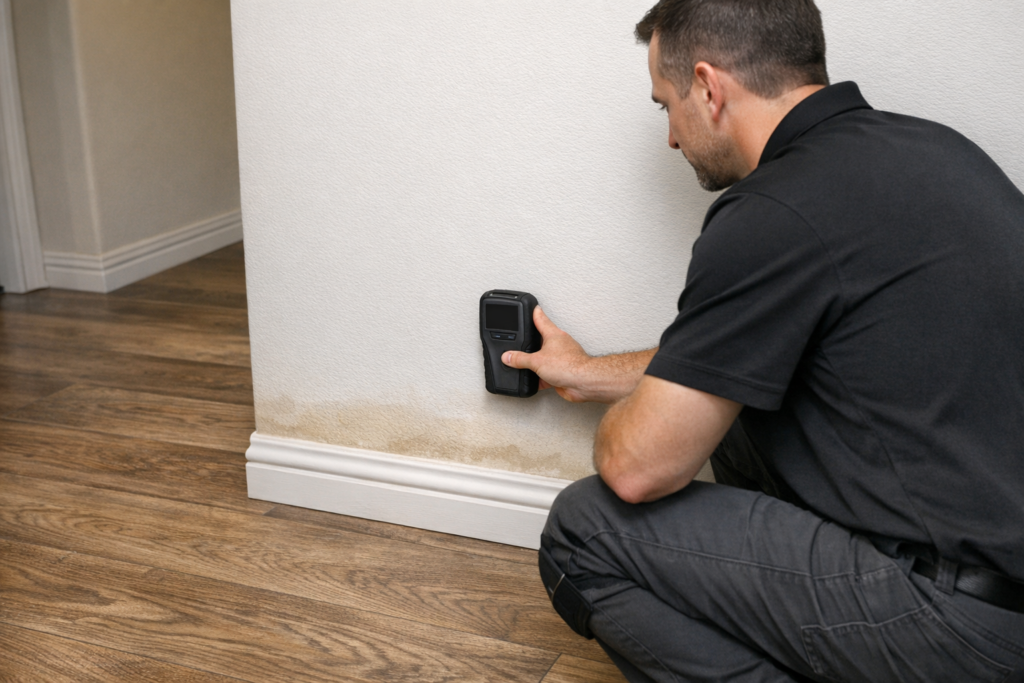
Moisture readings and material comparison are useful when each measurement is matched to the material, meter mode, inspection location and a suitable reference. A number from drywall should not be ranked against a number from wood trim or concrete as though all three use the same scale. After a Las Vegas water loss, ask what was measured, what it was compared with and what the comparison establishes.
This guide focuses on interpreting differences between materials, rather than operating a meter yourself. A stopped plumbing supply leak can leave drywall, baseboards and adjoining flooring with different moisture conditions and different repair needs. The important question is not simply which number is highest. It is whether each affected component has been assessed using a defensible comparison and whether concealed layers remain uncertain.
1. Why moisture readings and material comparison need context
Moisture instruments do not all report the same thing. Some measurements can represent moisture content in a material for which the instrument is designed and appropriately set. Others use a relative scale that helps locate differences. A relative reading is not automatically a moisture percentage, even if the display resembles a familiar percentage range.
Material density, thickness, coatings and what lies behind a surface can affect interpretation. Metal fasteners or other conductive components may influence some readings. The professional should explain whether an unexpected result appears consistent with wet material or requires another method of investigation.
For example, after a plumbing supply leak reaches a wall base, the drywall and painted baseboard may show different readings. That difference alone does not establish that one is drier or more damaged. Each component needs a comparison appropriate to its composition. An engineered wood baseboard also should not automatically be compared with solid wood trim elsewhere.
Ask whether the result is a screening observation, a material-specific measurement or part of a drying trend. These serve related but different purposes. Our guide to what moisture meters can and cannot establish provides background on the instruments. Here, the goal is to understand whether the materials being compared are actually comparable.
2. Make safe observations before discussing the numbers
You can provide useful context without touching damaged materials or taking readings. From a dry, stable location, identify the room, wall and visible changes. Describe paint blistering, separated trim joints, swollen edges or flooring changes as observations rather than conclusions about hidden moisture.
Do not enter standing water, approach wet electrical equipment, press on weakened surfaces or pull trim away to investigate. Stay clear of sagging ceilings. Do not open walls or ceilings, lift flooring or move heavy appliances to find a measurement location. Where sewage or suspected mold is involved, avoid disturbing the area and do not use household fans on it.
- Record location: Note the wall near the hallway doorway or another fixed feature, not just the wet wall.
- Separate materials: Describe the drywall, trim and floor individually.
- Record timing: Distinguish when you discovered the water from when the leak may have started.
- Explain changes: Note whether a stain, gap or swollen edge appears different in later photographs.
- State access limits: Identify areas you could not safely see.
Photographs taken from the same safe viewpoint help connect later findings with the original condition. A dry-looking surface does not confirm a dry wall cavity, while an old stain does not prove active wetting. Presto Water Damage’s Las Vegas restoration information outlines local service options when observations warrant professional assessment.
3. Ask how a suitable dry reference was selected
A dry reference is a measurement from material considered unaffected that helps establish a comparison. Its usefulness depends on similarity and location. Drywall should generally be evaluated against comparable drywall, not a cabinet panel. Similar finishes, thicknesses and assembly conditions make the comparison more meaningful.
Nearby does not always mean unaffected. Water may travel beyond a visible stain or into an adjoining room. Ask how the assessor determined that a proposed reference location was outside the affected area. A reference chosen only because it looks clean can introduce uncertainty into the entire comparison.
Also ask whether the reference and affected readings were taken with a consistent instrument and appropriate settings. If access requires a different method, the report should explain that change rather than presenting all numbers as interchangeable. Where a close match is unavailable, the limitation should be stated plainly.
A useful explanation might identify comparable painted drywall away from the water path, explain why it appears unaffected and describe how affected locations differ. It should not imply that one reference point establishes the condition of every wall in the property.
Questions worth asking include: Which reference belongs to this material? Is the assembly similar? Could the reference have been affected? What other evidence supports the comparison? Moisture mapping after a leak shows how location records help organize these relationships, rather than leaving measurements as an unexplained list.
4. Compare components separately before deciding what stays
A wall and floor junction is an assembly, not one material. Water can contact painted drywall, composite trim, a floor covering and the substrate below. Even when these components share the same leak history, their moisture behavior and physical condition can differ.
Drywall: Ask whether measurements concern the exposed face or whether concealed materials still need assessment. Softening, loss of integrity, contamination concerns and access can affect retention decisions independently of a declining reading. See the discussion of whether wet drywall can be saved for material-specific considerations.
Baseboards and trim: Identify solid wood, fiberboard or another product where records or accessible edges allow a professional to do so. A swollen composite edge may remain permanently distorted after moisture decreases. Drying progress and restoration of original shape are separate questions.
Flooring: A reading on the finish surface may not describe underlayment, adhesive or substrate conditions. Tile, resilient flooring and wood products require different interpretation. Ask which layer the measurement represents and whether other layers remain unverified. Our guide to water damage beneath flooring explains why the visible surface may not define the full extent.
Cabinet components: Cabinet doors, side panels, backs and bases may use different materials. A sound-looking door is not a reference for a wet particleboard cabinet base. Material identification matters more than treating the cabinet as one item.
Concrete: A surface screening result is not automatically a flooring installation clearance. If replacement flooring is planned, ask what substrate testing the product and installation system require. Keep restoration moisture observations distinct from any additional installation-specific evaluation.
5. Connect assessment questions with each restoration stage
Source repair, mitigation, drying verification and rebuild answer different questions. A plumber’s repair can stop a supply leak without establishing that surrounding materials are dry. Extraction can remove accessible water without resolving moisture held in an assembly. Equipment running in a room does not itself prove completion.
During mitigation, ask which materials are affected, which can reasonably be retained and what access is needed. When accessible water requires removal, professional water extraction is a distinct task from later monitoring. Contamination history and material integrity remain part of the assessment, even where readings are falling.
During structural drying and dehumidification, ask how each retained material is being tracked against its own appropriate goal. Different components may progress differently. One wall section improving does not establish that a concealed floor edge has reached an acceptable condition.
- Which materials and layers were assessed, and which remain inaccessible?
- What measurement supports keeping this component?
- What condition would lead you to revise the drying or removal plan?
- How will repeated readings be taken at comparable locations?
- What evidence is needed before equipment removal and finish work?
If progress stalls, the explanation should consider the source, hidden moisture, access and assembly conditions rather than merely extending an assumed schedule. There is no universal drying duration for every material. Before patching, painting or reinstalling trim, ask for a clear handoff identifying what has been verified and what remains outside the inspected scope.
6. Request records that make comparisons understandable
A useful moisture record lets another person understand where a measurement came from and why it matters. A photograph of a meter display without the material or location may be difficult to interpret later. Ask for a room map or location descriptions tied to the readings.
For each monitored component, the record should explain the material, location, date, measurement method or mode, reference information and applicable drying goal. Where relevant, it should distinguish surface observations from findings about deeper layers. Room temperature and humidity provide supporting drying context, but they do not replace material measurements.
Repeated observations are most useful when the comparison remains consistent. If the technician changes the instrument, method, location or access, ask that the change be noted. A lower number from a different point may not demonstrate improvement at the original point.
Request written explanations for material decisions as well. Retaining trim, removing a damaged panel or delaying flooring should connect to findings, not just an isolated number. Unknown water duration, unavailable product information and inaccessible cavities should remain visible in the record rather than being treated as resolved.
The guide to water damage documentation, readings and scope can help organize a shared file. Keep source-repair findings, mitigation records, drying summaries and rebuild proposals together but clearly labeled. These records support communication; they do not guarantee insurance coverage or acceptance of a claim.
7. Use the findings for repairs and future leak monitoring
A material may be sufficiently dry for the next planned step yet still need replacement because it is swollen, delaminated or otherwise damaged. Conversely, an intact-looking surface may need more evaluation because the assembly behind it has not been checked. Moisture condition and physical serviceability should be discussed separately.
Before authorizing water damage repair and reconstruction, ask which components are cleared for repair, which are being replaced and whether any verification remains pending. New coatings or finishes should not be used to hide unresolved moisture questions. The repair scope should explain transitions between retained and replacement materials.
Keep the final material map and completion records for future reference. If another stain or swollen edge appears, those records can help distinguish a newly observed change from a previously documented condition. They are a baseline for discussion, not a guarantee against another leak.
Prevention begins with the identified source. Follow the repairing contractor’s maintenance recommendations, keep accessible plumbing areas visible and report recurring drips or water marks promptly. Ask whether a leak alarm is practical near the repaired supply connection. Avoid storing items in ways that block future inspection of the affected wall base.
During restoration, follow the agreed access and equipment instructions rather than changing the setup yourself. Afterward, report renewed staining, swelling or unexplained water promptly. Las Vegas outdoor conditions do not establish the condition inside a covered wall or floor assembly; documented material assessment remains the useful guide.
Frequently Asked Questions
Can the same moisture number mean different things in drywall and wood?
Yes. The number may come from different settings or scales, and the materials respond differently to measurement. A relative drywall reading is not interchangeable with a wood moisture-content reading. Ask the assessor to identify the material, scale and reference before interpreting the result. Matching numbers do not establish matching moisture conditions or identical repair needs.
What if there is no matching unaffected material for comparison?
The assessor should explain the limitation and describe what other evidence supports the evaluation. That may include appropriate material-specific methods, additional inspection and documented trends. A different material should not silently substitute for a close reference. Ask how confidence in the conclusion is affected and whether additional access or testing is needed before repairs.
Does a lower reading mean a swollen baseboard can stay?
Not necessarily. A lower comparable reading may support drying progress, but it does not reverse permanent swelling, splitting or delamination. Retention also depends on water contact history, condition and the adjacent assembly. Ask for separate explanations of moisture status and physical damage so that a drying decision is not mistaken for a finish-repair decision.
Can a dry surface reading rule out moisture beneath flooring?
No. Its meaning depends on the instrument, material and measurement depth. A dry-looking or low-reading finish does not automatically establish the condition of underlayment or substrate. Ask which layers were evaluated and which remain uncertain. Do not lift flooring yourself to investigate; professional assessment should determine whether additional access is appropriate.
Which moisture records should I request before repairs begin?
Request the affected-material locations, suitable reference information, initial and final observations, measurement methods and an explanation of the drying goals used. Also request notes about inaccessible layers, changed methods and retained versus removed components. The final summary should identify what supports the repair handoff without implying that uninspected areas have been verified.
If you need help understanding moisture findings after a Las Vegas leak, contact Presto Water Damage. Share the known source, affected materials, safe observations and any existing reports so the assessment can address the right questions. Call 725-529-5195 to discuss moisture mapping, drying and the next restoration steps.