
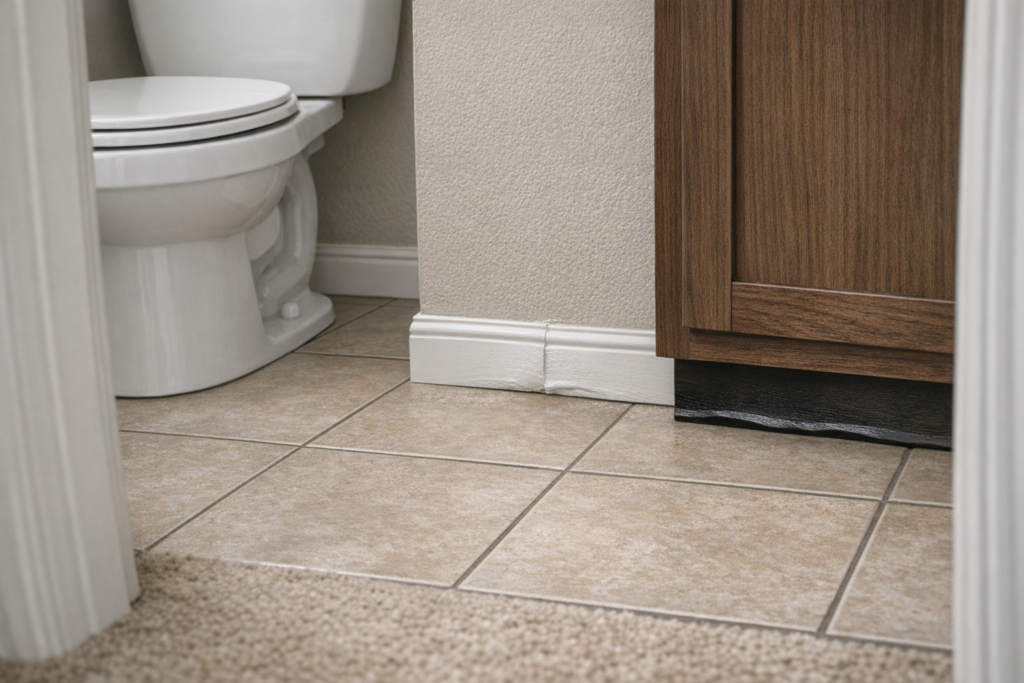
Toilet overflow affected materials need assessment based on water contact history, material construction, concealed moisture, and whether cleaning and drying can be completed and verified. Tile that looks unchanged, a swollen vanity panel, and carpet outside the doorway may require different decisions. Neither clear-looking water nor a dry-looking surface establishes that an assembly is suitable to keep.
For Las Vegas homeowners and property managers, the useful first step is not deciding what to tear out. It is limiting access, arranging source correction, and recording observations from a safe, dry location. This guide focuses on the material-by-material questions to ask before authorizing removal or repairs, rather than repeating the full cleanup process. Presto Water Damage provides toilet overflow cleanup, moisture assessment, drying, and restoration support.
1. Start the toilet overflow affected materials assessment with the water history
The phrase toilet overflow can describe different events. Water escaping from a supply connection is not the same event as water spilling over the bowl or backing up through the drain. Tell the restoration team where water first appeared, whether the toilet was being used, and whether other fixtures backed up. Do not try to establish contamination conditions by touching or smelling the water.
Separate what you know from what you assume. If you discovered the overflow after being away, record the discovery time and the last time the room was known to be unaffected. Do not describe discovery time as the start time unless someone actually witnessed the event.
Water that passed through a toilet bowl deserves careful contamination assessment even when it looks clear. Waste, contact with surfaces, elapsed time, and the source mechanism can influence the work plan. A professional should explain the basis for that assessment and how it affects porous materials. When sewage is involved, sewage and contaminated-water cleanup requires more than ordinary drying.
- Did water come from the bowl, tank, supply connection, or an uncertain location?
- Was this a single spill, repeated overflow, or backup affecting multiple fixtures?
- Which rooms and materials were visibly contacted?
- Has anyone already mopped, moved belongings, applied products, or operated equipment?
These details help establish the assessment scope. They do not replace inspection or justify treating all materials alike.
2. Make observations without entering or disturbing the affected area
Keep people and pets out of the affected bathroom and any connected wet area. Do not enter standing water, handle wet electrical equipment, or test outlets. If electrical involvement is possible, keep clear and arrange appropriate professional help. Do not cross the wet area to reach a shutoff. If the toilet shutoff is accessible from a safe, dry location, it may stop incoming supply water, but it will not necessarily stop a drain backup.
Do not flush again to see whether the blockage cleared. A plumber should investigate the source and explain any restrictions on using nearby fixtures. Stopping the visible spill does not establish that the plumbing problem has been corrected.
From a dry doorway or another safe position, photograph the room and note visible changes. Useful observations include water reaching a threshold, darkened trim joints, a distorted vanity edge, or moisture appearing in an adjoining room. Describe the location precisely: the hallway side of the bathroom doorway is more useful than somewhere near the bathroom.
Do not lift flooring, pull off baseboards, open ceilings, press on softened drywall, or move potentially contaminated rugs through clean rooms. Avoid directing fans across suspected sewage or mold. Those actions can disturb affected material or spread contamination beyond the original area.
If the bathroom is upstairs, report stains or dripping below without standing beneath a sagging ceiling. If conditions worsen, restrict access and notify the responding professionals rather than investigating the cavity yourself. Missing photographs are preferable to unsafe access.
3. Assess flooring as a layered assembly, not just a surface
A floor includes more than its visible finish. An assessment may need to address seams, adhesive, underlayment, subfloor, perimeter gaps, and transitions into other rooms. Ask which layers were checked and which remain inaccessible. The visible puddle is not automatically the full damage boundary.
Tile and grout: An intact tile face may be cleanable, but that does not establish the condition of the setting materials or substrate. Water may reach vulnerable areas through joints, cracks, penetrations, or perimeter openings. Ask whether findings support retaining the assembly and how moisture beneath it will be evaluated.
Vinyl plank and sheet flooring: A water-resistant surface does not mean the assembly below stayed dry. Seams and edges can allow water underneath, and some installations restrict access for cleaning or drying. Product information, contact history, and installation method matter more than a general waterproof label.
Laminate and wood: Raised seams, edge swelling, cupping, or finish changes should be documented without walking across a questionable floor to test it. Drying may not reverse permanent distortion. Retention also depends on contamination conditions, access, and the condition of underlying layers.
Carpet and padding: Water reaching a carpeted hallway creates separate questions about the carpet, pad, tack strip, and substrate. Porous materials exposed to sewage generally require removal rather than ordinary drying. A technician should identify the contact boundary and explain disposal and remaining-floor treatment.
The supporting guide to water damage beneath flooring explains why assessment must extend beyond the top surface. Ask for findings by layer before approving either wholesale replacement or drying in place.
4. Separate wall, trim, vanity, and contents decisions
Water at a wall base can affect trim, drywall paper and core, insulation, and concealed framing differently. A clean-looking baseboard face cannot establish what happened behind it. Likewise, trim swelling may show material damage without revealing the full moisture boundary.
Ask whether the baseboard is solid wood, composite material, or another product. Composite trim can swell and lose its original shape. Solid wood may present different options, but contamination, joints, finish condition, and access still matter. Do not assume that every baseboard must stay or that every wall needs the same removal height.
Drywall retention depends on more than whether it remains firm. Direct contact with contaminated water, damaged paper, concealed exposure, and the ability to complete cleaning influence removal decisions. The general guide to whether wet drywall can be saved provides background, but a toilet overflow requires its own exposure assessment.
A vanity should be evaluated by component. A finished door, particleboard side panel, plywood cabinet box, toe kick, and concealed base may not share the same condition. Swollen edges or separating layers can indicate irreversible damage, while apparently unaffected exterior faces may hide wet areas beneath the cabinet. Ask how the team will assess the underside and adjoining wall without assuming the entire vanity is either salvageable or ruined.
For more detail, review how water damage affects cabinets and vanities. Record product information if available, but leave access work to the restoration team.
Keep contents separate from building materials in the assessment. Bathmats, stored paper goods, fabric bins, toiletries, and hard-surface containers have different construction and cleaning limitations. Photograph items in place when safely visible. Do not transfer them into unaffected rooms or discard them without coordinating documentation and safe handling.
5. Ask for findings that support removal, cleaning, and drying
A useful assessment connects each recommendation to a location, material, and reason. A broad statement such as the bathroom is wet does not explain why a flooring section can stay, why a cabinet base needs removal, or whether the adjoining hallway was checked.
Ask the assessor to distinguish observed damage from suspected concealed involvement. Moisture mapping can organize inspection locations and readings, but inaccessible layers should remain identified as limitations until evaluated. Moisture meters help assess moisture; they do not establish that a material is sanitary. The guide to what moisture meters can and cannot establish explains why readings need material and location context.
- Water path: Which findings connect the toilet to each affected area?
- Contact history: Which materials had direct contact, and where is contact uncertain?
- Condition: Is the concern contamination, moisture, physical deterioration, or several of these?
- Access: Can concealed surfaces be assessed, cleaned, and dried adequately?
- Retention: What evidence supports keeping this specific component?
- Verification: What records will support completion before it is enclosed or covered?
Removal can be necessary because a material is unsuitable to clean, permanently damaged, or blocking access to another affected layer. Ask which reason applies. Conversely, a material should not be retained merely because it could eventually become dry. Cleaning suitability and physical condition are separate questions.
Request a clear explanation when the proposed scope changes after access reveals additional damage. A revised boundary should follow findings, not a predetermined assumption about how much of every bathroom must be replaced.
6. Keep source repair, mitigation, drying verification, and rebuild separate
Source repair addresses the plumbing cause. That may involve a blockage, fixture problem, or another condition a plumber investigates. Obtain the source findings and ask whether normal fixture use can resume. Restoration work does not by itself confirm that the drain or toilet is functioning correctly.
Mitigation addresses the affected area through appropriate water removal, controlled material removal, cleaning, and measures to limit further damage or spread. The sequence depends on the contamination assessment. It is not simply a matter of placing drying equipment beside a wet toilet.
Structural drying addresses moisture remaining in materials suitable to retain after appropriate preparation. Structural drying and dehumidification should be planned around the assembly and monitored with material-specific observations. Las Vegas weather is not proof that concealed bathroom materials will dry adequately on their own.
Drying verification should explain which retained materials were evaluated, how progress was compared, and what supports ending drying. Running equipment, a dry surface, or an absence of odor cannot establish completion alone. Ask whether inaccessible areas remain unresolved and whether cleaning-related requirements have also been addressed.
Rebuild restores removed or damaged finishes after the affected area is ready. New baseboards, patched drywall, or replacement flooring should not hide unresolved moisture or contamination concerns. The repair boundary may differ from the original wet boundary because matching finishes and installing replacement materials are separate construction questions.
There is no universal drying duration for every toilet overflow. Material thickness, exposure, access, removal decisions, and measured progress all affect the sequence. Request updates tied to findings rather than a fixed promise.
7. Build a material record and reduce the chance of another overflow
Organize the record by room and component. For each affected material, retain a wide photograph showing location, a closer photograph if safely available, the observation date, and the professional recommendation. Add source-repair findings, moisture records, authorized changes, and completion notes as work proceeds.
A simple entry might identify bathroom doorway trim, visible edge swelling, reported bowl-water contact, and a pending assessment. That is more accurate than labeling the entire room destroyed before inspection. Mark uncertainty clearly, especially where the event began before discovery or a concealed layer has not yet been reached.
The guide to documenting water damage before cleanup can help organize photographs and reports without delaying necessary work. If an insurer is involved, ask what records it requests. Documentation supports review but does not determine policy coverage or guarantee payment.
After source correction and restoration, ask the plumber what caused the overflow and which preventive steps fit that finding. Avoid flushing wipes, paper towels, hygiene products, or other items not intended for the toilet. Address recurring slow drainage rather than testing it with repeated flushing. If several fixtures behave unusually, report the pattern instead of assuming each fixture has an isolated problem.
Keep access to the toilet shutoff unobstructed and know where it is before an incident occurs. In managed properties, establish who receives overflow reports and who can authorize access. Keep maintenance findings with the restoration record so a later incident can be assessed against an accurate history.
Frequently Asked Questions
Does every material touched by toilet overflow water need replacement?
No single replacement rule fits every component. Water contact history, porosity, physical damage, cleaning access, and concealed exposure all matter. Porous materials contacted by sewage generally require removal, while some intact nonporous surfaces may be cleanable. Ask for a component-specific explanation rather than treating the bathroom as one uniform material.
Can bathroom tile stay after a toilet overflow?
Possibly, but the tile surface is only part of the decision. The assessment should consider joints, perimeter openings, setting materials, substrate condition, contamination, and moisture beneath the finish. An unchanged tile face does not establish that the assembly can remain. Ask how underlying layers were evaluated and what limitations remain.
How can I tell whether water reached beneath the vanity?
You may see swollen toe-kick edges, separating panels, or water along the cabinet perimeter, but a lack of visible damage does not rule out concealed involvement. Record what is visible from a safe location. Do not remove panels or reach underneath. Ask the assessor how the cabinet base and adjoining floor will be checked.
Does a normal moisture reading mean a material is safe to keep?
No. A moisture reading addresses moisture at an inspection location within the limits of the instrument and method. It does not establish cleanliness, eliminate the importance of sewage contact, or show that damaged material has regained its original condition. Retention requires consideration of contamination, cleanability, physical integrity, and drying evidence together.
What should I ask before approving replacement flooring or drywall?
Ask whether the source is corrected, required removal and cleaning are complete, retained materials have documented drying verification, and concealed areas have been addressed. Request a repair scope identifying replacement layers and finish boundaries. If an area remains inaccessible or uncertain, ask how that limitation will be resolved before new finishes cover it.
If a toilet overflow has affected flooring, walls, or a vanity, Presto Water Damage can discuss assessment and restoration needs for your Las Vegas property. Share the known source, affected rooms, and safe observations, and ask what needs evaluation before material decisions are made. Call 725-529-5195.