
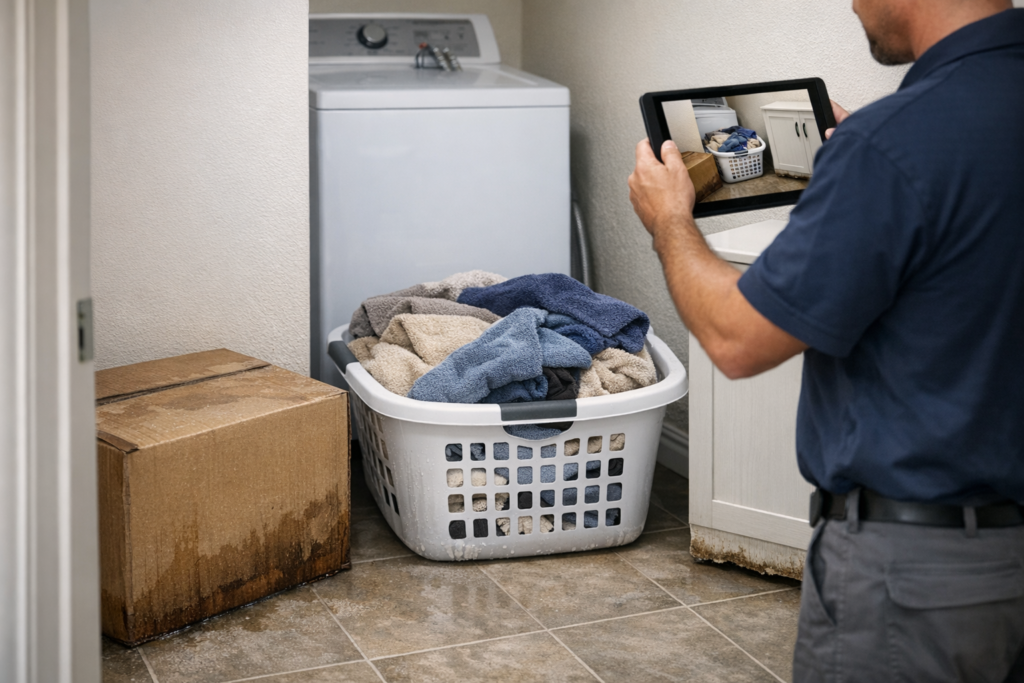
A water damage contents inventory is a room-by-room record of belongings that may have been affected by a leak, overflow, or flood. Start with safe photographs, give each item or clearly defined group an identifier, and record its original location, visible condition, known water contact, and current status. Leave salvageability, contamination assessment, and drying decisions to an appropriate professional. A good inventory supports those decisions; it does not establish them by itself.
For Las Vegas homeowners and property managers, the immediate problem is often uncertainty: a box looks dry on top, a chair has damp-looking feet, or belongings must move so technicians can reach the floor. This guide focuses on preserving an accurate contents record through that uncertainty, rather than treating every nearby possession as either ruined or unaffected.
1. Establish safe observation boundaries before making the list
Do not enter standing water to count belongings or get a better photograph. Water near electrical equipment, unstable flooring, sagging ceilings, and suspected contamination can make even a short inspection inappropriate. Keep people and pets outside restricted areas and tell the restoration team which rooms you could not safely observe. An incomplete list with clearly identified gaps is more useful than a complete list obtained through unsafe access.
Photograph from a dry, stable, authorized location when conditions permit. Do not plug in wet electronics, test outlets, open ceilings, move heavy saturated furniture, or disturb suspected mold or sewage residues. Do not use household fans on sewage-affected items or suspected mold. If the source or contact history is uncertain, record that uncertainty instead of handling items to investigate.
Urgent mitigation should not wait for a polished spreadsheet. When water removal is needed, coordinate documentation with professional water extraction. A few safe overview photos and a note about inaccessible belongings can establish a starting record while necessary work proceeds.
Before anything moves, ask who will authorize handling, identify items, and record their destinations. Presto Water Damage provides water damage restoration in Las Vegas; describe access limitations and affected belongings when discussing an assessment. Confirm the proposed contents work rather than assuming every item type or specialty treatment is included.
2. Build a water damage contents inventory that stays usable
Use one master list, whether it is a notebook, spreadsheet, or shared document. Give rooms consistent names and belongings stable identifiers. For example, an identifier can combine a room abbreviation and a sequence number. Keep that same identifier when an item is moved, assessed, cleaned, retained, or removed. Renumbering halfway through makes photographs and later decisions harder to reconcile.
Record observable details separately from conclusions. Write “lower edge swollen” rather than “cannot be restored,” and “near reported water path” rather than “contaminated” unless a qualified assessment supports that description. Include a status such as awaiting assessment, authorized for relocation, retained for treatment, or removal authorized. Each status should have a date and a responsible contact.
- Identity: Item number, plain-language description, quantity, and brand or model if safely visible.
- Location: Original room, position, and whether the item was on the floor, a shelf, or another object.
- Observed condition: Staining, swelling, finish changes, damp packaging, or other visible changes.
- Exposure history: Known direct contact, possible contact, or no contact observed.
- Supporting records: Photo filenames, available receipts, approximate purchase date, and owner.
- Next action: Assessment needed, decision pending, destination, and authorization record.
Group ordinary items only when the group remains understandable. “Six cotton bath towels from lower laundry shelf” is more useful than “miscellaneous contents.” Separate distinctive, high-value, sentimental, electronic, or differently affected items. Do not assign an exact quantity to a closed container you have not inspected; mark the contents and count as unverified.
3. Connect photographs with the water path and timeline
Begin with a room overview, then photograph the affected area and individual details if safe access allows. Show relationships: a carton beside the laundry doorway, a furniture leg at the carpet edge, or a storage bin below a stained wall. A close-up alone may show damage but not establish which item it belongs to or where it was found.
Use item identifiers in your photo index rather than relying on memory. Keep original image files and save annotated copies separately. Add dates to written notes, especially when photographs show later conditions. The broader guide to documenting water damage before cleanup explains how room views and detail images work together; the contents list should connect those images to specific belongings.
Separate discovery time from the suspected start of the leak. If you found water in the morning but do not know when it began, say so. Record when the source was reportedly stopped, when belongings were first observed, and whether someone moved them beforehand. Statements from occupants should be attributed, not silently converted into confirmed inspection findings.
After a washing machine supply or drain leak, for instance, record the reported source and whether laundry baskets, cartons, or nearby furniture were in the observed water path. Do not assume the water condition from the appliance name alone. The washing machine leak assessment guide covers adjoining areas worth reporting without pulling the machine out yourself.
Also photograph apparently unaffected belongings that must be moved for access. Their presence in a restoration work area does not prove water damage. Mark them as moved for access, with condition not fully assessed if appropriate, so they are not confused with confirmed affected items later.
4. Ask assessment questions before choosing treatment or disposal
A useful professional assessment connects the item, water history, material, and practical treatment options. Ask what is known about the source, what remains uncertain, and how that uncertainty changes handling. Clear-looking water is not proof of a sanitary exposure. Source information, contact with other materials, and conditions over time can all matter; water damage categories provide background for that conversation.
Ask the assessor to distinguish visible condition from concealed concerns. Upholstery may include fabric, foam, backing, and a wood frame. A storage cabinet may combine a durable outer finish with absorbent composite panels. An answer about the visible surface does not necessarily address the whole item. Request a reason for each proposed decision, including limitations on inspection or treatment.
- Which items have been assessed, and which remain unexamined?
- What exposure information supports the recommended handling?
- Can the relevant layers be accessed, cleaned, dried, and checked?
- What condition changes could remain after treatment?
- Does the item need a specialist, and is that work included in this proposal?
- Who authorizes treatment, relocation, or disposal, and how is that approval recorded?
Discuss carpet, floor, and contents restoration as an item-specific scope, not a promise that everything can be saved. Some belongings may warrant further assessment; others may have damage or exposure that makes retention inappropriate. A pending status is legitimate when the available information does not yet support a decision.
Sentimental value should be noted early because it can change which options an owner wants explored. It does not establish that restoration is technically feasible. Likewise, a damaged item’s appearance does not determine an insurance settlement or authorize someone else to dispose of it.
5. Record material differences instead of treating all belongings alike
Wood and composite furniture: Note lifted veneer, joint separation, swollen edges, finish changes, and the apparent height of contact. Solid wood and particleboard may respond differently, and a single piece can contain both. Do not force swollen drawers or dismantle furniture for photographs. Record inaccessible compartments so the assessor knows the visible inspection is incomplete.
Upholstered furniture and textiles: Describe which surfaces were exposed and whether cushions or fabric were already moved. A dry-feeling cover does not establish that filling or the frame is dry. Avoid sealing wet fabrics in containers for storage without professional direction; handling and temporary placement should suit the water history and the material.
Paper, photographs, and boxed storage: Record the container’s visible condition and the likely contents without opening suspect or unstable packaging. Wet cardboard can lose strength, making lifting unreliable. Important records, artwork, and photographs may need specialist advice. Flag urgency and significance, but do not assume Presto provides every specialty conservation method.
Electronics and powered equipment: Record the device description and visible exposure from a safe location. Do not turn it on to determine whether it works. A restoration assessment of the room is separate from an appropriate evaluation of a water-exposed electrical device. Include accessories only when identified, rather than assuming all components were present.
Hard-surface belongings: A nonporous exterior may permit different treatment options than an absorbent item, but seams, hollow spaces, finishes, and attachments still matter. Ask what parts were considered. Keep movable belongings separate from building components such as installed cabinets and flooring; related moisture concerns may require structural drying and dehumidification, not simply contents cleaning.
6. Track movement, approvals, and supporting documents
Once items move, the inventory becomes a location record as well as a condition record. For each transfer, note the date, person or company handling it, original location, destination, and associated container identifier. If belongings stay onsite, distinguish an unaffected holding area from an active work zone. Do not place suspect items among unaffected possessions without an agreed handling plan.
If offsite handling or storage is proposed, ask for its written scope before agreeing. Confirm who is responsible, how items will be identified, what condition records will be made, and how return questions will be handled. Do not assume transportation, storage, specialty cleaning, or replacement purchasing is automatically part of a restoration agreement.
Before disposal, request documentation of the item, reason for removal, and authorization. If urgent conditions prevent an ordinary review, ask the responsible team to explain and record what occurred. Documentation should support necessary action, not require someone to retain unsafe materials or delay mitigation solely for photographs.
Keep receipts and purchase information where available, but label estimates and uncertain dates honestly. Do not invent values to complete blank fields. For an insurance review, ask the insurer what format and evidence it needs; the water damage insurance documentation guide explains related source, moisture, and scope records. A detailed inventory does not guarantee coverage, valuation, reimbursement, or claim acceptance.
In rentals or shared properties, identify ownership separately from location. A room can contain tenant belongings, owner furnishings, and business equipment. Record disputed or unknown ownership without deciding legal responsibility. Limit access to photographs containing personal documents or sensitive business information.
7. Close the inventory only after the right checks
Source repair, mitigation, drying verification, and rebuild answer different questions. A plumber or other appropriate trade corrects the source. Mitigation addresses water and affected conditions. Drying verification evaluates retained materials using relevant assessment records. Rebuild restores approved building components after the necessary preparation. None of these steps alone confirms the condition of every personal belonging.
Before items return, ask whether their destination is ready and whether remaining work requires clear access. The handoff from drying to reconstruction can affect when furniture and stored belongings should be placed back. Do not use a completed source repair or a dry-looking floor as the only basis for that decision.
Review the list against returned or retained items. Record unresolved staining, missing components, pending specialist evaluations, and any differences from the agreed scope. Keep treatment status separate from owner acceptance. An item marked treated may still need a documented discussion about condition or an outstanding question.
Use the finished inventory to improve storage: keep vulnerable papers and cartons away from floor-level plumbing exposure where practical, leave access to supply connections, and maintain current photographs of important possessions. Ask the appropriate trade about source-related prevention. Storage changes may reduce exposure, but they do not replace leak repair or guarantee protection from another loss.
Frequently Asked Questions
Should I finish the contents inventory before cleanup begins?
No. Take safe overview photographs and begin a basic list if possible, but do not delay necessary mitigation to finish every entry. Tell the team which belongings are undocumented and ask how movement or removal will be recorded. Add later observations with their actual dates rather than presenting them as pre-cleanup findings.
How should I list belongings inside a wet closed box?
Record the box’s location, visible condition, and any known description of its contents. Mark the item count and internal condition as unverified. Do not open suspected contaminated packaging or lift weakened cardboard to investigate. Ask how professional handling can preserve identification while the contents are assessed.
Does a photograph prove that an item cannot be restored?
Usually not by itself. A photograph can document swelling, staining, or where an item was located, but it may not reveal internal materials, exposure history, or treatment limitations. Request an item-specific assessment and record the basis for the recommendation alongside the images.
Can I combine similar belongings in one inventory entry?
Yes, when the quantity, description, location, and observed condition remain clear. Keep separate entries for distinctive items or belongings with different exposure histories. If a grouped item later needs individual treatment or disposal, give it a linked identifier so the original group count can be reconciled.
What records should I keep after belongings are returned?
Keep the final inventory, original photographs, movement records, approved treatment or disposal decisions, and relevant receipts or reports. Note unresolved questions and the person responsible for follow-up. These records can support future discussions, but they do not establish insurance coverage or replace any separate specialist evaluation.
Need help assessing belongings after a Las Vegas leak? Contact Presto Water Damage to discuss the source history, safe access, affected contents, and the proposed restoration scope. Bring your initial photos and list, even if they are incomplete, and call 725-529-5195.