
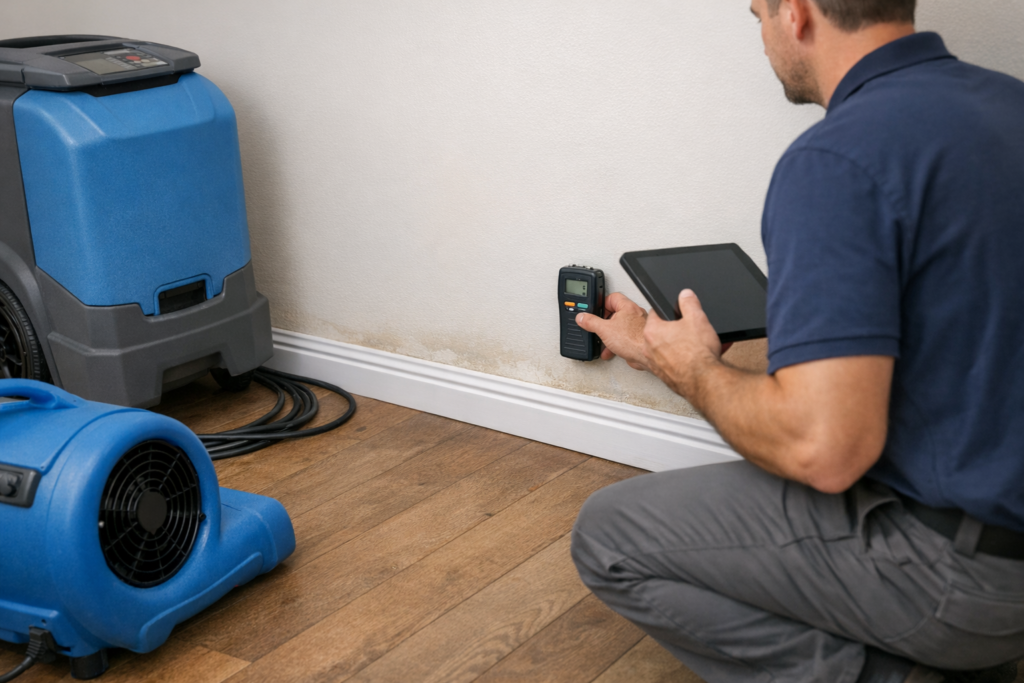
Restoration equipment monitoring records in Henderson 89011 should connect equipment operation with measured conditions in the affected building materials. Restoration equipment monitoring records identify what equipment was placed, where it operated, when conditions were checked, which materials were measured, and why the drying plan changed. Equipment being present—or sounding as though it is running—is not proof that a wall, floor edge or concealed assembly is dry.
Table of Contents
For homeowners and property managers, the practical goal is not to supervise technical settings. It is to recognize missing information, report interruptions safely and ask what evidence supports continued drying, selective removal or equipment removal. The discussion below focuses on drying after a plumbing supply leak has affected lower drywall, baseboards and adjoining flooring. It is guidance, not a description of a particular customer project.
Presto Water Damage provides water damage restoration in Henderson. The 89011 ZIP identifies the postal area for this guide; it does not establish building construction, jurisdiction or a special drying risk.
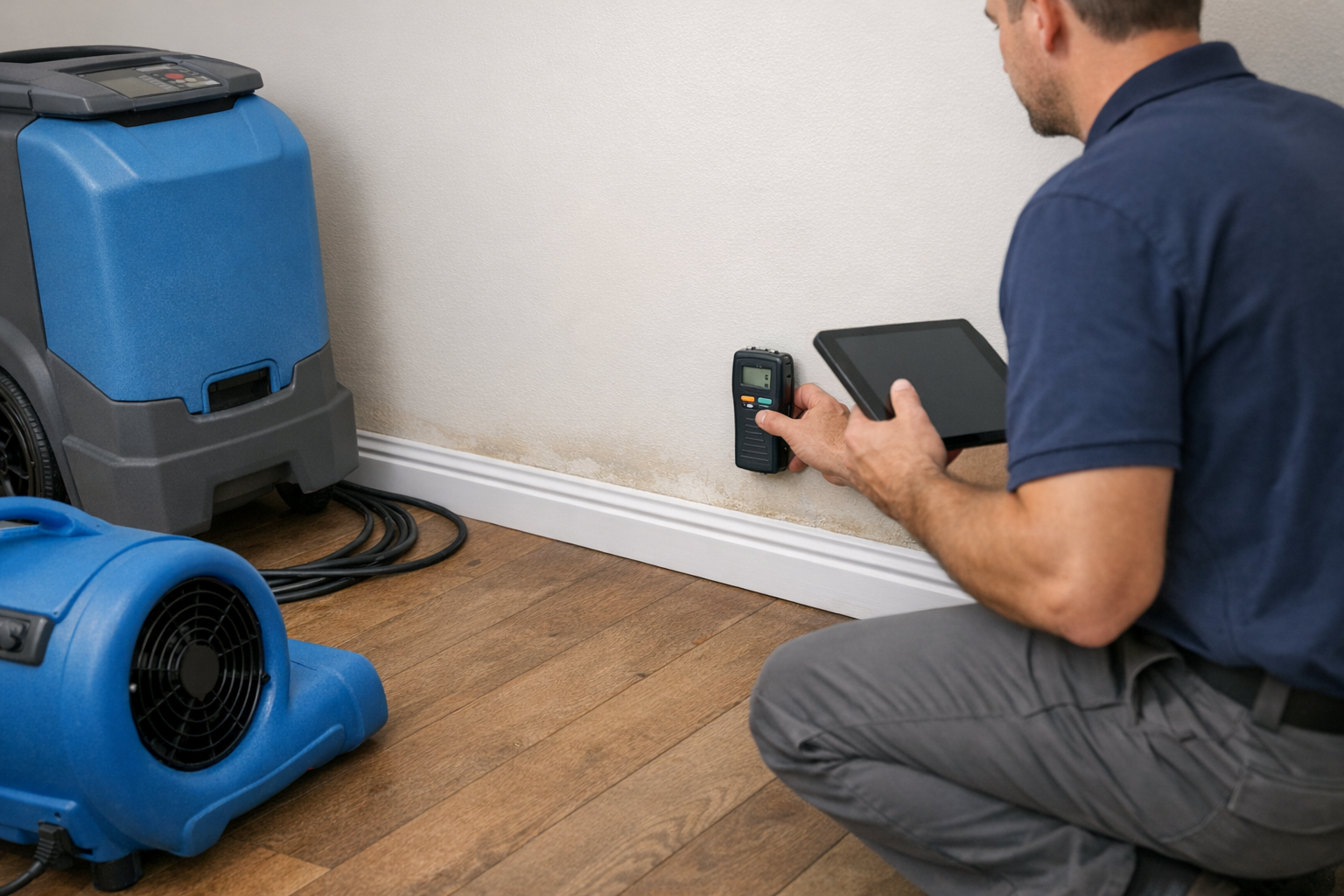
1. What restoration equipment monitoring records should explain
Restoration equipment monitoring records are most useful when someone unfamiliar with the room can follow the work. A list of air movers and dehumidifiers is only one part. The record should connect those tools to the affected materials and to the technician’s interpretation of progress.
- Equipment identification: the type, quantity and an identifier that distinguishes individual units.
- Placement and dates: the room or drying area, installation time, recorded moves and removal time.
- Operating observations: observed status during visits and any known interruption, alarm or drainage problem.
- Environmental measurements: relevant temperature and humidity conditions, with locations and times.
- Material measurements: identified drywall, trim, flooring or substrate locations and the measurement method.
- Interpretation and next step: whether the findings support continuing, adjusting or ending that part of the drying work.
Ask the provider how this information is organized and what records will be available to you. Different reporting formats can be useful; a particular software platform is not the objective. What matters is traceability between observations and decisions.
Professional structural drying and dehumidification involves evaluating retained materials, managing evaporation and checking progress. Restoration equipment monitoring records support that process but cannot replace the assessment itself.
2. Establish the source history and initial material map
Before interpreting progress, establish what happened and what was initially checked. A repaired supply connection and a dry-looking floor do not establish that water stopped at the visible edge. Water may have reached the wall base or traveled beneath a covering.
Keep source repair separate from mitigation. The appropriate plumbing professional addresses the leaking supply component. Mitigation addresses released water and affected materials. Drying verification evaluates retained assemblies. Rebuild restores removed or damaged finishes after the relevant conditions have been assessed.
Initial restoration equipment monitoring records should distinguish the discovery time from the actual leak start time, which may be unknown. Include the source repair report when available, along with the first moisture map and photographs. Do not delay necessary response while trying to create a perfect file.
Ask which lower-wall sections, floor transitions and neighboring rooms were assessed. If furniture, cabinetry or restricted access prevented an inspection, the report should identify that limitation rather than imply the area was checked. Our guide to how moisture mapping organizes leak observations explains why location labels matter.
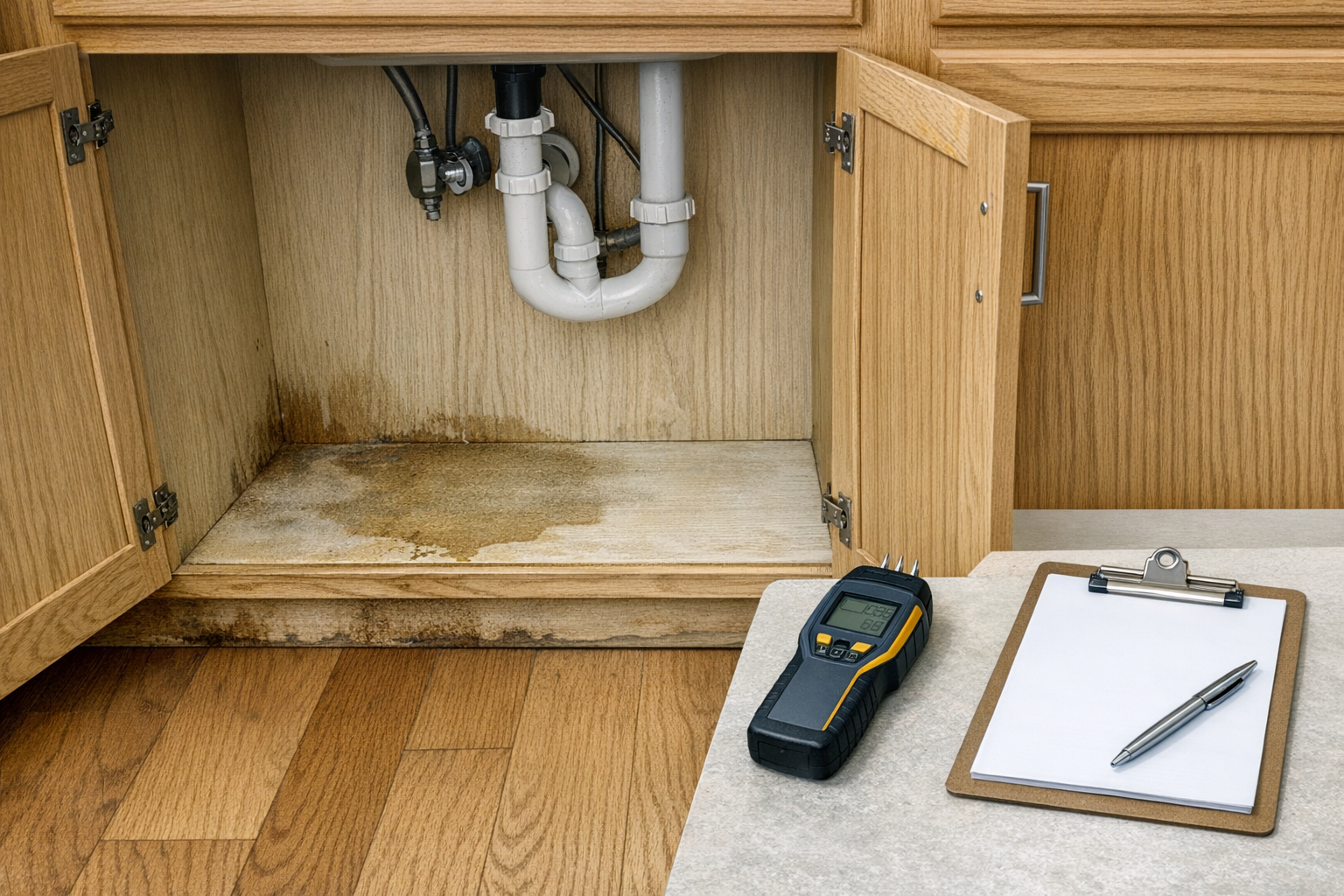
A map can use simple descriptions such as the wall beside the doorway or the floor edge adjoining the closet. Consistent labels are more valuable than vague notes saying only that a room remains wet. The equipment placement plan should relate to those documented areas.
3. Make safe observations without changing the drying setup
Occupants can provide useful information without handling equipment or testing materials. From an authorized, dry and unobstructed position, note a newly visible floor-edge change, a spreading stain, an unusual equipment sound or an apparent interruption. Record the time you noticed it and notify the restoration contact.
Do not enter standing water, touch wet electrical equipment, test outlets or reset breakers to restore drying equipment. If you notice smoke, sparks or a burning smell, keep clear and seek appropriate emergency assistance. A record is never more important than safe access.
Do not move air movers, reposition dehumidifiers, reroute hoses or adjust settings yourself. These changes can alter the drying conditions and make later readings harder to interpret. Ask the team how cords, hoses and equipment will be arranged to preserve safe passage.
Also avoid opening walls or ceilings, lifting flooring or pulling trim to see whether it feels wet. Report the concern and request an assessment. If suspected mold or sewage is present, do not disturb it or add household fans. The drying approach must account for contamination concerns before air movement is used.
For ordinary observations, a short message is enough: the room, the time, what changed and whether access is affected. A photograph taken safely can clarify the location, but it should not require stepping over equipment or entering a restricted area.
4. Ask how measurements demonstrate progress
Air conditions and material conditions answer different questions. A dehumidifier removes moisture from air; its operation does not by itself show that the drywall behind a baseboard or the layer beneath a floor covering has reached an appropriate drying goal. Ask how restoration equipment monitoring records and material readings are being evaluated together.
Comparable measurements matter. A reading from one material, instrument mode or location should not casually be compared with a different one. Some readings are relative indications rather than a literal moisture percentage. Numbers need material identification and an explanation of the method.
- Which specific materials and layers are being monitored?
- Are repeat visits checking the same labeled locations?
- What instrument method or scale is used, and what limitations apply?
- What comparable unaffected material or other basis supports the drying goal?
- Does the observed trend support the current equipment arrangement?
- What remains inaccessible or uncertain?
A single favorable reading does not establish the condition of every layer in an assembly. Likewise, an unchanged reading deserves interpretation, not an automatic conclusion that the entire plan failed. Access, material composition, an unresolved source or measurement interference may need investigation. The technician should explain the possibilities supported by the findings.
Our overview of moisture meter readings and their limits can help you frame these questions. Request plain-language explanations rather than attempting to diagnose the building from a spreadsheet.
There is no universal drying deadline. Material thickness, water exposure, access and operating conditions affect progress. Ask what the next review will evaluate instead of relying on a promised number of days.
5. Use a decision guide for interruptions and scope changes
For a Henderson 89011 homeowner or manager, the key decision is usually whether to report an observation, request reassessment or restrict access. Choose based on the condition—not the postal area or the number of machines in the room.
- Equipment appears stopped, with no immediate hazard: report the location and observation time. Do not open the unit or attempt electrical troubleshooting. Ask whether a visit or another action is needed.
- A hose appears displaced or new water is visible: keep clear of wet areas and notify the team. Ask whether the moisture map needs updating and whether the source requires renewed investigation.
- A wall or floor looks worse despite equipment operation: record the visible change safely. Request reassessment of the affected assembly rather than simply requesting more machines.
- Readings show limited progress: ask what explains the trend, which uncertainties remain and whether access, placement or material retention needs reconsideration.
- Equipment is proposed for removal: request the supporting material findings and any unresolved limitations before treating removal as the repair handoff.
An interruption report should state what is known. If you noticed silence in the morning, do not claim the machine was off all night unless that is established. Restoration equipment monitoring records can distinguish an observed outage from an estimated duration and describe the follow-up assessment.
Restoration equipment monitoring records should also explain equipment changes. A unit may be moved because the affected boundary changed or because part of the area met its goal. Record the location and timing so subsequent readings have context. The supporting articles on air mover placement during drying and dehumidifier operation during restoration explain the different roles of these tools.
6. Connect the records to retain, remove and repair decisions
Monitoring is valuable because it informs material decisions, not because it produces a large file. Lower drywall, baseboards and flooring must be evaluated as related components with potentially different outcomes. One component may be suitable to retain while another requires removal because of condition, contamination concerns or limited access for drying and verification.
For drywall, ask whether the panel remains sound, what is known about the cavity and how retained sections will be checked. A surface that looks better may still leave questions about insulation or adjoining framing. Readings alone do not reverse physical damage. See the factors involved in retaining wet drywall for a fuller discussion.
For baseboards, distinguish finish staining from swelling, separation or loss of integrity. Ask whether the trim obscures needed assessment of the wall base. For flooring, identify the actual product, installation and underlying layers. A dry top surface cannot resolve every question about underlayment or substrate.
Ask the team to document why drying in place remains appropriate or why selective removal is recommended. If an area cannot be reached, the next step should address that uncertainty rather than label it dry by assumption. Additional work should be explained and authorized through the agreed process.
Before patching, painting or installing replacement finishes, clarify what has been verified and what remains outside the completed scope. Our guide to drying verification before drywall repairs addresses that handoff. Later water damage repair and reconstruction is a separate phase, even when one company coordinates both stages.
7. Keep a usable file and prevent avoidable setbacks
Maintain one shared file with source information, initial assessment, restoration equipment monitoring records, progress updates, approved changes and completion notes. Keep occupant observations separate from technician measurements. Both are useful, but they have different evidentiary limits. Preserve original photographs and reports rather than replacing them with edited summaries.
For managed properties, name a primary contact and a backup who can arrange authorized access. Agree on visit arrangements and who receives updates. An access delay should be recorded because an uninspected room cannot be treated as verified. Avoid distributing entry details or unrelated occupant information beyond people who need them.
During drying, follow the team’s instructions about doors, windows, room use and equipment clearances. Do not cover machines, use them as storage surfaces or alter the setup to reduce noise without discussing alternatives. Report an occupancy or access problem early so the provider can review it rather than discovering an undocumented change later.
After completion, retain the source repair record and follow the relevant maintenance recommendations for the repaired plumbing component. Keep accessible areas observable and report renewed staining, floor-edge changes or water promptly. These steps support early recognition; they do not guarantee that another leak cannot occur.
If records will be shared with an insurer, ask what documents are requested and retain copies of what you submit. Logs may help explain work performed, but they do not establish coverage or guarantee payment. The water damage documentation guide provides a broader filing framework.
A monitoring-log template to discuss with your provider
Ask your provider whether its report includes the fields below. This is a blank planning template, not a technician report or a record of work performed. Restoration equipment monitoring records should identify the person making each observation and distinguish measured findings from information reported by an occupant.
| Record field | Information to request |
|---|---|
| Visit and area | Date, time, technician, room and the location labels used on the moisture map. |
| Source status | What source correction is documented, who provided that information and any remaining uncertainty. |
| Equipment | Unit identifier, location, observed operating status and any documented adjustment or interruption. |
| Material findings | Material and layer checked, measurement location, method or scale, result and the basis for comparison. |
| Access limitations | Areas not inspected, the reason, the resulting limits on conclusions and the agreed follow-up. |
| Next decision | Whether to continue, adjust or end drying in the assessed area, with the supporting explanation. |
At each update, compare like locations and methods. Ask why a location was added, omitted or renamed rather than treating every change as a trend. Keep the original report available beside any summary so the repair team can trace a conclusion back to its supporting observations.
If an entry is missing, request clarification; do not supply an estimated reading or reconstruct an operating period as though it were observed. When an occupant reports a stopped machine, record when it was noticed separately from any confirmed outage duration.
At the handoff, ask which remaining tasks belong to drying and which belong to repairs. Agree on who receives unresolved questions and who authorizes additional assessment. This makes restoration equipment monitoring records useful to the next person responsible for the room, rather than leaving a collection of numbers without a clear next step.
8. Frequently asked questions about monitoring records
Does a running dehumidifier mean the room is dry?
No. It shows only that the equipment appears to be operating at that observation time. Material measurements, the assessed assembly, appropriate drying goals and remaining access limitations are needed to explain whether retained materials are ready for the next stage.
Should I keep my own equipment log?
Alongside restoration equipment monitoring records, a simple observation log can help: record the time, room and visible or audible change. It should supplement—not substitute for—professional records. Do not inspect controls, move units or take material readings unless the provider has established an appropriate, safe role for you.
What if the records have a gap?
Ask whether the gap reflects a missed visit, unavailable access, a reporting omission or an unknown operating period. Request clarification and any needed reassessment. A gap should remain identified as uncertainty; neither the occupant nor provider should invent measurements to fill it.
Can the equipment count tell me whether the setup is correct?
Not by itself. Suitability depends on the affected materials, moisture load, space, access and measured response. Ask what the placement is intended to accomplish and how progress supports that choice. Comparing machine counts between unrelated properties is not a reliable assessment.
What should I request when drying equipment is removed?
Request restoration equipment monitoring records and a completion summary identifying assessed areas, final material findings, the basis for ending drying and unresolved limitations. Clarify which repairs remain and whether another assessment is needed before closure. Equipment removal does not itself certify that every finish is repaired or every concealed space was inspected.
For additional background on moisture control and concealed mold, see the EPA guide to mold and moisture. General guidance does not replace assessment of the affected materials at your property.
If you need help reviewing drying progress after a leak in Henderson 89011, contact Presto Water Damage. Describe the source, affected materials, equipment observations and access concerns so the next assessment can address the actual questions. Call 725-529-5195.