Water damage odor investigation in Las Vegas 89104 should connect the odor report with the water history, affected materials, and professional moisture findings. A smell alone cannot establish mold, identify contamination, or prove that a wall or floor is still wet. The useful next step is to record where and when the odor is noticed, avoid disturbing affected materials, and request an assessment that explains what was checked and what remains uncertain.
This guide focuses on preparing for that assessment and deciding what should happen next—not choosing a fragrance or assuming every odor requires demolition. Presto Water Damage provides moisture mapping, structural drying, cleanup, and restoration support. For properties described as Las Vegas 89104, provide the actual location and access details when arranging help. A ZIP identifies a postal area; it does not establish building construction, jurisdiction, or the cause of an odor.
1. Define the investigation before choosing a treatment
Odor investigation begins with a question: is the reported smell connected to the known water event, another building issue, affected contents, or something not yet identified? Several explanations may remain plausible at the first visit. Wet carpet padding, damp wall assemblies, stored belongings, drain problems, and unrelated household sources require different follow-up.
Describe the odor in ordinary language, such as musty, sour, or drain-like, without treating that description as a diagnosis. People notice and describe smells differently. The strongest-smelling location can help prioritize inspection, but air movement may carry an odor away from its origin. Do not put your face close to a stain, drain, or wall opening to investigate.
The existing guide to why musty odors can remain after water damage explains the broader problem. Here, the goal is more specific: build an observation record and use findings to decide whether source investigation, moisture assessment, contamination evaluation, or another trade’s inspection comes next.
Ask the assessor to separate observations from conclusions. “Odor reported near the hallway wall” is an observation. “The entire wall contains mold” is a conclusion requiring supporting evidence. A useful report should not blur those categories.
2. Make safe observations without exposing concealed materials
Observe only from accessible, dry, stable areas. Do not enter standing water, handle wet electrical equipment, test outlets, or approach a sagging ceiling. Keep people away from unstable finishes and suspected contaminated areas. If the odor resembles gas, smoke, or burning electrical equipment, stop treating it as a restoration puzzle, leave the affected area, and contact the appropriate emergency or utility service from a safe location.
Do not remove baseboards, lift flooring, pull carpet, open ceilings, or disturb suspected growth. Do not start fans where sewage or suspected mold may be involved. Investigation should not spread material or create a new exposure path simply to locate a smell.
- Location: Name the room and a fixed feature, such as the wall beside the laundry doorway.
- Timing: Record when the odor was first noticed and when it returns or changes.
- Visible changes: Photograph swelling, staining, separated joints, or curling floor edges from a safe position.
- Ordinary conditions: Note whether doors were closed or the HVAC was operating, without deliberately changing settings to provoke the odor.
- Prior actions: List cleaning products, fragrances, painting, or equipment use that may affect observations.
A short dated note is more useful than repeated close inspection. If there is no safe view of a suspected area, record that limitation rather than moving furniture or entering a restricted space. Absence of visible damage does not establish absence of concealed moisture.
3. Reconstruct the water history and arrange authorized access
The discovery date is not necessarily the start date. State what you know and what you cannot establish. Record the last known normal condition, the first water observation, the first odor report, and any source repair. If an appliance connection leaked, distinguish a technician’s confirmed finding from your initial suspicion.
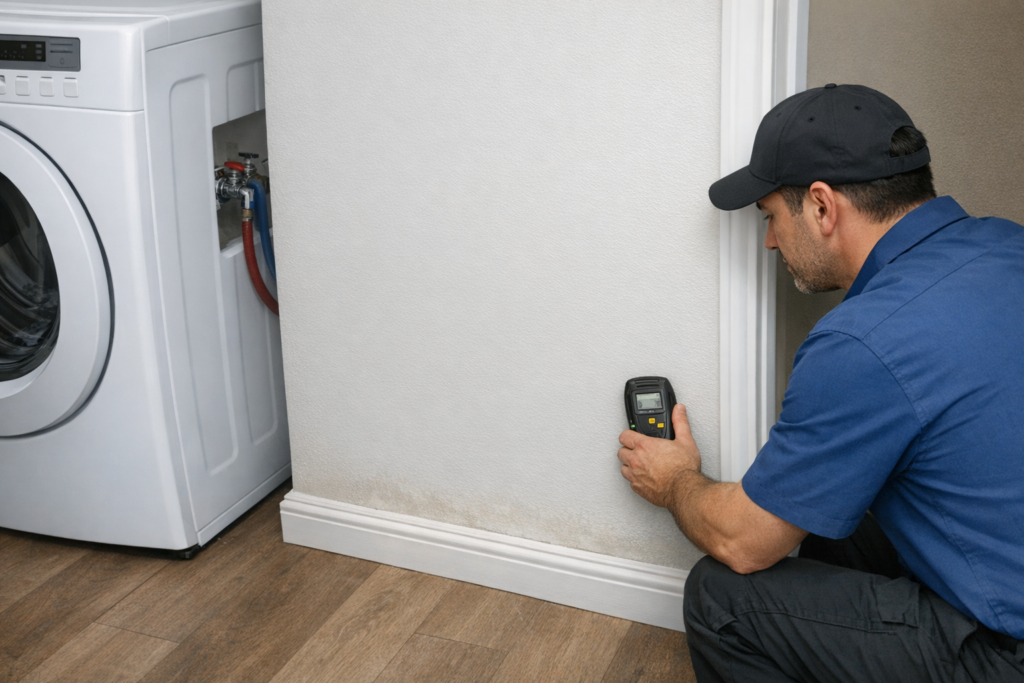
For example, a repaired washing-machine supply connection may explain water at the laundry wall, but the repair does not establish that adjacent drywall, trim, or flooring has dried. During the assessment stage, a technician may check intact wall surfaces and the floor perimeter before proposing access to concealed layers. This is an assessment approach, not a claim about a particular customer job.
Gather available plumbing or appliance repair records, earlier photographs, and previous drying reports. If there was an overflow, drain backup, or uncertain water source, say so before work begins. Water contact history influences cleaning and material decisions; odor intensity does not substitute for that history.
Managers should identify who can authorize entry, source repairs, and restoration work. If a shared wall or adjoining room may be relevant, arrange permission rather than assuming the team can enter. Give the scheduling contact the property location, occupied areas, and restrictions. Presto’s Las Vegas restoration service information provides the applicable city connection without suggesting a separate office in this ZIP.
4. Use a water damage odor investigation in Las Vegas 89104 decision guide
Choose the next step based on conditions and evidence, not how unpleasant the smell seems. This guide helps homeowners and managers explain priorities when requesting an assessment.
- Water is still appearing or finishes are changing: Arrange source investigation and restoration assessment promptly. Stop use of the suspected appliance when this can be done safely; do not reproduce the leak for photographs.
- The source was repaired, but odor persists near affected materials: Request moisture mapping and a review of the earlier work boundaries. Ask whether the wall base, floor layers, and adjacent room were included.
- There is suspected growth, sewage history, or unknown dirty-water contact: Limit access and request contamination-focused assessment before ordinary drying or cleaning proceeds.
- Available moisture checks do not explain the odor: Ask what areas were inaccessible and whether plumbing, HVAC, contents, or another source needs separate investigation.
- The odor returns after finishes were replaced: Preserve the completion records and request reassessment before adding paint, sealant, or flooring over the area.
Where retained materials are suitable for drying, structural drying and dehumidification addresses moisture rather than merely changing the smell. If findings indicate suspected growth needs further evaluation, discuss the appropriate mold remediation scope. Neither service should be prescribed solely from an odor description.
For a managed property, assign one person to consolidate reports. Conflicting accounts from separate occupants should remain attributed observations, not be combined into a falsely certain timeline.
5. Ask what the professional assessment can actually establish
A useful assessment follows the possible water path while recognizing the limits of each tool. Moisture readings need a material, location, measurement method, and appropriate comparison. A thermal image may help identify an area for further checking, but it does not independently prove moisture or locate mold. Odor, photographs, and instrument findings should be considered together.
Ask these questions before treating the inspection as complete:
- Which materials and rooms were checked, and how were the boundaries selected?
- Were readings taken at the reported odor location and along plausible water paths?
- What suitable comparison supports the interpretation of each material’s readings?
- Which cavities or flooring layers could not be assessed without additional access?
- What evidence would justify selective access, and who must authorize it?
- Does the water history change the cleaning or removal plan?
- If moisture findings do not explain the odor, what is the next investigation step?
The guide to what moisture meters can and cannot establish helps put readings in context. There is no single number that answers every material question, and a normal reading at one surface does not clear an entire assembly.
Request a plain-language summary of findings, uncertainties, and recommended next steps. An inaccessible area should remain an identified limitation. It should not quietly become either an assumed problem or an assumed dry area.
6. Make material decisions separately from odor-control decisions
Keeping or removing material depends on water history, physical condition, contamination findings, access, and whether drying can be verified. A smell alone does not justify replacing an entire room. Conversely, a temporarily improved smell does not establish that damaged material is suitable to retain.
Drywall and trim: Ask about the drywall face, core, adjoining cavity, and baseboard separately. Swollen fiber-based trim may remain physically damaged after moisture is reduced. The discussion of when wet drywall may be retained explains why condition and assembly access matter alongside readings.
Flooring and padding: A dry-looking surface can conceal affected layers. Carpet, padding, underlayment, and substrate need separate decisions. Ask whether inspection reached those layers and how retention would be verified. See how water spreads beneath flooring for the distinction between visible wetting and the full assembly.
Cabinets and contents: Cabinet bases, unfinished edges, stored textiles, and cardboard may need individual assessment. Do not assume cleaning the room treats belongings inside it. Avoid moving suspect contents through unaffected spaces without a handling plan.
Keep the stages clear: source repair stops the release; mitigation addresses water and affected materials; drying verification supports decisions about retained assemblies; rebuild restores finishes. Discuss water damage repair and reconstruction after the preceding findings support closure. Odor treatment, where appropriate, should have an explained purpose and should not replace source correction, cleaning, or drying.
7. Document the outcome and prevent an unexplained return
Keep one file containing the observation timeline, source-repair records, assessment findings, authorized scope changes, moisture records, and completion notes. Label photographs by room and date. For odor reports, record the reporter and ordinary conditions; photographs cannot capture a smell, but they can connect the report to a location and visible changes.
Ask the team to explain why work boundaries changed if additional affected material was discovered. Preserve the reason for selective removal or retention, not just the final quantity. The checklist for documenting water damage before cleanup can help organize the initial record. Documentation supports communication but does not guarantee insurance coverage or claim acceptance.
Before rebuilding, review the evidence needed before drywall repairs. Request clarification if the completion note only says equipment was removed. Equipment operation and an odor improvement are not, by themselves, drying verification.
Prevention should follow the established cause. Have the responsible trade address the confirmed leak or drainage issue, follow applicable appliance maintenance instructions, and keep service access unobstructed. Managers can include the formerly affected location in routine visual inspections without opening assemblies. Give occupants a clear way to report renewed staining, swelling, or odor.
If the smell returns, record the date and location and share the earlier findings. Do not assume recurrence proves the same source failed, but do not dismiss it because previous work was completed.
8. Frequently asked questions about odor assessment
Does a musty smell prove there is mold?
No. It is a reason to investigate, particularly after water damage, but it does not identify the cause or extent. Report any visible changes without disturbing them. Ask how the professional findings distinguish moisture concerns, suspected growth, and other possible odor sources.
Should I spray deodorizer before the assessment?
Avoid masking the odor beforehand when possible. Fragrance can complicate the observation record and does not correct trapped moisture or damaged materials. If you already used a product, provide its name, application location, and date rather than trying additional treatments to compare results.
What if the room smells worse only when the HVAC runs?
Record that timing without repeatedly cycling equipment to test it. Air movement may transport an odor from another location, so timing alone does not identify the HVAC system as the source. Ask whether restoration findings support a separate HVAC inspection and who should perform it.
Can dry moisture readings end the investigation?
They can narrow it, but only within the materials and locations assessed. Ask about concealed layers, inaccessible areas, and measurement limitations. If the moisture assessment does not explain the odor, the next step may involve contents, plumbing, HVAC, or another source rather than more drying equipment.
What should I have ready when calling Presto Water Damage?
Provide the property location, callback number, source history, affected rooms, odor timing, and any access restrictions. Mention standing water, ceiling instability, sewage history, or suspected growth before entry is arranged. Share available repair and drying records so the next assessment starts with the existing evidence.
If an unexplained odor remains after water damage at your Las Vegas 89104 property, contact Presto Water Damage to discuss safe observations and the appropriate assessment next step. Call 725-529-5195.