
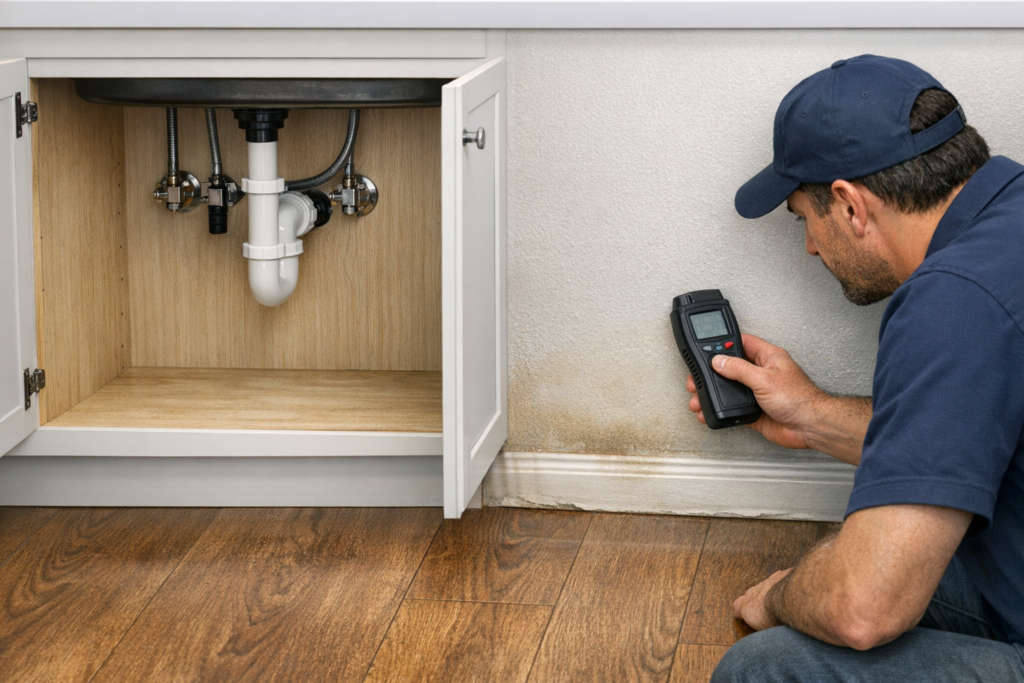
A water damage repair estimate scope in Las Vegas 89103 should explain the affected rooms and materials, the proposed work, the evidence supporting that work and any areas that still need assessment. It should separate repairing the water source from mitigation, drying verification and reconstruction. A total alone cannot tell you whether the proposal addresses the damage.
For a homeowner or property manager, the immediate decision is often whether to authorize cleanup now, request more assessment or approve finish repairs. Those decisions may require different information. You do not need to investigate concealed spaces yourself to contribute useful details. A dated photograph, an accurate source history and a question about an excluded floor layer can improve the discussion.
This guide focuses on reviewing the work description after a plumbing supply leak has affected a wall base and adjoining flooring, while explaining when other water histories change the approach. Presto Water Damage provides water damage restoration in Las Vegas. The ZIP identifies the postal area for this guide; it does not establish jurisdiction, building construction or special local risks.
1. What a water damage repair estimate scope should explain
A useful scope connects observations to actions. For example, a description of damaged baseboard should identify its location, the proposed removal or retention, and how the adjoining drywall and flooring will be assessed. It should not leave you guessing whether a trim replacement also includes checking the wall behind it.
Look for room names that match the property and material descriptions that distinguish the visible finish from underlying layers. A kitchen floor, hallway floor and closet floor may need separate entries even when water traveled between them. Conversely, a continuous finish does not automatically mean every part requires replacement.
- Locations: Rooms, wall segments, floor areas and relevant adjoining spaces.
- Operations: Extraction, cleaning, selective removal, drying, monitoring and finish repairs.
- Basis: Visible condition, water history, measurements and access limitations.
- Boundaries: What is included, excluded, provisional or awaiting approval.
- Handoff: What must be established before the next phase begins.
Ask whether the document is a preliminary assessment, an emergency mitigation authorization or a reconstruction proposal. Each can be useful, but they are not interchangeable. The water damage repair and reconstruction service addresses later repairs; its work should be defined separately from the immediate effort to limit damage.
2. Gather safe observations without investigating the building
Begin with what you can see from a dry, stable, accessible location. Record where water first appeared, when someone noticed it and whether the apparent source has been corrected. Keep discovery time separate from the unknown start time. If nobody knows how long a supply connection was leaking, say so instead of choosing a duration.
Photograph the room first, then visible material changes. Useful details include swollen trim joints, peeling paint at the wall base, separated flooring seams and discoloration extending into a doorway. Describe appearance rather than diagnosing concealed damage. A raised floor edge is an observation; a ruined subfloor is a conclusion requiring assessment.
Do not enter standing water, touch wet electrical equipment, move heavy appliances, lift flooring or remove baseboards to improve the estimate. Stay away from sagging ceilings and unstable surfaces. Suspected sewage, contaminated water or visible mold calls for restricted access and professional assessment, not household fans or exploratory cleaning.
For managers, collect existing information without sending an occupant into the affected area. Request photographs already taken safely, source-repair notes and the name of the person authorized to arrange entry. Record inaccessible rooms as unassessed, not unaffected. The distinction matters when a preliminary estimate appears to cover the entire loss but technicians have only seen one room.
A simple room list is enough: location, visible change, photograph reference and date. Avoid making marks on damaged materials or touching them to judge softness.
3. Keep source correction, mitigation, drying and rebuild separate
Source correction stops the event that introduced water. For the supply-leak situation discussed here, an appropriate plumbing professional should identify and repair the failing connection or pipe. A restoration estimate should state whether that source-related work is included, excluded or being handled by someone else. Stopping the leak does not establish that affected building materials are dry.
Mitigation limits further damage and addresses immediate water and material conditions. Depending on findings, it may involve extraction, protection of unaffected areas, contents handling, cleaning or selective removal. Ask which actions are urgent and which decisions can reasonably wait for additional assessment. Do not delay necessary protective work simply to obtain a finished reconstruction proposal.
Structural drying addresses moisture in materials suitable for retention. The scope should explain the materials being dried, equipment arrangements, monitoring and the basis for adjustments. Learn more about structural drying and dehumidification before treating equipment placement as a complete drying plan.
Drying verification evaluates whether retained affected materials have reached the documented goals appropriate to the assembly. Rebuild restores removed or damaged components after the necessary prerequisites are met. Neither a plumber’s invoice nor a dry-looking painted surface substitutes for that handoff.
Ask who is responsible for each stage and how completion will be communicated. If the proposal combines phases, request separate descriptions so you can understand what you are authorizing and what may change.
4. Ask how the assessment establishes the work boundaries
The visible wet spot is a starting point, not necessarily the full assessment boundary. Water from a supply leak can reach a wall base, continue along a floor edge or enter adjoining layers. Ask which nearby areas were checked and which could not be reached. A closed closet, cabinet base or inaccessible floor layer may leave a legitimate uncertainty.
Professional moisture observations should be tied to locations and materials. Ask how readings from affected materials are interpreted, whether comparable materials provide useful reference conditions and how inspection limitations are recorded. The guide to moisture meters in restoration explains why an isolated number does not describe an entire wall or floor.
- Which materials were measured, and where are those locations recorded?
- Were adjoining rooms and the opposite side of the affected wall considered?
- Which layers remain concealed or inaccessible?
- What finding would justify additional access or a revised scope?
- How will any proposed opening be explained and authorized?
An assessment can narrow uncertainty without eliminating it. If concealed conditions cannot be confirmed until authorized work begins, the estimate should identify that limitation and the process for reporting discoveries. Do not open walls or ceilings yourself to resolve the gap.
Also ask what is known about the water’s contact history. Water appearance alone cannot establish contamination conditions. A supply leak that contacted other materials requires assessment of the actual event, not an assumption based solely on where the water originated.
5. Review material decisions component by component
An estimate should explain why each affected component is proposed for retention, removal or replacement. Drywall, trim, insulation, flooring and cabinet panels behave differently. Drying a material may address moisture without reversing swelling, delamination or loss of strength. Equally, visible staining alone does not establish that every adjoining component must be removed.
Drywall and trim: Ask whether the proposal addresses the face of the wall, its cavity and any affected insulation separately. What condition supports drying in place? If removal is proposed, how were its boundaries selected? The discussion of when wet drywall may be retained provides context, but the decision must follow the actual assessment.
Flooring assemblies: Identify the finish product, underlayment and underlying floor where known. A water-resistant surface does not establish that the layers below stayed dry. Ask how transitions, installation method and access affect the plan. The guide to water damage beneath flooring helps explain why the finish and substrate need separate consideration.
Cabinets and belongings: Distinguish cabinet doors, boxes, end panels and toe kicks instead of treating the entire installation as one item. Contents movement, storage, cleaning and disposal also need clear boundaries. Ask who records items and approves their disposition.
Finally, separate damage-related work from optional improvements. Different flooring, upgraded trim or a layout change should not be blended into the original restoration description. Where matching existing finishes is uncertain, ask how that uncertainty affects selections and repair limits rather than assuming an exact match is available.
6. Use a decision guide before signing or requesting revisions
For a Las Vegas 89103 owner reviewing a wall-base and flooring leak estimate, the most useful comparison is not simply the total. Compare the same rooms, layers and phases. One proposal may include monitoring and finish restoration while another covers only removal. Different totals may reflect different work rather than different pricing for an identical scope.
- Water is still spreading: Prioritize safe source control and necessary mitigation. Request a clear immediate-work authorization and identify what later assessment remains pending.
- The proposal covers only visible finishes: Ask how concealed wall and floor layers will be evaluated before approving cosmetic repairs.
- A material decision lacks a reason: Request the supporting condition, measurement or access concern. Do not decide retention solely from appearance.
- Part of the property was inaccessible: Arrange authorized professional access and keep that area listed as pending assessment.
- New damage is discovered: Request photographs, an explanation and a written scope revision before nonurgent added work proceeds.
- Rebuild is ready for approval: Confirm source correction, material decisions and the drying handoff, then review finish boundaries and exclusions.
A manager should also identify who may authorize work and who receives updates. Permission to enter is not necessarily authorization to remove materials. Keep occupant communications, owner approvals and any association involvement distinct without assuming responsibility from the ZIP or property address.
Before closing walls or installing finishes, request the relevant drying verification information. If an estimate specifies equipment for an initial period, ask how continued use or removal will be determined from conditions rather than assuming a universal drying deadline.
7. Keep a usable record and plan for recurrence prevention
Maintain one file containing the original estimate, revisions, dated photographs, source findings, authorizations and completion records. Label revisions so everyone can identify the current scope. When quantities or boundaries change, request an explanation connecting the change to inspection findings, material condition or an approved selection.
For a straightforward documentation method, follow the guide to documenting water damage before cleanup. Preserve available records without delaying necessary mitigation or keeping contaminated materials for photographs. Financial or insurance review is separate from restoration authorization, and documentation does not guarantee coverage or payment.
At the handoff, ask what remains unfinished. A room can have completed drying but still need trim, paint or floor repairs. Conversely, replacing a visible finish does not demonstrate that the underlying assembly was evaluated. The guide to reconstruction after water damage explains that later repair phase.
Prevention should follow the identified cause. Ask the plumbing professional what maintenance or component correction is appropriate for the supply failure. Keep accessible shutoff information available, avoid blocking routine observation points with storage and report recurring stains or floor changes promptly. Leak detection devices may provide useful alerts where appropriate, but they do not replace source maintenance or guarantee that every leak will be detected.
8. Frequently asked questions about estimate scope
Can I get a complete estimate from photographs?
Photographs can support an initial conversation, but they cannot reliably establish concealed moisture, floor layers or material condition. Ask which parts of a photo-based proposal are provisional and what an on-site assessment must confirm. Do not take additional photographs if doing so requires unsafe entry.
Should the estimate include plumbing repairs?
It should clearly say whether source repairs are included or separate. Restoration of wet materials and correction of the failing plumbing are different tasks. Ask who confirms source correction and how that information reaches the restoration team before finish work begins.
Why might an estimate change after work starts?
Authorized access can reveal affected materials that were previously concealed. A change may also follow a documented material decision or owner selection. Request the discovery record, revised work description and applicable authorization rather than accepting an unexplained increase or assuming every revision is unnecessary.
Does equipment removal mean the room is ready to rebuild?
Not by itself. Ask for the drying conclusions for retained affected materials, confirmation that necessary cleanup or removal is complete and a list of unresolved conditions. Equipment removal is an operational step; readiness for reconstruction depends on the assembly and documented findings.
What should I have ready when calling Presto Water Damage?
Provide the property location, callback number, known source history, affected rooms and safe access arrangements. Explain whether you need immediate mitigation, an assessment or clarification of repair scope. Mention inaccessible spaces and any suspected contamination without investigating them yourself.
If you need help understanding the proposed work for water damage in Las Vegas 89103, contact Presto Water Damage. Describe what you can safely observe and ask about assessment, drying and repair boundaries. Call 725-529-5195.