
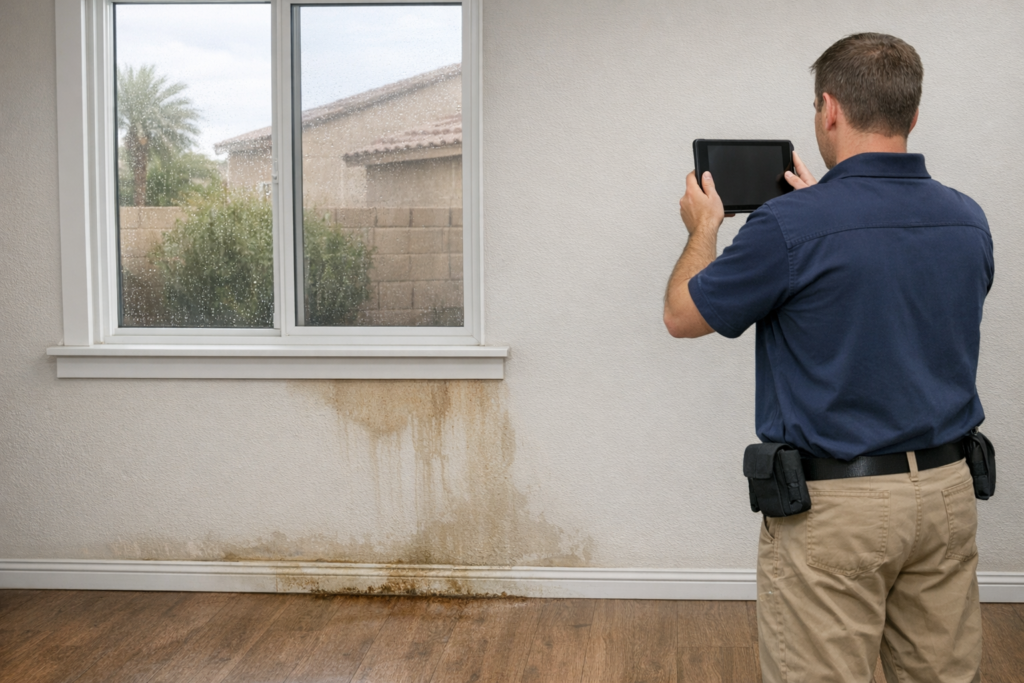
Useful storm water intrusion documentation connects the rain event, the first visible water, the affected materials and the professional findings without treating an assumption as a confirmed cause. Start with dated observations and photographs taken from a safe, dry location. Record what remains unknown, then request an assessment that follows moisture beyond the visible stain. Do not delay necessary mitigation to assemble a perfect file.
For Las Vegas homeowners and property managers, the difficult question is often not whether something got wet, but how rain reached it. Water at a wall base might have traveled down inside the wall or entered at floor level. A ceiling stain may be associated with rainfall without proving the roof defect directly above it. This guide focuses on preserving those distinctions so source investigation, cleanup, drying and repairs can proceed with clearer information.
1. Establish Safe Observation Boundaries Before Taking Photos
Documentation begins with deciding where you can observe safely, not with approaching every wet surface. Stay out of standing water and away from wet electrical fixtures, outlets, equipment and cords. Do not test electrical systems or cross a flooded room to reach a panel. If electrical or structural conditions are uncertain, keep the area inaccessible and request qualified assistance.
Stay clear of sagging ceilings, loose finishes, damaged glass and unstable flooring. Do not stand beneath a bulge to photograph it, puncture a ceiling or remove trim to expose a water path. A distant photograph with a note explaining the access restriction is more useful than an unsafe close-up. For immediate danger, leave the affected area and contact the appropriate emergency service.
Outdoor runoff may carry contamination, and its appearance does not establish whether contact is safe. Avoid handling wet debris or disturbing suspected mold or sewage. Do not aim household fans at suspected contamination. Tell the restoration team what you can see from outside the affected boundary and let the assessment establish appropriate access and work methods.
Presto Water Damage provides flood and storm damage cleanup. When requesting help, describe active entry, affected rooms and any access hazards first. Photographs and paperwork can follow; they should not become a reason to postpone reporting ongoing damage.
2. Build a Storm Water Intrusion Documentation Timeline
Keep discovery time separate from the estimated start of water entry. If you found damp drywall in the morning after overnight rain, write exactly that. Do not record the beginning of rainfall as the beginning of the loss unless someone actually observed entry then. An honest gap in the timeline helps the assessor understand uncertainty.
Create one dated event log rather than several conflicting summaries. Include the observer, room and source of each statement. Distinguish direct observations from a tenant’s report, a contractor’s finding or your own working theory. Useful entries describe changes, such as water appearing at a door threshold while rain continued, rather than declaring a failed component without inspection.
- First discovery: When and where water or a new stain was noticed.
- Observed weather relationship: Whether entry was seen during rain, afterward or at an unknown time.
- Changes: New dripping, expanding discoloration, swelling or water appearing in another room.
- Actions: Calls made, access restrictions and professional stabilization or mitigation.
- Uncertainty: Unoccupied periods, inaccessible rooms and an unconfirmed entry path.
Include earlier stains or repairs if known. A preexisting mark and a new wet area can coexist, and neither should be erased from the record. Our guide to documenting water damage before cleanup explains the broader photo and record process; the storm-specific task is connecting changing interior observations with a carefully qualified event history.
3. Photograph the Possible Water Path Without Claiming the Cause
Use a repeatable sequence: a wide view identifying the room, a middle-distance view showing the affected wall or floor, and a closer view of visible damage when safely accessible. Preserve the original image files. Add captions in a separate index so edits or labels do not replace the originals.
Give locations consistent names, such as living room exterior wall, window left corner or hallway ceiling near doorway. Repeat photographs from approximately the same safe position when conditions change. Similar framing helps distinguish actual expansion from a different camera angle. Do not move into a restricted area just to reproduce a photograph.
Photograph visible relationships rather than isolated stains. A safe view including a window, adjacent wall and floor edge can help an assessor orient the damage. At a doorway, document the threshold and nearby interior finishes from a dry location. Exterior observations should be made only after conditions are safe and from ground level; do not climb onto a roof or use a ladder for documentation.
Keep captions neutral. Write “discoloration below window after rain” rather than “window flashing failed.” Water can travel along concealed surfaces before emerging. Likewise, an upper-wall stain does not exclude another source. The guide to possible causes of ceiling water stains explains why appearance alone cannot reliably distinguish roof, plumbing and condensation-related moisture.
If a surface cannot be photographed safely, list it as unobserved and explain why. Never interpret an absent photograph as evidence that an adjoining room or concealed assembly was unaffected.
4. Ask How the Assessment Will Separate Entry From Spread
A useful assessment addresses two different questions: where water entered the building and how far it traveled afterward. These may require different providers and different evidence. A roofing or building-envelope professional may investigate the entry defect, while the restoration assessment maps affected interior materials. Ask who is responsible for each investigation and what remains outside the proposed scope.
For example, a wet floor near an exterior wall could relate to threshold entry, water descending through the wall or another unresolved source. That is a reason to investigate, not a basis for selecting one explanation. Ask whether the findings support a confirmed path, a likely path or several possibilities requiring further review.
- Which rooms and adjoining assemblies will be assessed beyond the visible wet area?
- What water contact history informs the contamination assessment?
- Which locations cannot be evaluated without authorized professional access?
- What findings support the proposed entry path, and what remains uncertain?
- How will additional discoveries change the moisture map and written scope?
Request location-specific moisture records. A reading needs the material, inspection point, date and measurement context to be meaningful. Different materials should not be treated as though one number means the same thing everywhere. Our explanation of moisture readings and material comparison provides questions about suitable reference materials and consistent follow-up checks.
Ask how instruments complement the physical inspection. Thermal images can identify temperature patterns that warrant investigation, but they do not independently prove moisture or its source. Meter readings also need interpretation; they do not by themselves establish when water entered or whether a material can be retained.
5. Record Material Decisions Component by Component
“Storm-damaged room” is too broad to explain a restoration decision. Break the room into drywall, insulation, trim, flooring layers and contents. For each component, request the observed condition, relevant water history, assessment limitations and reason for retention, cleaning, drying or removal. A surface looking intact does not establish that the assembly behind it is suitable to keep.
Drywall decisions should consider condition, contamination concerns and whether concealed materials can be assessed and dried appropriately. Record visible swelling, separation or distortion without pressing on the surface. If removal is recommended, ask which findings support the boundary and how the adjoining retained material will be evaluated. The discussion of whether wet drywall can be saved offers more detail on these considerations.
Insulation needs its own decision rather than being included automatically with the visible wall finish. Ask whether it was actually inspected, what type is present and whether its condition and accessibility support retention. An inaccessible cavity should remain an identified assessment gap, not be marked dry because the paint has changed color.
Flooring also requires a layered record. Surface covering, underlayment and substrate can respond differently to water. A dry-looking plank or tile surface cannot establish the condition below it. Ask which layers were evaluated and how the work plan reaches affected material. Our guide to water damage beneath flooring explains why visible floor boundaries may underestimate the affected assembly.
For belongings, record item location, visible condition and known contact history without moving contaminated objects for a better photograph. Separate a treatment recommendation from a final disposal decision. Ask how authorization and any necessary condition photographs will be handled before items leave the property.
6. Keep Source Repair, Mitigation, Drying and Rebuild Records Separate
These stages answer different questions. Source repair addresses the entry defect. Mitigation limits further damage through appropriate extraction, cleaning and material work. Drying verification evaluates retained affected materials. Rebuild restores finishes and components after the relevant conditions have been addressed. One completed stage does not automatically establish completion of the others.
Request a source report identifying the inspected component, findings, work performed and any remaining limitations. A temporary protective measure should be described as temporary. A roof repair invoice does not establish that interior insulation or framing is dry, just as an interior moisture map does not prove the roof defect has been corrected.
For mitigation, retain the original scope and dated revisions. Ask that changes identify the newly discovered location, supporting finding and effect on the work. If access was unavailable or a decision was deferred, preserve that status in the record rather than allowing the missing area to disappear from later summaries.
During structural drying and dehumidification, ask for material-specific monitoring that connects initial conditions with subsequent checks. Equipment operation alone is not evidence that the affected assembly has reached the project’s drying goals. Record interruptions or renewed water entry and report them without moving or adjusting the equipment yourself.
Before finish work, request a clear handoff identifying retained materials, completed drying checks and unresolved items. The guide to drying verification before drywall repairs explains that transition. Keep insurance correspondence in a separate folder linked to the same event record; documentation supports review but does not determine coverage or guarantee claim acceptance.
7. Use the Finished Record to Plan Follow-Up and Prevention
A usable file can be simple: one event log, one room-based photo index, source investigation reports, mitigation scope changes, material decisions and drying completion records. Name files consistently and keep copies of the originals. Share relevant records through an agreed channel while limiting unnecessary personal information in photographs and reports.
At the final review, ask which entry-related findings require follow-up beyond restoration. Roof components, exterior joints, windows, thresholds or drainage conditions may need qualified investigation depending on the actual findings. Do not assume every storm-related wet area has the same cause, and do not apply sealant indiscriminately to an unexplained entry path.
Document recommended maintenance, the responsible party and whether work was completed. In managed properties, make the follow-up assignment explicit so a source concern does not remain between departments. Safe ground-level observations after later rain can supplement the record, but recurrence should prompt reassessment rather than repeated cosmetic repairs.
New staining, renewed dripping or additional swelling should be reported with the date and location. A previously completed drying record describes conditions at that assessment; it does not rule out later intrusion. For local restoration options, see Presto Water Damage’s Las Vegas service information. Provide the current conditions, not just the description from the original storm.
Frequently Asked Questions
Should I wait to document everything before storm cleanup begins?
No. Take a few orientation photographs from a safe location if possible, then prioritize reporting active entry and arranging appropriate mitigation. Ask the restoration team to document conditions encountered during its work. A short, accurate initial record can be supplemented later; delaying necessary work to capture every item can allow damage to continue.
Does water appearing during rain prove that the roof leaked?
No. Timing is an important clue, but rain may enter through several building components, and another source may also be present. Record when water appeared and where it was visible. Request findings that explain the proposed entry path and distinguish a confirmed defect from a possibility that still needs investigation.
What should I record if water disappeared before the assessment?
Preserve earlier photographs and describe the observed water location, discovery time and subsequent changes. Record visible residue or deformation without touching suspected contamination. Tell the assessor that standing water was previously present, even if the surface now looks dry. Concealed layers may require evaluation independently of the current surface appearance.
Can storm damage photographs establish whether drywall needs replacement?
Photographs can show staining, swelling or distortion, but they generally cannot establish concealed moisture, contamination history or cavity conditions. A retention decision should connect material condition with professional findings and the ability to clean, dry and verify the assembly. Ask for the reasons behind the recommendation, not simply a conclusion based on the photograph.
What if another storm occurs while drying is underway?
Record the new event separately within the same project history, including renewed entry locations and when they were noticed. Notify the restoration team and the provider handling source correction. Do not change drying equipment or assume previous readings still describe current conditions. The team may need to reassess moisture boundaries, material decisions and the drying plan.
If storm water has entered your Las Vegas property, contact Presto Water Damage to discuss the visible damage, safe access and assessment needs. Have your discovery timeline and available photographs ready, but do not wait for a complete file before calling 725-529-5195.